Ontario · M1 test

Ontario M1 motorcycle test

The M1 motorcycle test in Ontario is the first step to riding: a vision test and a written knowledge test on traffic signs, motorcycles and the rules of the road. You take it at a DriveTest centre. Pass, and you get an M1 licence, the first of two learning levels before a full M. The Ministry of Transportation (MTO) tells you to study the Official MTO Motorcycle Handbook first.

  • 16Minimum age to apply
  • 11Topics the test may ask about
  • May 11, 2026Residency declaration needed from

Key facts

At a glance

What it covers
Traffic signs, motorcycles and the rules of the road, from the motorcycle handbook and two Driver’s Handbook chapters
Where
In person at a DriveTest centre
Fee
Charged for the licence application and the written test; DriveTest publishes the amounts
Handbook in French
The Guide officiel des motocyclettes publié par le MTO

How it works

How the M1 motorcycle test works in Ontario

  1. You apply at a DriveTest centre. You’ll be asked questions about your health, because some physical or medical conditions mean you can’t be licensed.
  2. There’s a vision test and a written knowledge test on traffic signs, motorcycles and the rules of the road.

Topics

What’s on the test

01

Getting your motorcycle licence

Which licence each kind of motorcycle needs, how graduated licensing works and what the tests cover.

Key points (4)
  • To ride a motorcycle in Ontario you must be at least 16 and hold a Class M1, M2 or M licence.
  • With an M1, your blood alcohol level must be zero, you ride only in daylight and you carry no passengers.
  • The vehicle you bring to the road test decides your licence: a limited-speed motorcycle or moped adds an L condition, and a three-wheeled motorcycle adds an M condition.
  • A new resident with a valid motorcycle licence from another province or country can use it in Ontario for 60 days.
02

Getting ready to drive

Being fit to ride, wearing the right helmet and clothing, knowing your controls and checking the vehicle.

Key points (4)
  • Ontario law requires you and your passenger to wear approved helmets with the chin strap fastened.
  • The six primary controls are the handlebars, throttle, front brake lever, rear brake lever, clutch lever and shift lever.
  • A motorcycle must use its white headlight and red tail light at all times, day and night.
  • Adjust each mirror to show about half the lane behind you and as much of the lane beside you as possible.
03

Basic motorcycle and moped driving skills

Starting, shifting, steering, turning, braking and parking.

Key points (4)
  • To start a turn, push the handlebar on the side you want to turn toward: push right to go right. This is counter-steering.
  • The front brake gives about three-quarters of your stopping power, but use both brakes every time you slow down or stop.
  • Do all your braking before a turn, and don’t shift gears while you’re turning.
  • Gearing down doesn’t turn on your brake light, so apply the brakes to show others you’re slowing down.
04

Safe and responsible driving

Seeing and being seen, signalling, keeping space around you and choosing your lane position.

Key points (4)
  • Check your mirrors every five to seven seconds, and look over your shoulder before you turn or change lanes.
  • Keep at least a two-second distance behind the vehicle in front, and more when conditions are poor.
  • The best lane position is usually the left or right tire track. The centre of the lane collects oil and gets slippery when wet.
  • Lane splitting, riding on the line between lanes of traffic, is extremely dangerous. Don’t do it.
05

Dealing with particular situations

Freeways, slippery and uneven surfaces, bad weather, group riding, passengers and cargo.

Key points (4)
  • Cross railway or streetcar tracks that run alongside your path at an angle of at least 45 degrees.
  • Groups ride in a staggered formation: the leader on the left of the lane, the second rider about one second behind on the right.
  • M1 riders can’t carry passengers, and carrying a passenger on a moped is an offence under the Highway Traffic Act.
  • Keep cargo light, low, over or in front of the rear axle, and evenly spread.
06

Dealing with emergencies

Emergency braking and swerving, blowouts, a stuck throttle, wobbles and pulling off the road.

Key points (3)
  • If a tire blows out, hold the handgrips tightly, stay off the brake and close the throttle gradually.
  • In a wobble, grip the handlebars firmly and close the throttle gradually. Don’t brake, and never accelerate.
  • A helmet placed on the ground near the road is a signal among riders that a motorcyclist needs help.
07

Keeping your motorcycle or moped on the road

Insurance, registration and plates, and buying or selling a used motorcycle.

Key points (3)
  • You must insure your motorcycle or moped for third-party liability of at least $200,000.
  • Carry the pink liability insurance card for the vehicle you’re riding, and show it when a police officer asks.
  • A private seller of a used motorcycle must buy a used-vehicle information package (UVIP). A moped doesn’t need one.
08

Signs and rules from the Driver’s Handbook

The motorcycle handbook’s test checklist also sends you to two Driver’s Handbook chapters: traffic signs and lights, and safe and responsible driving.

Key points (2)
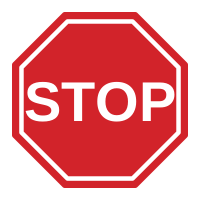
  • A stop sign is eight-sided, with a red background and white letters.
  • Warning signs are usually yellow diamonds. Orange diamonds warn of temporary conditions, such as road work.

Road signs

Signs to know before you ride

Traffic signs are one of the knowledge test’s topics. These come from the Driver’s Handbook’s signs chapter, picked with riders in mind, such as surfaces that are slippery or grooved.

  • Red octagon with a white border and the word STOP in white.Stop: come to a complete stop at the stop line, or at the crosswalk if there’s no line
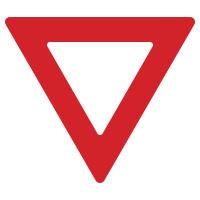
  • Downward-pointing triangle with a wide red border and white centre, no text.Yield: let traffic in or close to the intersection go first, and stop if you need to
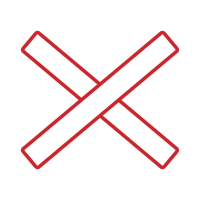
  • White X-shaped crossbuck with a red outline.Railway crossing: slow down, look both ways for trains and be ready to stop
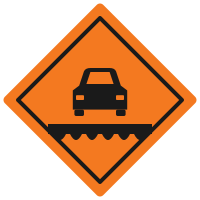
  • Orange diamond: a black car on a grooved road surface.Grooved pavement: the handbook warns that motorcyclists may have less traction on it
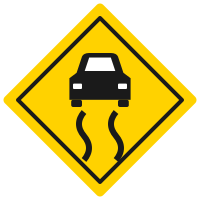
  • Yellow diamond with a black car and two wavy skid marks behind it.Slippery when wet: slow down and ride with caution
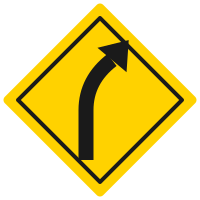
  • Yellow diamond with a black arrow curving gently to the right.Slight bend or curve in the road ahead
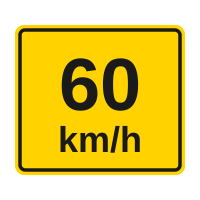
  • Yellow square with a black border showing 60 above km/h.Posted under a curve sign, it shows the highest safe speed for the curve
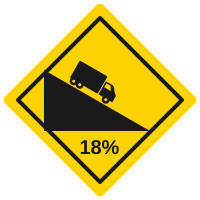
  • Yellow diamond: a black truck on a steep downward slope, with 18% below.Steep hill ahead: you may need a lower gear
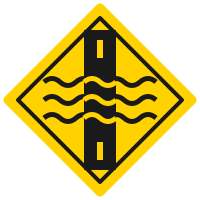
  • Yellow diamond: a vertical black road crossed by wavy lines of water.Water may be flowing over the road
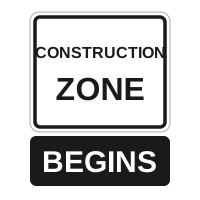
  • White sign CONSTRUCTION ZONE above a black tab with white BEGINS.Construction zone begins: ride with extra caution and expect a lower speed limit
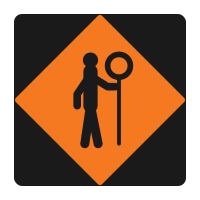
  • Square sign: orange diamond with black corners, showing a person holding a sign paddle on a pole.Traffic control person ahead: slow down and watch for instructions
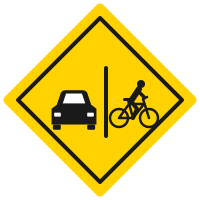
  • Yellow diamond: a black car and a cyclist side by side, separated by a road edge line.Share the road: leave safe space for cyclists and other vehicles

Test day

What to bring to DriveTest

  • Original ID that shows your legal name, date of birth and signature. The handbook’s checklist asks for two pieces of identification, so bring two from the accepted list
  • Money for the test fees: cash, debit or credit card
  • Your glasses or contact lenses, if you need them to read or write

Before you go

  1. Check your ID against the accepted documents list. A passport, a Permanent Resident Card and an Ontario Photo Card are all on it.
  2. Book your first road test early. An M1 licence is valid for a short time, and you have to wait before your first road test. The road tests page has the dates.
DriveTest: Find a DriveTest centreOntario.ca sends you to a DriveTest centre to apply and take the vision and knowledge tests. This finder lists the centres.

Study options

Where to study

The Official MTO Motorcycle Handbook is the main thing to study, with the two Driver’s Handbook chapters it names. The study page sets out a plan and compares approved motorcycle safety courses and practice apps from other companies.

OptionPriceFree to useLinks
Official and free
Official MTO Motorcycle HandbookOfficial · online, or in printThe Ministry of Transportation’s study book for the M1 knowledge test and the road tests. Its “Could you pass?” page has a sample question and the test’s topics.
Online: no charge shown. Print: $14.95 plus taxesThe online version
Official MTO Driver’s Handbook: two chaptersOfficial · onlineThe motorcycle handbook’s test checklist names these two chapters, on safe and responsible driving and on traffic signs and lights.
No charge shownBoth chapters
In person
Government-approved motorcycle safety coursesRiding courses, with a road testOntario.ca’s list of approved courses, by provider and town.
Set by each course providerNot stated
Apps and websites
M1 Test Ontario 2026 (Quizzard Exam Preparation)iPhone and iPad appMore than 14 practice quizzes sorted by handbook section, and a review list of questions you got wrong. Rated 4.7 from 135 ratings on the Canadian App Store.
Free download; Premium listed at $9.99All questions, the developer says in a reply on the listing; Premium adds practice by category
M1 Test Ontario Prep (Intellect Studio)iPhone and iPad appIts listing describes 70 or more lessons, 400 or more questions and 10 or more mock tests, and says it follows the MTO Motorcycle Handbook. Rated 5.0 from 66 ratings on the Canadian App Store.
Free downloadThe whole app; the listing shows no in-app purchases
Ontario M1 Test (Deedal Studios)iPhone and iPad appAbout 160 questions in 13 topics, with a mode for questions you got wrong. Its listing describes its questions as from 2017. Its last listed update is from December 2017. Rated 4.6 from 72 ratings on the Canadian App Store.
Free download; full version $2.99, ad removal $0.99The app and some questions; the listing doesn’t say what the full version adds

Prices and ratings checked November 2026.

Explore

Everything else, in one place

FAQ

Common questions

How many questions are on the M1 motorcycle test in Ontario?

Ontario.ca’s motorcycle licence page and the Official MTO Motorcycle Handbook don’t give the number of questions or the pass mark. The handbook’s one sample question is multiple choice, with four answers to pick from.

What’s on the M1 knowledge test?

The handbook says it may ask about the rules of the road, traffic signs, motorcycle controls, lane position, steering, equipment rules, helmets, carrying passengers or cargo, dangerous surfaces, downshifting and looking after your motorcycle. The handbook describes the written part as one test on signs and one on motorcycles and the rules of the road.

Do you need a G licence before you get an M1?

No. In Ontario you need a Class G licence before any other class, with one exception: motorcycles. You can get a Class M licence without a car licence first.

Can you take the M1 test online?

Ontario.ca doesn’t describe an online M1 test. It tells you to visit a DriveTest centre to apply and take the required tests, with your original ID.

What happens after you pass the M1 test?

You get an M1 licence and enter Level One of graduated licensing. You can ride, with conditions such as zero alcohol, daylight only and no passengers. Two road tests then lead to an M2 and a full M licence, and the licence levels page has the rules and time limits.

What changed for motorcycle licence applicants in 2026?

From May 11, 2026, when you apply for a class G or class M licence, you declare that Ontario is your primary place of residence and that your presence in Canada is legal.

I have a motorcycle licence from another province or country. Do I take the M1 test?

It depends where it’s from. With two or more years of riding experience in the last three years in another Canadian province or territory, Australia, Northern Ireland, Switzerland or the United States, you may get a full M licence without a knowledge or road test. From other countries, you pass the vision and written tests, and proof of two years’ experience lets you go straight to the Level Two road test. You can ride on your old licence for your first 60 days as a resident.

Sources: Government of Ontario and 7 more. Checked November 2026.

Rules and fees can change, so check the official site before your test.