What is the youngest age you can apply for a Class 7 learner’s licence in Alberta?
14 You can apply for a Class 7 learner’s licence at 14. If you’re under 18, a parent or guardian has to give consent on the application.
You hold a Class 7 learner’s licence and want to drive a car. Who must be with you?
A fully licensed (non-GDL) driver who is 18 or older, sitting next to you A learner must be accompanied by a fully licensed driver, not a GDL driver, who is at least 18 and sits in the seat next to you. Probationary drivers can’t act as supervisors.
As a Class 7 learner, during which hours are you not allowed to drive?
From midnight to 5 a.m. Class 7 learners aren’t permitted to drive from midnight to 5 a.m. This applies even when a supervising driver is with you.
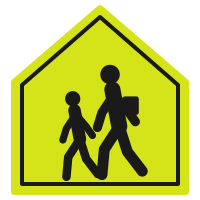
You see this sign ahead. What does it tell you?
You are near a school zone or school area In Alberta, a pentagon with a fluorescent yellow-green background marks a school zone or school area. If a maximum speed sign is attached, it’s a school zone with a speed limit when the zone is in effect.
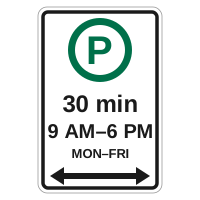
Look at the circle on this sign. What does a green circle like this tell you?
The action shown inside the circle is permitted A green circle on a white sign is a permissive sign. Whatever is shown in the green circle is allowed. On this one it’s parking, during the times shown.
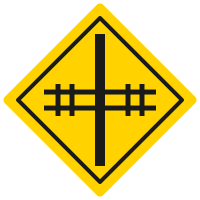
You see this sign on a rural highway. What is it warning you about?
A railway crossing is ahead Yellow diamonds warn you about a hazard ahead. This one shows a railway track crossing the road, so a railway crossing is coming. Slow down, look and listen for trains, and be ready to stop.
You pass this sign with a maximum speed sign attached. No times are posted under it. When does the lower speed apply?
On school days, 8:00 to 9:30 a.m., 11:30 a.m. to 1:30 p.m. and 3:00 to 4:30 p.m. A school sign with a speed sign attached marks a school zone. Unless a municipality posts other times, it applies on school days from 8:00 to 9:30 a.m., 11:30 a.m. to 1:30 p.m. and 3:00 to 4:30 p.m. The limit is 30 km/h unless another speed is posted.
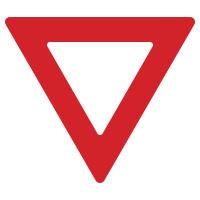
You come to this sign. No vehicles or pedestrians are coming that you need to yield to. What may you do?
Go through without coming to a complete stop At a yield sign you slow down and get ready to stop. If there’s no traffic or pedestrian you must yield to, you can go through without coming to a full stop.
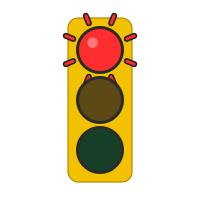
You come to an intersection where this signal keeps flashing. What must you do?
Stop, then go when it’s safe, just like at a stop sign A flashing red light is treated like a stop sign. Stop before the stop line or crosswalk, yield the right-of-way, and go only when it’s safe. If it flashes red in all directions, it’s a four-way stop.
You’re driving in a lane with a lane reversal signal above it. The signal shows a solid red X. What should you do?
Don’t enter or stay in that lane; move safely into a lane with a green arrow A red X over a lane means you must not enter or remain in it, because it’s being used by oncoming traffic. Move safely into a lane showing a downward green arrow.
You reach an intersection with no signs or signals at the same time as another vehicle. Who must yield?
You must yield to the vehicle on your right At an uncontrolled intersection, you must yield the right-of-way to a vehicle on your right. Slow down enough to stop easily, and make sure the other driver is actually yielding before you go.
At a four-way stop, you and another driver stop at the same time. The other car is on your right. What should happen?
The driver on the right goes first At three- and four-way stops, the vehicle that arrived first goes first. If two arrive at the same time, the vehicle on the right goes first. Never go unless it’s safe.
You’re about to enter a roundabout. Who has the right-of-way?
Drivers already in the roundabout Drivers entering a traffic circle or roundabout must yield to drivers already in it. Wait for a safe gap, and watch for pedestrians and cyclists at the crosswalks.
In normal road and weather conditions, what is the minimum following distance behind the vehicle ahead?
Two seconds In normal conditions, stay at least two seconds behind the vehicle ahead, and leave more when conditions aren’t ideal. For large vehicles such as motor homes, the guide recommends at least four seconds.
You’re driving at night with your high beams on. A vehicle is coming toward you. When must you switch to low beams?
When it’s within 300 metres Use your low beams when you’re within 300 metres of an oncoming vehicle. Use them too when you’re following within 150 metres of another vehicle.
On a highway with a 100 km/h limit, you’re in the lane next to a tow truck that is stopped with its lights flashing. How fast may you pass it?
60 km/h When passing emergency vehicles or tow trucks stopped with their lights flashing, slow to 60 km/h or the posted speed, whichever is lower. This applies in the lane next to them, and speeding fines there are doubled.
On a two-lane undivided highway, a school bus ahead of you stops with its alternating red lights flashing and its stop arm out. What must you do?
Stop about 20 metres from the bus and stay stopped until the red lights go off and the stop arm is pulled in When a school bus has its alternating red lights flashing on an undivided highway, traffic in both directions must stop about 20 metres away. Stay stopped until the red lights turn off and the stop sign is no longer extended.
The red lights at a railway crossing start flashing and the bell rings. You’re the first vehicle at the crossing. Where must you stop?
At least 5 metres back from the nearest rail When the lights flash and bells ring, the driver nearest the crossing must stop at least five metres back from the nearest rail. Don’t go until the lights and bells stop and the train has passed or come to a complete stop.
As a GDL driver (Class 7 or Class 5-GDL), how many demerit points within two years lead to an automatic suspension?
8 or more GDL drivers are automatically suspended if they reach eight or more demerit points within two years. Fully licensed drivers are suspended at 15.
Under Alberta’s Traffic Safety Act, what is the penalty for using a hand-held cell phone while driving?
A fine and three demerit points The Traffic Safety Act sets fines and three demerit points for certain distractions, including using a hand-held cell phone, texting or emailing, and using other electronic devices.
 Alberta · Learner’s test