Nova Scotia · Learner’s test

Nova Scotia learner’s test (Class 7)

Before you can get a Learner’s Licence (Class 7), you pass the Nova Scotia learner’s test, which the province calls the Knowledge Test. It comes in two parts, one on the rules of the road and one on road signs. The Registry of Motor Vehicles (RMV) runs it, and you can take it online at home or in person at Access Nova Scotia. Some RMV pages call the Learner’s Licence a beginner’s licence, so you’ll also see it called the Nova Scotia beginner’s test.

  • 16Minimum age
  • 40Questions, in two parts of 20
  • $15.03Fee each time you take the test

Key facts

At a glance

Time
30 minutes for each part
Where
Online with a webcam, or in person at an RMV or Access Nova Scotia location
Languages
English or French online; the RMV can arrange an interpreter
Who can take it
Anyone 16 or older, with a parent’s or guardian’s written consent at 16 or 17

How it works

How the Nova Scotia learner’s test works

Rules of the Road Test · 16 to pass
Road Sign Recognition Test · 16 to pass
To pass you need 16 of 20 on the Rules of the Road Test, and 16 of 20 on the Road Sign Recognition Test.
  1. The Knowledge Test has two parts. The Rules of the Road Test covers traffic laws and safe driving, and the Road Sign Recognition Test asks what highway signs mean.
  2. You take it on your own, with no help from anyone and no study material in front of you.
  3. You should get your result right away.
  4. Passing doesn’t give you a licence on the spot. You also pass a vision test, show ID, bring consent if you’re 16 or 17, pay the Learner’s Licence fee and have your photo taken.

Topics

What’s on the test

01

Your Driver’s Licence

The three stages of Nova Scotia’s Graduated Driver Licensing (GDL) program, demerit points and licence classes.

Key points (4)
  • With a Learner’s Licence you drive only with a supervising driver in the front seat, and no other passengers.
  • A learner’s blood alcohol level must be zero.
  • Demerit points count against learners too, and a suspension delays the move up a stage.
  • A recognized driver education course shortens the wait before the road test.
02

Rules of the Road

Traffic signals, right of way, speed, following distance, passing, parking and sharing the road.

Key points (4)
  • Unless a sign says otherwise, the limit on a Nova Scotia highway is 80 km/h, and 50 km/h in business and residential districts.
  • Use the two-second rule to check your following distance, and leave more room on slippery roads or when you can’t see well.
  • When an emergency vehicle is stopped with its lights flashing, slow to 60 km/h, or the limit if it’s lower, and move over a lane if you safely can.
  • Under the Traffic Safety Act, traffic going either way stops for a school bus with flashing red lights, except on the other side of a divided highway with a physical median.
03

Signs, Pavement Markings and Work Zones

Regulatory, warning, guidance and work zone signs, and the lines painted on the road.

Key points (4)
  • An eight-sided sign is always a stop sign, and a red and white triangle is a yield sign.
  • Most warning signs are yellow diamonds. Guidance signs are rectangles, usually green with white letters.
  • Yellow lines separate traffic going opposite ways, and white lines separate traffic going the same way.
  • Orange signs mark work zones. Follow traffic control persons and their STOP/SLOW paddles.
04

Safety

Keeping your vehicle safe, protecting passengers and driving defensively.

Key points (4)
  • Every motor vehicle registered in Nova Scotia must pass a safety inspection every year.
  • Studded tires are legal only from October 15 to April 30.
  • Have tires checked for a tread depth of at least 1.5 millimetres.
  • A slow-moving-vehicle sign marks a vehicle that can’t keep up a speed over 40 km/h. Slow down when you see one.
05

Adverse Driving Conditions

Night driving, bad weather, slippery roads, emergencies and collisions.

Key points (3)
  • Dim your headlights within 150 metres of an oncoming vehicle, and within 60 metres when you’re following one.
  • Use low beams when you drive at night in a city.
  • To stop on ice, press the brakes gently and gradually so the wheels don’t lock.
06

Driving and Impairment

Alcohol, drugs, fatigue and being fit to drive.

Key points (3)
  • Legal impairment is a blood alcohol content of .08 or more, but you can be charged below that if you show signs of impairment.
  • A roadside reading between .05 and .08 can bring a 7-, 15- or 30-day licence suspension.
  • Only time removes alcohol from your body. Black coffee or a cold shower won’t.

Road signs

Road signs and what the handbook says they mean

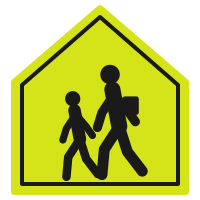
Half the test is road signs. The handbook teaches them by shape and colour, so an eight-sided sign always means stop and a five-sided yellow-green sign marks a school zone.

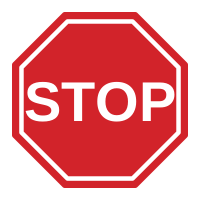
  • Red octagon with a white border and the word STOP in white.Stop: the eight-sided shape is used only for stop signs. Stop completely, then go when the way is clear
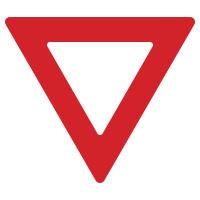
  • Downward-pointing triangle with a wide red border and white centre, no text.Yield: slow down and give the right of way, stopping if you need to
  • Five-sided fluorescent yellow-green sign with a black border and two black schoolchildren walking.School zone: with children present, 30 km/h where the approach limit is 50 km/h, or 50 km/h where it’s higher
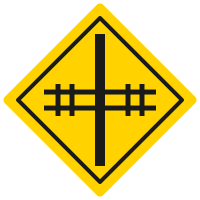
  • Yellow diamond: a vertical black road crossed by a horizontal railway track with short ties.Railway crossing ahead: the symbol shows the angle of the tracks across the road
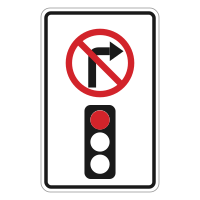
  • Vertical white sign: a right-turn arrow in a red circle and slash above a traffic-signal symbol with the red light lit.No right turn on red signal: wait for the green light before you turn right
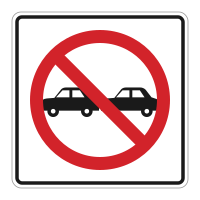
  • White square: two black cars side by side inside a red circle with a red slash.Do not pass
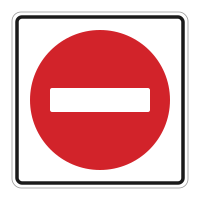
  • White square with a black border holding a red circle crossed by a white horizontal bar.Do not enter
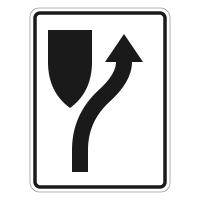
  • White vertical sign with a black island shape on the left and a black arrow curving around it to the right.Keep to the right of the traffic island or obstruction
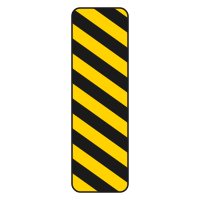
  • Tall narrow yellow board with black diagonal stripes sloping down to the right.Hazard warning: the black lines slope to the right, so drive to the right of the sign
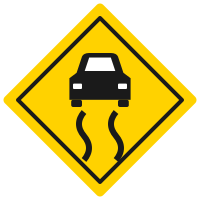
  • Yellow diamond with a black car and two wavy skid marks behind it.Slippery when wet
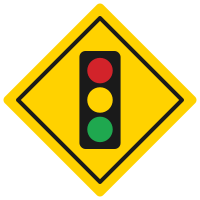
  • Yellow diamond with a black traffic-signal housing showing red, yellow and green lights.Traffic signal lights ahead
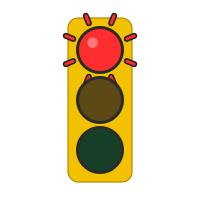
  • Traffic-signal head with the red light lit and short rays showing it is flashing.Flashing red signal: it means the same as a stop sign

Test day

What to bring to Access Nova Scotia

  • Original ID showing your legal name and date of birth. A valid Canadian passport or Permanent Resident Card covers all of the RMV’s ID requirements on its own
  • The signed parental consent form if you’re 16 or 17, or a parent or guardian who can sign it with you
  • Your glasses or contact lenses, if you need them for the vision test
  • Your payment confirmation or test receipt, if you paid ahead
  • A way to pay: credit card, debit, cash, or a cheque or money order payable to the Minister of Finance

Before you go

  1. Pay any outstanding fines or privilege reinstatement fees. You can’t take the test until they’re paid.
  2. Choose online or in person. In person, the vision test, ID and consent come before the test. Online, you do them after you pass.
  3. For an in-person test, book an Access Nova Scotia appointment, or walk in and allow extra time.
Access Nova Scotia: Book an appointmentAppointments are for testing in person. To test at home, start from the RMV’s Knowledge Test page instead.

Study options

Where to study

The RMV names one study source, the Nova Scotia Driver’s Handbook. The study page explains how to use it, and covers driving schools on the RMV’s licensed list and practice apps made by other companies.

OptionPriceFree to useLinks
Official sources
Government of Nova Scotia: Nova Scotia Driver’s HandbookOfficial · PDFThe study material the RMV (Registry of Motor Vehicles) names for the Knowledge Test. Read the update pages at the front, then chapter 3 for the signs part.
Online: no charge shown. Printed: $9.75, tax includedThe PDF
Government of Nova Scotia: online Knowledge Test and sample testOfficial · web, with a webcamThe RMV’s page for the Class 7 test, where you start the online test. Its sample test shows how online testing works, not what the questions are.
$15.03 for the test; no charge shown for the sampleThe sample test
In person
Licensed driving schools (RMV list)Lessons and driver education coursesThe RMV’s list of licensed schools, with columns for GDL (Graduated Driver Licensing) approval and online theory. A recognized course shortens the wait before your road test.
Set by each schoolNot stated
Apps and websites
Nova Scotia Driving Test Prep (Intellect Studio)iPhone, iPad and Android appLessons, practice questions and mock tests, with audio lessons and offline use. Its listing says the content is based on the Nova Scotia Driver’s Handbook. Rated 4.8 from 88 ratings on the Canadian App Store.
Free download; the Android version contains adsNot stated
Nova Scotia Driving Test (Quizzard Exam Preparation)iPhone, iPad and Android appQuizzes for each part of the handbook, a review list of missed questions and timed mock exams. Rated 4.6 from 35 ratings on the Canadian App Store. Its Google Play listing says it isn’t affiliated with any government agency.
Free download; Premium listed at $9.99 on the App StoreNot stated
Nova Scotia Driving Test NS (Movil Softwares)iPhone and iPad appPractice questions with answers and explanations. Its listing says it isn’t affiliated with any government agency. Rated 5.0 from 21 ratings on the Canadian App Store.
Free download; subscriptions from $2.99 a week, or $12.99 for lifetime accessNot stated

Prices and ratings checked November 2026.

FAQ

Common questions

How many questions are on the Nova Scotia learner’s test?

Forty multiple-choice questions in two parts of 20: the Rules of the Road Test and the Road Sign Recognition Test. You need at least 16 right on each part, and each part is scored on its own, so a strong signs score can’t make up for a weak rules score.

What happens if you fail the learner’s test?

You pay for another test and take it again, but only the part you didn’t pass. If you failed both, you retake both. Online there’s no waiting period, so you can try again when you’re ready. In person, you can’t retake it until the following day.

Is the Nova Scotia beginner’s test the same as the learner’s test?

Yes. It’s the same Knowledge Test, with the same two parts. A beginner’s licence is the RMV’s other name for the Class 7 Learner’s Licence. Nova Scotia doesn’t use the word permit: a learner’s permit here is the Learner’s Licence (Class 7).

How old do you have to be to get a learner’s licence in Nova Scotia?

16. If you’re 16 or 17, you need written consent from a parent or guardian on the RMV’s parental approval form. A parent or guardian can withdraw that consent in writing to the Registrar of Motor Vehicles any time before you turn 18, and the licence may then be cancelled.

How much does a learner’s licence cost in Nova Scotia?

The Knowledge Test is $15.03 a try, tax included. Once you pass, the Learner’s Licence itself is $25.10, with no tax. The road test you take later as a learner has its own fee.

Can you take the learner’s test orally or in another language?

Yes. Online, the test is in English and French. For another language, contact the RMV to review your options and arrange the test with an interpreter. If you’re not comfortable with a written test, contact the RMV or book an Access Nova Scotia appointment to take it verbally.

Did the Traffic Safety Act change the learner’s test?

Not its format. The Traffic Safety Act replaced the Motor Vehicle Act on October 19, 2026, and the RMV’s Knowledge Test page describes the same two parts of 20 multiple-choice questions. Some rules of the road did change, and the handbook was written before them. The Driver’s handbook page lists the main ones.

Sources: Government of Nova Scotia and 11 more. Checked November 2026.

Rules and fees can change, so check the official site before your test.