You’re 16 with a learner permit. How much supervised driving must you log before you can apply for a first-year restricted license?
50 hours, with 10 of them at night Under 18, you need at least 50 hours of supervised driving, including 10 hours at night, before you move up to a first-year restricted license. A parent, legal guardian or responsible adult logs the hours.
For the first six months of a first-year restricted license, with no licensed driver 18 or older supervising, how many unrelated passengers under 18 may ride with you?
Just one unrelated passenger under 18 For the first six months of a first-year restricted license, unless a licensed driver 18 or older supervises, you may have only one unrelated passenger under 18. For the second six months, the limit rises to three.
You hold a first-year restricted license. Apart from the listed exceptions, when may you not drive?
Between 11 p.m. and 5 a.m. Teen drivers on a first-year restricted license may not drive between 11 p.m. and 5 a.m. The exceptions include emergencies, farm-related activities, travel to and from school, church or work, and purposes a parent, guardian or responsible adult authorizes.
Under Montana law, which children must ride in a child safety seat?
Children up to age 6 and 60 pounds Babies and children up to age 6 and 60 pounds must be buckled into a child safety seat. Booster seats are recommended for older children until the car’s lap and shoulder belt fits properly.
Within what distance of an oncoming vehicle must you dim your high beams?
1,000 feet Dim your high beams within 1,000 feet of an oncoming vehicle. When you follow another vehicle, dim them within 500 feet.
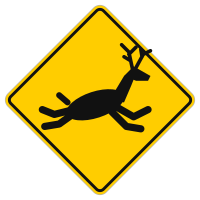
You see this sign on a rural highway. What should you do?
Watch for deer and slow if you see one This sign marks an area where deer often cross the highway. Stay alert, slow down if you see a deer, and look for more, because deer travel in herds.
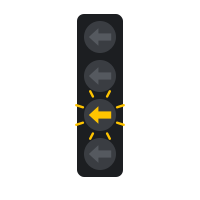
You want to turn left, and this signal is showing for your lane. What may you do?
Turn after yielding to traffic and pedestrians A flashing yellow arrow means left turns are allowed, but you must first yield to oncoming traffic and pedestrians. Oncoming traffic has a green light, so wait for a safe gap.
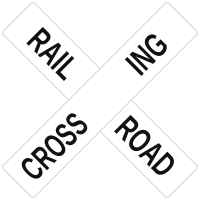
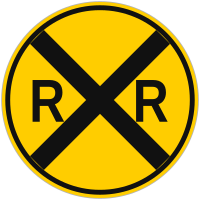
You reach this sign and a train is coming. Where must you stop?
No less than 15 feet from the nearest rail When a train is coming, stop as close to the crossing as practicable, but not less than 15 feet from the nearest rail. Cross only when it’s safe and there’s room for your vehicle on the far side.
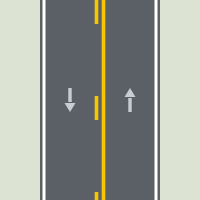
You’re on a two-lane road and see this center line marking. May you pass the car ahead here?
No, passing isn’t allowed from your lane Where a solid and a dashed yellow line run side by side, you may not pass if the solid line is on your side. Drivers on the dashed side may pass when it’s safe.
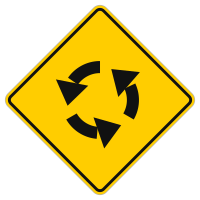
This sign warns you of the intersection ahead. Once you get there, who has the right-of-way?
Vehicles already in the circle In a roundabout, yield to vehicles already in the circle, because they have the right-of-way. Traffic moves counterclockwise, at 15 mph or less.
On a rural road, how far before a turn should you start signaling?
300 feet Use your turn signal 100 feet before a turn in town and 300 feet before a turn on a rural road. Signaling gives other drivers time to react to your moves.
How close to a fire hydrant may you park?
No closer than 15 feet Don’t park within 15 feet of a fire hydrant. The manual gives other distances too, such as 30 feet from a stop sign or signal and 50 feet from a railroad crossing.
You’re passing a bicyclist on a two-lane highway, and nothing is coming the other way. How much room does the manual recommend?
Five feet If there’s no oncoming traffic, carefully cross the center line to give the cyclist a recommended five feet. If traffic is coming, slow to the cyclist’s speed and wait until it’s safe to pass.
In normal conditions, what following distance does the manual tell you to keep?
At least 3 seconds Use the three-second rule: when the vehicle ahead passes a fixed point, count the seconds until you reach it. If you get there before you count three, you’re following too closely.
The road ahead is covered with packed snow. How much does the manual tell you to cut your speed?
By about one half On packed snow, cut your speed in half. On a wet road, slow down by about 10 mph, and on ice, slow to a crawl.
You want to merge into traffic. About how big a gap do you need?
About four seconds You need a gap of about four seconds whenever you merge, change lanes or enter a roadway. If you move into the middle of it, you and the car behind you each have two seconds.
You’re 19. What blood alcohol concentration (BAC) is the legal limit for you?
0.02 The BAC limit for a driver under 21 is 0.02, and for older drivers it’s 0.08. You can also be arrested for driving under the influence.
What does Montana’s vision test check that you have?
20/40 in at least one eye Montana requires you to pass a vision test before you get a license. It checks that you have at least 20/40 vision in at least one eye, with or without glasses or contact lenses.
On a highway posted at 70 mph, you’re in the lane next to a patrol car stopped with its lights flashing. What’s the fastest you may pass it?
50 mph On a highway posted at 50 mph or more, slow to at least 20 mph below the limit in the lane next to a stopped emergency or police vehicle showing its signals. When you can, move to a lane farther away.
A police officer signals you to pull over. What does the manual say to do first?
Turn on your right turn signal Turn on your right turn signal to show the officer you’ve seen them, then move onto the right shoulder. Stay in the car with your hands in clear view unless the officer tells you otherwise.
 Montana · Permit test