Idaho · Permit test

The Idaho DMV written test (Class D knowledge test)

You need 34 right answers out of 40. The Idaho DMV written test, officially the Class D knowledge test, is taken in person at a county driver’s license office, and its questions come from the Idaho Driver’s Handbook. At 17 or older, this is your permit test: pass it and you can buy a Class D instruction permit, the learner’s permit. Under 17, you take it near the end of the graduated driver’s license (GDL) program.

  • 40Questions on the Class D knowledge test
  • 15Youngest age to take the test
  • 3 daysWait after a failed test
  • $5Fee for each attempt

Key facts

At a glance

Who sets the rules
The Idaho Transportation Department’s (ITD) Division of Motor Vehicles (DMV)
Who gives the knowledge test
Your county sheriff’s driver’s license office
Online testing
Not offered. You test in person
Driving on an instruction permit
With a licensed adult 18 or older in the seat beside you

How it works

How the Idaho DMV written test works

Class D knowledge test · 34 to pass
To pass you need 34 of 40 right.
  1. You take the test in person at a county driver’s license office, after a vision screening. You need 20/40 vision in at least one eye, with or without glasses or contacts.
  2. The questions are taken directly from the Idaho Driver’s Handbook: traffic laws, signs by shape and symbol, signals, pavement markings and the equipment a vehicle must have.
  3. The test comes in 11 written languages with an audio option, plus American Sign Language (ASL) on video. Idaho Code §49-313 also lets the examiner give the written test orally.
  4. Phones, smart watches, earbuds and other electronic devices aren’t allowed in the testing area, and neither are the handbook or notes. You can’t talk with others or leave except to go to an examiner. Each county decides whether children and bags may come in.
  5. If you have a disability, ask for reasonable accommodations. The handbook asks you to give the county office two weeks to arrange them.

Topics

What’s on the test

01

Licenses, permits and the GDL program

The handbook’s first section, “One Driver, One License, One Record,” covers the credentials Idaho issues, the permits for new drivers, the graduated driver’s license (GDL) program, the documents you bring and the Star Card.

Key points (4)
  • You can be licensed at 15, but under 17 you must first finish approved driver training and the graduated driver’s license (GDL) program.
  • The supervised instruction period lasts at least six months and includes at least 50 hours of driving, 10 of them at night.
  • A Class D instruction permit lets you practice for one year with a licensed adult 18 or older beside you.
  • Under 16, a licensed driver may drive only from 5 a.m. to 10 p.m., unless a licensed driver 21 or older sits beside them.
02

Vehicle equipment and safety

The equipment section lists what every vehicle must have, the child seat and seat belt laws and the equipment you may not use.

Key points (4)
  • Idaho has no annual safety inspection, but you may not drive a vehicle that is mechanically unsafe.
  • Each tire should have at least 2/32 of an inch of tread.
  • Children 6 and younger must ride in approved child car safety seats.
  • Studded snow tires are allowed only from October 1 to April 30, though ITD sometimes moves the dates for the weather.
03

Signs, signals and pavement markings

The Highway and Vehicle Knowledge section teaches signs by color and shape, then traffic signals, pedestrian beacons and the lines painted on the road.

Key points (4)
  • Most warning signs are black on yellow diamonds. In a work zone, warning signs are orange and black.
  • Guide signs are white on green for directions and distances, white on blue for services and white on brown for points of interest.
  • A flashing yellow arrow lets you turn after yielding to oncoming traffic and to people in crosswalks.
  • If a traffic signal isn’t working, treat the intersection as a four-way stop.
04

Railroad crossings, roundabouts and interchanges

The intersections pages explain railroad crossings, roundabouts and the newer road layouts on Idaho highways: thru-turns, single point urban interchanges and diverging diamonds.

Key points (4)
  • When you must stop at a railroad crossing, stop within 50 feet of the nearest rail but no closer than 15 feet.
  • Never drive through, under or around a crossing gate that is down or coming down.
  • Enter a roundabout counterclockwise and yield to vehicles already in the circle.
  • To turn left at a thru-turn, go straight through, make a U-turn at the next signal, then turn right.
05

Speed, stopping, turns and passing

Traffic Laws and the Rules of the Road starts with the basic speed rule, then covers when to stop, how to signal and turn, who yields and when you may pass.

Key points (4)
  • Unless posted otherwise, the limit is 75 mph on interstates, 65 mph on state highways and 35 mph in residential, business and urban districts.
  • Signal at least 100 feet before you turn in business or residential areas, and five seconds before on freeways or highways.
  • If two vehicles reach a four-way stop at the same time, the one on the left yields to the one on the right.
  • Stop for a school bus with flashing red lights. On a highway with two lanes going each way, traffic in the opposite direction doesn’t have to stop.
06

Following distance, parking and freeways

This part covers the three-second rule, how and where to park, backing up safely and getting on and off a freeway.

Key points (4)
  • Stay at least three seconds behind the car ahead, and add more at high speed or in bad weather.
  • Park within 18 inches of the curb, facing the same way as traffic on your side.
  • Don’t park within 15 feet of a fire hydrant, 20 feet of a crosswalk, 30 feet of a stop sign, yield sign or signal, or 50 feet of railroad tracks.
  • Backing is never allowed on a freeway, expressway or other controlled-access highway, including the shoulder.
07

Sharing the road and open range

Sharing the Road covers emergency vehicles, people on foot, bicycles, motorcycles and large vehicles, then Idaho’s mountain roads, wildlife and open range.

Key points (4)
  • When an emergency vehicle comes with a siren or flashing lights, pull to the right edge of the road and stop until it passes.
  • Passing a stopped emergency vehicle, tow truck or incident response vehicle with lights flashing, slow below the posted limit and, if you safely can, move out of the lane next to it.
  • Livestock being moved over a road have the right-of-way, and on open range, animals may be loose even where there are fences.
  • Yield to a blind person walking with a white cane or a guide dog.
08

Night, weather and emergencies

These pages cover driving at night and in fog, rain, flash floods and winter, then skids, blowouts and what the law asks of you after a crash.

Key points (4)
  • Dim your headlights 500 feet before meeting and 200 feet before overtaking another vehicle.
  • At 55 mph on a wet road, your tires may lose all contact with the road and hydroplane.
  • In a skid, take your foot off the gas and steer in the direction of the skid.
  • Report to police any crash with an injury or more than $1,500 of property damage.
09

Your driving record, alcohol and drugs

What Affects Your Driving Privilege and Record explains the point system, the GDL penalties, suspensions, implied consent and driving under the influence.

Key points (4)
  • You’re driving under the influence (DUI) at a blood alcohol concentration (BAC) of .02 or more under 21, .04 or more in a commercial vehicle and .08 or more at 21 or older.
  • Refusing an evidentiary test brings a $250 civil penalty and, for a first refusal, a one-year suspension with no driving at all.
  • 12 to 17 points in any 12 months means a 30-day suspension.
  • Texting while driving is illegal. The law doesn’t cover hands-free devices used without either hand.

Road signs

Road signs in the Idaho Driver’s Handbook

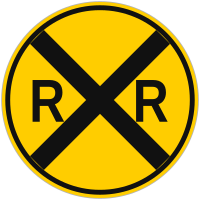
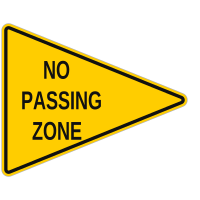
The handbook teaches signs by color and shape. Regulatory signs are generally black and white, though some are red and white. Most warning signs are black on a yellow diamond, work zone warning signs are orange and black, and school signs may be yellow or fluorescent yellow-green. The no-passing zone sign is a pennant on the left side of the road.

  • Red octagon with white border and the word STOP in whiteStop: stop at the marked stop line. With no line, stop before the crosswalk, and with no crosswalk, stop where you can see traffic on the road you’re entering
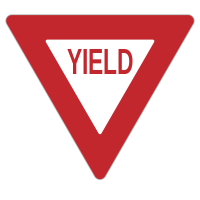
  • Downward-pointing red triangle with white center and the word YIELD in redYield: slow down and give the right-of-way to vehicles and people on foot in the intersection or road you’re entering. Stop if you need to
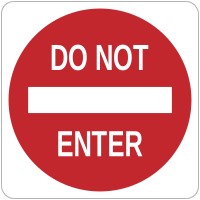
  • Red circle with a white horizontal bar on a white square, reading DO NOT ENTERDo not enter: you may not enter this section of road from the direction you’re traveling
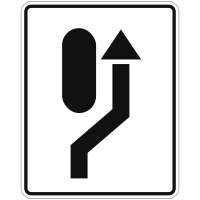
  • White sign with a black island symbol and an arrow passing to its rightKeep right of island: the road ahead is divided, so stay to the right of the island or barrier
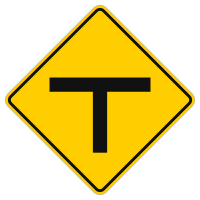
  • Yellow diamond with a black T symbol3-way intersection: the road ends at a T and you’ll turn right or left. Stop and yield to drivers coming from the other two directions
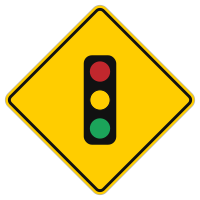
  • Yellow diamond with a black traffic signal showing red, yellow and green lightsTraffic signal ahead: used on faster roads or where the view of the light is blocked. Be ready for an intersection and a stop light
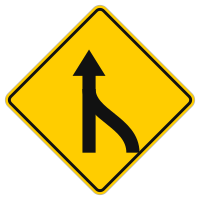
  • Yellow diamond with an upward arrow for the main road and a second road merging into it from the rightMerging traffic: if you’re on the main road, be ready for cars and trucks entering your lane
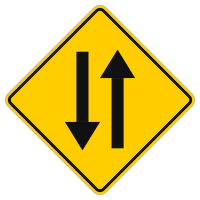
  • Yellow diamond with two black arrows, left pointing down and right pointing upTwo-way traffic: a multi-lane divided highway changes to a two-lane road with traffic in both directions
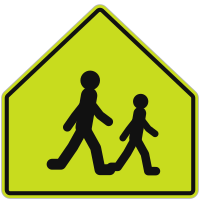
  • Fluorescent yellow-green pentagon with two children walkingSchool zone: you’re nearing a school area with a crossing. Watch for children. Breaking a school zone speed limit carries increased penalties
  • Round yellow sign with a black X and two letters RRailroad crossing: early warning of a crossing ahead. Be prepared to stop before the tracks if a train is coming
  • Yellow pennant pointing right reading NO PASSING ZONENo passing zone: this pennant sits on the left side of the road and warns of a no-passing zone for your lane
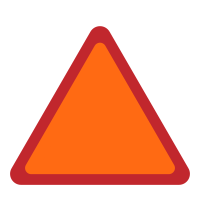
  • Fluorescent orange triangle with a red reflective borderSlow-moving vehicle: you’re coming up on a slow vehicle, often farm or construction equipment. Slow down and approach with caution
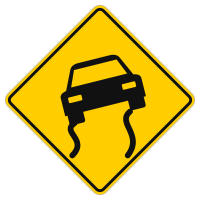
  • Yellow diamond with a car and two S-shaped skid marksSlippery when wet: the road ahead may get slippery in wet weather, so slow down
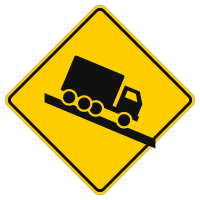
  • Yellow diamond with a truck on a downhill slopeHill: the road goes down a steep hill. Check your brakes before you start down

Test day

What to bring to the county driver’s license office

  • A certified original birth certificate or another proof of US citizenship or lawful presence, such as a US passport or a permanent resident card. Photocopies and laminated documents aren’t accepted
  • A photo identity document, such as a passport, an Idaho or out-of-state license or ID card, or a junior or senior high school photo card or yearbook. Under 18, a parent or guardian can show their own photo ID with your birth certificate instead
  • Your Social Security number, which the office checks with the Social Security Administration
  • Proof of your Idaho address from the last 12 months, such as a signed lease, a public utility statement (cell phone bills don’t count) or a bank statement
  • Under 18: a parent or legal guardian to sign as your liability signer, and a verification of compliance (VOC) letter from your school dated within the past year, or your diploma
  • Money for the knowledge test fee and your permit or license fee, which aren’t refundable

Before you go

  1. Read the Idaho Driver’s Handbook, dated July 2026. ITD also posts a Spanish edition and an audio version.
  2. Try the Idaho Transportation Department’s (ITD) online sample Class D test, in English or Spanish, and the practice questions at the back of the handbook.
  3. Check your papers against ITD’s required documents page.
  4. Look up your county office on ITD’s locations list. Some offices take appointments, some don’t test at all and some stop testing before they close.
  5. Under 17: check the test eligibility date your county office recorded when you finished driver training. A test taken before that date doesn’t count.
Idaho Transportation Department: DMV locations and appointmentsEach county’s sheriff runs its driver’s license offices. Where an office takes appointments, ITD’s list links its booking page.

Study options

Where to study

The test questions are taken directly from the Idaho Driver’s Handbook. ITD also posts a sample Class D test online in English and Spanish, and the handbook ends with a set of practice questions and an answer key. Apps and websites from other companies add more practice of their own.

OptionPriceFree to useLinks
Official
Idaho Driver’s HandbookOfficial · PDF, Spanish edition and audioThe Idaho Transportation Department (ITD) handbook the knowledge test questions come from, dated July 2026. The Spanish Manual del Conductor carries the same date, and ITD says printed copies are at county driver’s license offices.
No price listedThe whole handbook to download, plus an audio version
ITD Practice Class D Drivers TestOfficial · web pageThe handbook says web-based practice tests don’t accurately represent the Idaho knowledge test, with the exception of ITD’s own sample questions. ITD also posts a bicycle safety quiz.
No price listedSample questions that mark your answers, in English or Spanish, with an answer sheet
Apps and websites
DMV-Permit-Test.comWebsitePremium adds lifetime access to its premium tests and a pass guarantee. Its Idaho page describes the real test as 40 questions with up to 6 misses allowed, which matches the handbook. A Spanish version of the site is linked.
Practice tests on the site, optional one-time Premium feeIdaho car, motorcycle and commercial driver’s license (CDL) practice tests open on the site
ZutobiWeb and app · all statesSays it has 600+ Idaho questions and narrated video lessons by certified instructors. The app has 4.7 stars from about 239,000 App Store ratings.
3-day free trial, then Zutobi Plus (App Store prices from $4.99)A free start on the Idaho course
DMV GenieApp · all statesCar, motorcycle and CDL practice in one app; pick Idaho when you start. Check the plan length before you pay. It has 4.8 stars from about 184,000 App Store ratings.
Free to download, Premium in the app (App Store prices from $7.99)Free and premium study tools, per its App Store listing

Prices and ratings checked October 2026.

FAQ

Common questions

How many questions are on the Idaho DMV written test?

40. The Idaho Driver’s Handbook says you can miss up to six before you fail, so you need 34 right, which is 85%.

Can I take the Idaho permit test online?

No. ITD doesn’t offer the Class D knowledge test online. Its driver’s test guide sends you to a county driver’s license office to take it. The online tests ITD posts, a sample Class D test and a bicycle safety quiz, are for practice and don’t count.

What happens if I fail the knowledge test?

You can’t retake it for three calendar days, a wait set by Idaho Code §49-313, and you pay the test fee again. ITD doesn’t publish a limit on the number of tries.

Can I use a translator or an interpreter?

Only in two cases: your language isn’t offered in ITD’s testing system, or you’ve tried the test at least three times in a language that is offered and haven’t passed. The translator can’t be a family member or on ITD’s disqualified list, must fill out a State of Idaho W9 tax form the first time if they charge you, and may only read the questions and answers, with no gestures or change in tone. You choose your own answers. Arrange it with your county driver’s license office, and call ITD’s Driver’s License Unit at 208-584-4343, option 3, with questions.

Do I take a permit test if I’m under 17?

Not at the start. Under 17, you buy a driver training permit before your first driver training class, with no test. After you pass the course, it becomes your supervised instruction permit (SIP). You take the knowledge test and the skills test once you’ve held the SIP for at least six months and driven at least 50 supervised hours. Idaho Code §49-307 sets this order.

Who runs driver’s license testing in Idaho, the DMV or the sheriff?

Both, at different levels. ITD’s Division of Motor Vehicles sets the rules, publishes the handbook, runs the testing system and keeps driving records, working with Idaho’s 44 counties. The offices where you take the knowledge test and get your permit or license are run by each county’s sheriff; Idaho Code §49-313 lets the sheriff, a deputy or ITD’s agents examine applicants. Vehicle services are run by the county assessor’s office, some locations combine both, and third-party examiners approved by ITD give the road skills test.

Is anything changing for Idaho permits in 2026 or 2027?

Nothing in Idaho’s driver licensing law, Idaho Code Title 49, chapter 3, is set to change on January 1, 2027. Four 2026 changes are already in effect. Since March 17, 2026 (House Bill 628), a parent anywhere in Idaho may teach the driving part of driver training. Since July 1, 2026, new DMV customers show government-issued photo ID in person to set up their DMV profile. Since July 1, 2026 (House Bill 667), Idaho no longer issues nondomiciled commercial driver’s licenses (CDLs) or learner’s permits. And since July 1, 2026 (House Bill 570), driving more than 20 mph over the limit in an active school zone or construction zone counts as reckless driving.

Sources: Idaho Transportation Department · Idaho Legislature and 11 more. Checked October 2026.

Rules and fees can change, so check the official site before your test.