North Carolina · Permit test

North Carolina DMV permit test

To get a learner permit in North Carolina, you pass a vision check, a road signs test and a knowledge test at an NCDMV driver license office. This guide explains how they’re scored, what teens need first, and what to bring. There’s a free 20-question practice test further down.

  • 80%Correct answers you need on the knowledge test
  • 9 of 12Road signs you must identify on the signs test
  • $25.50Learner permit fee (as of October 2026)
  • 15Minimum age for a Level 1 permit, after driver education

Key facts

At a glance

Questions
Knowledge test (NCDMV doesn’t publish the count) plus 12 road signs
Minimum age
15, after driver education
Where
An NCDMV driver license office. Walk in or book up to 7 days ahead
Languages
Several languages, and an audio test if you ask

How it works

A signs test and a knowledge test, scored separately

  1. For a permit you take three tests at an NCDMV driver license office: vision, traffic signs and a knowledge test on traffic laws and safe driving.
  2. The knowledge test is taken on a computer. You need 80% of the questions right. NCDMV doesn’t publish how many questions there are.
  3. On the signs test you name signs by their color and shape and explain what they mean. NCDMV’s licensing rule says you must identify 9 of 12 signs correctly for a Class C license.
  4. Each test is scored on its own, so you need to pass both the signs test and the knowledge test.
  5. Tests are offered in several languages, and audio tests are available if you have trouble reading. NCDMV doesn’t list which languages.
  6. For an unrestricted license your vision must be 20/40 or better, in either eye or both together. If you need glasses or contacts, wear them for the test.
  7. If you’re under 18, a parent or guardian must be with you for the tests.

Topics

What’s on the test

01

Getting your permit and moving up the levels

The tests you take for a permit, who can supervise you, and how North Carolina’s three-level graduated license works for drivers under 18.

Key points (4)
  • At 15 to 17 you need a driver education certificate (30 hours of class and 6 behind the wheel) before testing for a Level 1 permit.
  • Level 1: 5 a.m. to 9 p.m. only for the first six months, always with a supervising driver who has been licensed for at least five years.
  • Hold the Level 1 permit for nine months and log at least 60 hours, 10 of them at night, before Level 2.
  • Under 18, you may not use a cell phone while driving, except for emergency calls and calls to a parent, guardian or spouse.
02

Reading road signs by shape and color

The signs test asks you to name signs by their color and shape and explain what each one means, so learning the shapes pays off fast.

Key points (4)
  • Eight sides means STOP, a point-down triangle means YIELD, and five sides means a school zone or crossing.
  • Yellow diamonds warn of hazards. Orange diamonds mean a work zone.
  • A round yellow RR sign warns of a railroad crossing ahead. The X-shaped crossbuck is at the tracks.
  • North Carolina route markers are diamond-shaped, U.S. routes use a shield and interstates a red, white and blue shield.
03

Traffic signals and pavement markings

What each light, arrow and line color tells you, including flashing yellow arrows and signals that have lost power.

Key points (4)
  • After a full stop you may turn right on red unless a NO TURN ON RED sign is posted. Yield to traffic and pedestrians first.
  • A flashing yellow arrow allows the turn, but you must yield to oncoming traffic and pedestrians.
  • Treat a dark or broken signal as a stop sign on every approach.
  • Yellow lines separate traffic going opposite ways, white lines traffic going the same way. Red pavement markers mean you’re going the wrong way.
04

Right-of-way, school buses and emergency vehicles

Who goes first at intersections and roundabouts, when you must stop for a school bus, and what the move-over law asks of you.

Key points (4)
  • When two vehicles reach an uncontrolled intersection at the same time, the vehicle on the right goes first.
  • Yield to vehicles and bicyclists already in a roundabout. Traffic moves counterclockwise.
  • For a stopped school bus, traffic in both directions stops unless the road has four or more lanes with a median or center turn lane. Then only traffic behind the bus stops.
  • Pull to the right and stop for emergency vehicles using lights and sirens. For one stopped at the roadside, move over a lane or slow down.
05

Speed, following, passing and parking

North Carolina’s default speed limits, safe following distance, the rules for passing and being passed, and where you can’t park.

Key points (4)
  • Unless posted otherwise: 35 mph in cities and towns, 55 mph outside them, and up to 70 mph on interstates.
  • Keep at least two seconds behind the vehicle ahead, and double it on wet roads.
  • When someone passes you, move right and never speed up. Don’t pass where you can’t see at least 500 feet ahead on a hill or curve.
  • Don’t park within 15 feet of a fire hydrant or within 25 feet of the curb line of an intersecting street.
06

Bad weather, night driving and emergencies

How to adjust for rain, fog, ice and darkness, and what to do when something goes wrong with your car.

Key points (4)
  • Headlights are required from sunset to sunrise, when you can see 400 feet or less, and whenever your wipers are on for bad weather.
  • If you hydroplane, ease off the gas, don’t brake and keep the wheel straight.
  • Never drive through standing water. Six inches of fast-moving water can sweep a car off the road.
  • In a skid, ease off the gas and steer in the direction the rear of the car is sliding.
07

Alcohol, impaired driving and your record

North Carolina’s DWI laws, the zero-tolerance rule for drivers under 21, and how points can cost you your license.

Key points (4)
  • Adults are impaired by law at a BAC of 0.08 or more. Refusing a breath or blood test means immediate revocation.
  • A driver under 21 convicted of driving with any alcohol or drugs in their body loses their license for one year.
  • Only time sobers you up. Coffee, food or a cold shower won’t.
  • Passing a stopped school bus is 5 points. Twelve points in three years can lead to suspension.

Road signs

Learn the shape and color first

In North Carolina the signs test is its own test: you need 9 of 12 right, apart from the knowledge test. Start with these, then work through the rest in Chapter 5 of the handbook.

  • Red octagon with white border and the word STOP in whiteStop: full stop at the line, then go when it's safe
  • Downward-pointing red triangle with white center and the word YIELD in redYield: slow down, stop if traffic means you have to
  • Fluorescent yellow-green pentagon with two children walkingSchool zone or crossing: watch for children
  • Yellow pennant pointing right reading NO PASSING ZONENo passing zone starts here
  • Round yellow sign with a black X and two letters RRailroad crossing ahead: slow down and be ready to stop
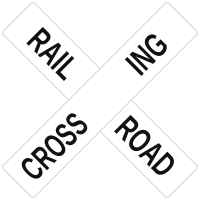
  • White X-shaped crossbuck reading RAILROAD CROSSINGCrossbuck: the tracks are here, yield to trains
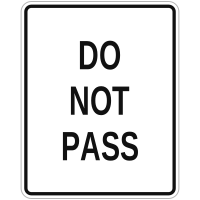
  • White sign reading DO NOT PASSDo not pass on this stretch
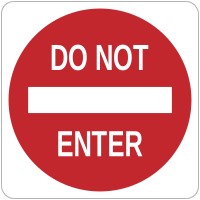
  • Red circle with a white horizontal bar on a white square, reading DO NOT ENTERDo not enter: you'd be going the wrong way
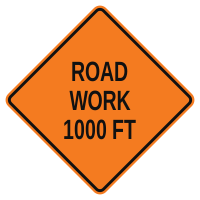
  • Orange diamond reading ROAD WORK 1000 FTRoad work ahead: slow down, fines may be higher
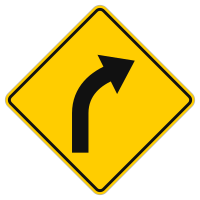
  • Yellow diamond with a black arrow curving to the rightCurve ahead: slow down before it
  • Four-section left-turn signal with the flashing yellow arrow litFlashing yellow arrow: turn after yielding
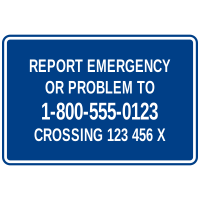
  • Blue rectangle: REPORT EMERGENCY OR PROBLEM TO 1-800 number, CROSSING numberBlue railroad sign: call this number if you're stuck on the tracks

Free practice test

Try 20 questions in the same style

NCDMV doesn’t say how many questions the real knowledge test has, but you need 80% to pass. Here are 20 in the same style, with 5 sign questions mixed in, at the same 80% bar, so 16 right is a pass. After each answer you can ask the tutor to explain it another way, or why a different answer is wrong. Anything you miss comes back at the end.

Question 1 of 20

You’re 15 and just got your Level 1 limited learner permit. How long must you hold it before you can apply for a Level 2 limited provisional license?

Sample of the knowledge test: same format, 20 questions.

Test day

What to bring to the driver license office

  • One document proving your identity and date of birth, such as a certified birth certificate or a U.S. passport.
  • Your Social Security card or another document showing your full Social Security number.
  • Proof of your North Carolina address. NCDMV’s permit page asks for one document, but the handbook asks minors for two, so bring two if you can.
  • Under 18: your driver education certificate, and a parent or guardian with you.
  • Not a U.S. citizen: a document from the U.S. government showing your legal presence.
  • The $25.50 permit fee, and your glasses or contacts if you need them to see.

Before you go

  1. Read the North Carolina Driver Handbook. Everything on the signs test is in it.
  2. Under 18: finish driver education first. That’s 30 hours of class and 6 hours behind the wheel.
  3. Decide whether to book. You can make an appointment up to seven days ahead, or walk in until the office reaches capacity.
  4. If you book, confirm by text or email within 15 minutes, or the slot is released.
  5. Gather originals or certified copies. NCDMV doesn’t take photocopies or laminated documents.
  6. Since October 1, 2026, teens no longer need a Driving Eligibility Certificate from school to get a permit.
  7. Arrive 5 to 10 minutes before an appointment. If you’re 15 minutes late or more, it’s cancelled.
NCDMV: Driver license appointmentsAppointments open up to seven days ahead, and teen learner permits are one of the services you can book. Walk-ins are accepted too, until the office is full.

Study options

Where to study

Both tests come from the North Carolina Driver Handbook, which is free in English and Spanish. Want more practice? We’ve compared the apps, websites and driving schools people use.

OptionPriceFree to useLinks
Official and free
North Carolina Driver HandbookOfficial · PDFBoth permit tests are based on this, and NCDMV says everything on the signs test is in it. Chapter 1 covers the teen permit rules and Chapter 5 the signs. The Spanish edition is the Manual de Manejo de Carolina del Norte.
FreeThe whole handbook, in English and Spanish
NCDMV regulatory and warning sign sheetsOfficial · PDFTwo short PDFs linked from NCDMV’s driver license tests page. Good for a last check on shapes and colors before the signs test, where you need 9 of 12 right.
FreePictures of the signs on the test
Apps and websites
ZutobiApp and web · all statesGame-style practice with a shorter version of the handbook. Its website says it has 600+ North Carolina questions. Very well rated: 4.7 stars from about 239,000 ratings on the App Store. The listing doesn’t say how long each PLUS option lasts.
Free start, then paid (Zutobi PLUS from $4.99 on iPhone)Some practice for free
Driving-Tests.org and DMV GenieWeb and app · all statesThese two are the same company. The website has five free North Carolina practice tests, several road sign tests and an audio version of the handbook (about 3 hours) if you’d rather listen. The DMV Genie app has 4.8 stars from about 184,000 ratings. In-app plans run up to $99.99 for lifetime access.
Free tests, app Premium from $9.99 a weekNC practice tests, road sign tests and handbook audio
DMV-Permit-Test.comWeb · all statesTwenty free North Carolina practice tests, a separate road signs test and a Spanish version of the site. A paid Premium tier exists, but we couldn’t confirm its price.
Free with ads, paid extras (cheat sheet $15.99 one-time)20 North Carolina practice tests and a road signs test
North Carolina DMV Permit test (Driver-Start)App · iPhoneThe most-rated North Carolina-only app we found: 4.5 stars from 602 ratings. It works offline and lets you hide questions you already know. Its version history lists the latest update in 2017, so double-check anything that looks out of date against the handbook.
FreeMock tests, flashcards and the driver’s manual
North Carolina DMV Permit Prep (S Mehta)App · iPhone4.7 stars from 132 ratings. Practice tests, a road sign quiz, a fines and limits section and a timed marathon mode, for car, motorcycle and CDL. Last updated in August 2025.
Free, then $3.99 a week, $8.99 a month or $17.99 lifetimeLimited until you pay
NC DMV Permit Test (Altaf Mogal)App · iPhone4.6 stars from 85 ratings. The listing says it has more than 1,000 questions with explanations, plus flashcards and a list of the questions you got wrong. Some reviews mention a lot of ads in the free version. Last updated in June 2025.
Free, then $2.99 for 7 days, $7.99 for 30 days or $14.99 lifetimeLimited, with ads
Video
Permit test walk-throughs on YouTubeVideoPlenty of channels talk through North Carolina permit practice questions and road signs. Useful if you learn better by listening. They’re unofficial, so check anything surprising against the handbook.
Free (ads)Everything
In person
Driver education (high school or licensed driving school)Classroom and behind the wheelRequired if you’re under 18: 30 hours of classroom teaching and at least 6 hours behind the wheel, and you can enroll from age 14½. You can take it through a North Carolina high school or an NCDMV-licensed driving school. NCDMV says commercial school fees vary, so check the price and that the school is licensed to teach students 18 and under.
Set by each schoolAsk your high school

Prices and ratings checked October 2026.

FAQ

Common questions

How many questions are on the NC permit test?

NCDMV doesn’t publish the number of questions on the knowledge test. Its rules say you need 80% of them right. The road signs test is separate: you must identify 9 of 12 signs correctly. You need to pass both, plus a vision check.

Is there a separate sign test in North Carolina?

Yes. On the traffic signs test you name signs by their color and shape and explain what they mean. NCDMV’s rule for a Class C license is 9 correct out of 12. It’s scored on its own, so a strong knowledge score won’t make up for missed signs. Every sign on the test is in the handbook.

Can I take the NC permit test online?

No. As of October 2026, NCDMV doesn’t offer an online permit test. You take the vision, signs and knowledge tests at a driver license office. What you can do online is book an appointment, and later things like ordering a duplicate permit or upgrading a teen license.

Do I need an appointment at the NC DMV?

No, but it can save you a wait. You can book up to seven days ahead at skiptheline.ncdot.gov, and teen learner permits are one of the services listed. Walk-ins are accepted all day until the office reaches capacity, and you can check in by phone and wait for a text.

How much is a learner permit in NC?

As of October 2026, a Level 1 limited learner permit costs $25.50, and so does the learner permit for adults 18 and older. The fee schedule doesn’t list a separate charge for the tests. Driver education is extra if you use a private driving school.

What happens if I fail the knowledge test?

You can take it again after seven calendar days. NCDMV states that rule for the Class C knowledge test. Use the week to go back over the handbook chapters you struggled with, especially signs and right-of-way.

All 20 practice questions with answersA printable list of the practice test above
  1. You’re 15 and just got your Level 1 limited learner permit. How long must you hold it before you can apply for a Level 2 limited provisional license?

    9 months The handbook says you must hold the Level 1 permit for nine months before applying for a Limited Provisional License. You also need to be at least 16 and have no moving violation, seat belt or cell phone convictions in the last six months.

  2. Your driving log has to be signed and handed in when you apply for Level 2. What’s the minimum it must show?

    60 hours of driving, with at least 10 at night You get a driving log with your Level 1 permit, and it must show at least 60 hours of driving. At least 10 of those hours must be at night. Your supervising driver signs it, and you turn it in when you apply for the Limited Provisional License.

  3. In your first six months with a Level 1 permit, when are you allowed to drive?

    Between 5 a.m. and 9 p.m., with your supervising driver beside you For the first six months, a Level 1 permit lets you drive only between 5 a.m. and 9 p.m., and only with your supervising driver. After six months you can drive at any hour, still with a supervising driver. That person must be a parent, grandparent, guardian or an adult they approve, and must have held a license for at least five years.
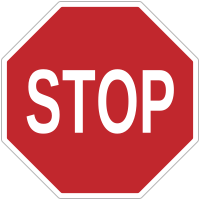
  4. Red octagon with white border and the word STOP in white

    You come to this sign. What must you do?

    Come to a full stop, and go only when the way is clear The eight-sided (octagon) shape is used only for stop signs. The law requires a full stop. Stop at the stop line if there is one. If there’s no line or crosswalk, stop before the intersection where you can see the crossing street, and move only when it’s safe.
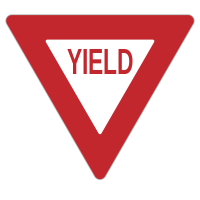
  5. Downward-pointing red triangle with white center and the word YIELD in red

    What does this sign tell you?

    Slow down and give the right-of-way, stopping if traffic means you have to That’s the yield sign. You must slow down and yield the right-of-way. Whether you stop depends on the traffic on the other road. If stopping is the only way to avoid getting in its way, you stop and wait for it to pass.
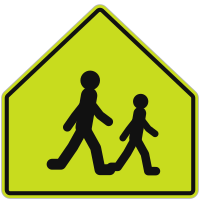
  6. Fluorescent yellow-green pentagon with two children walking

    What does this sign warn you about?

    A school zone or school crossing The five-sided (pentagon) sign warns of a school zone or school crossing. Watch closely for children. In many school zones the speed limit drops during certain school hours.
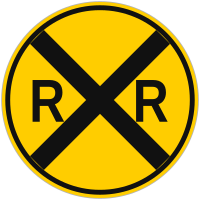
  7. Round yellow sign with a black X and two letters R

    You pass this sign. What does it mean?

    A railroad crossing is ahead, so slow down and be ready to stop The round yellow RR sign gives advance warning of a railroad crossing. Slow down, look both ways and listen, and stop if you need to so you can clear the crossing safely. Trains always have the right-of-way.
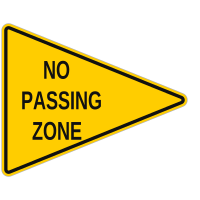
  8. Yellow pennant pointing right reading NO PASSING ZONE

    On a two-lane road you see this sign on the left side. What does it mark?

    The start of a no-passing zone The pennant-shaped yellow sign sits on the left side of the road and points to where the no-passing zone begins. That’s where a solid yellow line appears in your lane. It backs up the rectangular DO NOT PASS sign.
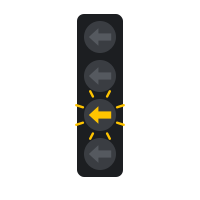
  9. Four-section left-turn signal with the flashing yellow arrow lit

    You want to turn left and this signal is showing. What should you do?

    Turn, but first yield to oncoming traffic and pedestrians A flashing yellow arrow means the turn is allowed, but you must yield to oncoming traffic and pedestrians first. A solid green arrow is the protected turn, where you shouldn’t need to yield.

  10. A storm has knocked out the power, and the traffic lights at an intersection are dark. No officer is directing traffic. How should you go through?

    Treat it as if there’s a stop sign on every approach The handbook says to approach a malfunctioning signal as though the intersection has a stop sign on all approaches. Stop, then go when it’s your turn and safe. This doesn’t apply if an officer or another authorized person is directing traffic.

  11. Driving at night, you notice red reflective markers in the pavement shining back at you. What does that mean?

    You’re traveling the wrong way Red pavement markers show wrong-way movement. If you see them facing you, you’re going against traffic. When it’s safe, pull to the right shoulder, stop, and turn around when the way is clear.

  12. You’re on a divided four-lane highway with a median. A school bus going the other way stops on its side and turns on its flashing red lights. What must you do?

    Keep going with care. Only traffic following the bus has to stop On a divided highway of four lanes or more with a median, only traffic following the bus must stop. On a two-lane road, a two-lane road with a center turn lane, or a four-lane road with no median, traffic in both directions must stop.

  13. You’re about to enter a roundabout. Who has the right-of-way?

    Vehicles and bicyclists already in the roundabout Drivers entering a roundabout yield to any vehicles or bicyclists already in it. Everyone travels counterclockwise, and those already in the roundabout don’t yield to vehicles approaching. Signal when you exit and yield to people in the crosswalk.

  14. On a highway with two lanes going your way, a police car is stopped on the shoulder with its lights flashing. What does North Carolina law require?

    Move into a lane that isn’t next to it, and stay there until you’re safely past When an emergency or service vehicle is parked within 12 feet of the road with its warning lights on, you must move over. With at least two lanes in your direction, change into a lane that isn’t the one nearest the vehicle. With only one lane your way, slow down to a safe speed until you’re past.

  15. Unless a sign says otherwise, what’s the speed limit in North Carolina cities and towns?

    35 mph Unless another limit is posted, the speed limit is 35 mph in cities and towns. Outside cities and towns it’s 55 mph, and on interstates the maximum is 70 mph. You must slow down further when conditions call for it.

  16. You’re parking on a street. How close to a fire hydrant can you legally park?

    No closer than 15 feet You may not park within 15 feet of a fire hydrant or the entrance to a fire station. Firefighters need room to reach the hydrant and get their trucks in and out.

  17. The driver behind you sounds the horn and starts to pass you on a two-lane road. What must you do?

    Move toward the right edge of the road and don’t speed up When you’re being passed, North Carolina law requires you to help the other driver pass. If they sound the horn, move to the right edge of the road and never increase your speed. Speeding up and causing a crash is a misdemeanor.

  18. On a wet road, your car starts to hydroplane and the steering feels loose. What should you do?

    Take your foot off the gas, don’t brake, and keep the wheel straight The handbook says to take your foot off the gas, resist the urge to brake and keep the steering wheel straight. Let the car slow until the tires grip the road again. Hydroplaning can start at speeds as low as 30 mph in water little more than 1/8 inch deep.

  19. It starts raining and you switch on your windshield wipers. What else does North Carolina law require?

    Turn on your headlights North Carolina requires you to use your headlights whenever you’re using your windshield wipers because of bad weather. Headlights help other drivers see you in the rain, even in the daytime.

  20. A 19-year-old is convicted of driving with any amount of alcohol in their body. What happens to their license?

    It’s revoked for one year If a driver under 21 is convicted of driving with any amount of alcohol or drugs in their body, the license is revoked for one year. For drivers under 21, there’s no safe amount: the limit is effectively zero.