Pennsylvania · Permit test

PA permit test

The PA permit test is PennDOT's knowledge test: 18 multiple-choice questions, and you need 15 right to pass. You walk in to a Driver License Center on or after your 16th birthday with a DL-180 your doctor has signed, and if you pass you leave with a learner's permit. Try the 20 free practice questions on this page first: they're written from the Pennsylvania Driver's Manual.

  • 18Multiple-choice questions
  • 15Correct answers needed to pass
  • Walk-inNo appointment needed for the knowledge test
  • 1 yearHow long the learner's permit lasts

Key facts

At a glance

Who gives it
PennDOT Driver and Vehicle Services, often called the PA DMV, at its Driver License Centers
Minimum age
16 for a learner's permit. The DL-180 physical can be done up to 6 months before
Appointment
None for the permit test: it's walk-in. The road test (driver's test) needs a booking.
Permit and license fee
$45.50, paid when you apply: $6 for the permit plus $39.50 for a 4-year license, as of October 2026
Formats
Written or audio, in English and many other languages on request

How it works

How the PA permit test works: 18 questions, 15 to pass

  1. The knowledge test has 18 multiple-choice questions on signs, Pennsylvania driving laws and safe driving. You need 15 right to pass.
  2. You take it in person at a PennDOT Driver License Center. You don't need an appointment for it.
  3. It comes in written or audio form, and in many languages on request, including Spanish, Arabic, Chinese (Mandarin), French, Korean, Russian, Ukrainian and Vietnamese.
  4. If your vision wasn't checked by your doctor or eye doctor, the center tests it before the knowledge test.
  5. You can only take the knowledge test once a day. If you fail, you can try again the next business day. Keep your DL-180 and bring it back.
  6. Pass, and the examiner issues your learner's permit, valid for one year.

Topics

What’s on the test

01

Learner's permits and the junior license

Pennsylvania drivers under 18 go from a learner's permit to a junior license, which becomes a regular license at 18. The permit has supervision rules, and the junior license has a curfew and passenger limits.

Key points (4)
  • You can apply for a permit on or after your 16th birthday. The physical can be done up to six months before.
  • Under 18, your supervisor must be a licensed driver 21 or older, or a licensed parent, guardian or spouse 18 or older, in the front seat.
  • Before the road test, under-18s need 65 hours of practice, including 10 at night and 5 in bad weather, and six months on the permit.
  • Junior drivers can't drive 11 p.m. to 5 a.m. without a qualifying adult, and can carry only one non-family passenger under 18 for the first six months.
02

Traffic signals, signs and work zones

Signal questions are about what each light and arrow lets you do. Work zones have their own orange signs and a headlight law.

Key points (4)
  • A flashing red light means stop, like a STOP sign. A flashing yellow light means slow down and go with care.
  • Right on red is allowed after a full stop unless a sign forbids it.
  • Treat a traffic signal that isn't working as a four-way stop.
  • Headlights must be on in every posted work zone, day or night.
03

Turns, signaling and right-of-way

Pennsylvania sets exact signaling distances and allows a left on red in one case. A flashing yellow arrow means you yield.

Key points (3)
  • Signal at least 100 feet before turning below 35 mph, and at least 300 feet at 35 mph or more.
  • A flashing yellow arrow is not a protected turn. Yield to oncoming traffic and pedestrians.
  • Left on red is allowed only from a one-way street onto another one-way street, after a stop.
04

Speed, following distance and headlights

The manual uses a 4-second following distance and a 15 mph school zone limit. Headlight rules come with set distances.

Key points (4)
  • Keep at least 4 seconds behind the car ahead on dry pavement.
  • School zone limit: 15 mph when the lights flash or during posted times. Pennsylvania's top speed limit is 70.
  • Use low beams within 500 feet of an oncoming vehicle and within 300 feet of one you're following.
  • Headlights are required when your wipers are on because of the weather.
05

School buses, parking and sharing the road

School bus and emergency vehicle rules carry heavy penalties. Parking questions test the distances in the manual's no-parking list.

Key points (4)
  • Stop at least 10 feet from a school bus with red lights flashing and stop arm out, unless you're across a divided highway.
  • When an emergency vehicle comes, pull over and stop, then stay at least 500 feet behind it.
  • Don't park within 15 feet of a hydrant, 20 feet of a crosswalk at an intersection or 30 feet of a stop sign.
  • Leave at least 4 feet when passing a cyclist.
06

Alcohol, child seats and other laws

Expect questions on BAC limits for drivers under and over 21 and on Pennsylvania's child restraint law.

Key points (3)
  • Under 21, a BAC of .02 percent or more counts as DUI. At 21 and over, the limit is .08.
  • Children under 4 ride in a child safety seat, and children 4 up to 8 in a booster seat.
  • Junior drivers get a 90-day suspension for 6 or more points, or for going 26 mph or more over the limit.

Road signs

Pennsylvania signs and signals to know cold

Chapter 2 of the Pennsylvania Driver's Manual covers signals, signs and pavement markings, and PennDOT publishes a separate set of practice questions just for it. Learn these first, and pay extra attention to flashing lights, the flashing yellow arrow and the orange work zone signs, which mean headlights on at any hour.

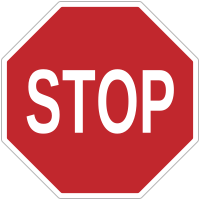
  • Red octagon with white border and the word STOP in whiteSTOP: stop completely, check for people and cross traffic, then go
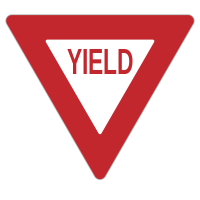
  • Downward-pointing red triangle with white center and the word YIELD in redYIELD: slow down and give the right-of-way, stop only if you need to
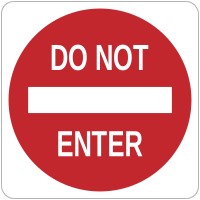
  • Red circle with a white horizontal bar on a white square, reading DO NOT ENTERDO NOT ENTER: don't drive onto this one-way street or ramp
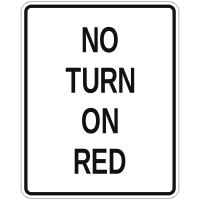
  • White sign reading NO TURN ON REDNO TURN ON RED: wait for the green signal
  • Traffic signal with the red light lit and flash marks around itFlashing red: treat it like a STOP sign
  • Four-section left-turn signal with the flashing yellow arrow litFlashing yellow arrow: you may turn left after yielding to oncoming traffic
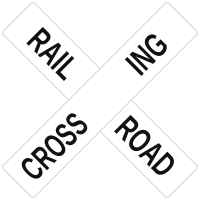
  • White X-shaped crossbuck reading RAILROAD CROSSINGRailroad crossbuck: treat it as a YIELD sign
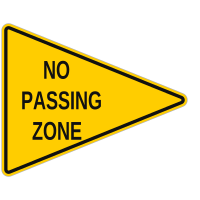
  • Yellow pennant pointing right reading NO PASSING ZONENO PASSING ZONE: the only pennant-shaped sign, it marks the start of a no-passing zone
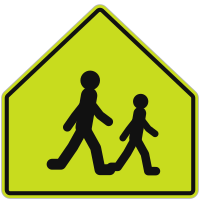
  • Fluorescent yellow-green pentagon with two children walkingSCHOOL: a school zone is ahead, slow down and watch for children
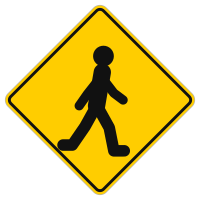
  • Yellow diamond with a black walking personPedestrian crossing: be ready to slow down or stop
  • Orange diamond reading ROAD WORK 1000 FTRoad work ahead: slow down, and headlights on in every posted work zone
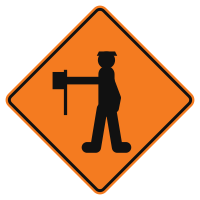
  • Orange diamond with a black flagger symbol holding a flagFlagger ahead: follow the flagger's STOP and SLOW paddle

Free practice test

20 practice questions from the Pennsylvania Driver's Manual

These 20 questions come from the Pennsylvania Driver's Manual, all multiple choice like the real PennDOT test. The real knowledge test has 18 questions and you need 15 right, which is about 83%. To match that bar here, aim for 17 out of 20. After each answer, the tutor can explain it another way or tell you why the other choices are wrong.

Question 1 of 20

What is the earliest you can apply for a Pennsylvania learner's permit?

Sample of the knowledge test: same format, 20 questions.

Test day

What to bring for your PA learner's permit

  • Your DL-180, with the back completed by a health care provider (don't mail it)
  • Under 18: the DL-180TD consent form, signed by a parent or guardian (or notarized if they can't come)
  • Your original Social Security card and an original proof of identity, such as a birth certificate with a raised seal or a valid US passport
  • 18 or older: two proofs of Pennsylvania residency
  • Payment by check, money order or card. Driver License Centers don't take cash
  • Your glasses or contacts, if you wear them

Before you go

  1. Download the DL-180 and have a health care provider fill in the back, no earlier than six months before your 16th birthday.
  2. If you're under 18, have a parent or guardian fill in the DL-180TD.
  3. Read the Pennsylvania Driver's Manual, free from PennDOT online, as a PDF in 33 languages or as audio.
  4. Try the 20 questions here, plus PennDOT's own question sets for Chapters 2, 3 and 4.
  5. Use PennDOT's Find a Location tool to pick a Driver License Center, and check its hours before you go.
  6. Gather your original documents. PennDOT doesn't accept photocopies.
PennDOT: Online Driver's Test Scheduling (road test)The knowledge test is walk-in, so you only book the road test. You can also book it by calling 717-412-5300.

Study options

Where to study

PennDOT gives the Pennsylvania Driver's Manual away free: online, as an audio version, and as a PDF in English and 32 other languages. Chapters 2, 3 and 4 end with review questions, PennDOT has those as separate question sets too, and its free PA Driver's Practice Test app is on iPhone and Android. We've also compared the other apps and websites Pennsylvania learners use.

OptionPriceFree to useLinks
Official and free
Pennsylvania Driver's Manual (PUB 95)Official · Online, PDF and audioPennDOT's handbook and the source of every knowledge test question. Read it online chapter by chapter, listen to the audio version, or download the PDF in English or one of 32 other languages. The English PDF is the April 2021 edition.
FreeThe whole manual, in 33 languages
PennDOT chapter question setsOfficial · PDFThree downloadable sets with answers, one each for signs and signals, learning to drive, and driving records. PennDOT doesn't say how many questions are in each.
FreeReview questions for Chapters 2, 3 and 4
PA Driver's Practice Test appOfficial · iPhone and Android appPublished by the Commonwealth of Pennsylvania. It describes its practice questions as a realistic version of the real knowledge test. It has 4.6 stars from about 1,600 App Store ratings, and was last updated in May 2025.
FreeThe whole app
PA Motorcycle Practice Test appOfficial · iPhone and Android appThe rider version, with practice questions for the motorcycle permit knowledge test and a section on next steps for licensing. It has 4.7 stars from 112 App Store ratings.
FreeThe whole app
Parallel parking tutorialOfficial · VideoLinked from PennDOT's Test Your Knowledge page. Worth watching before the road test, where you get one try at parking in a 24-by-8-foot space.
FreeThe video
Apps and websites
RoadReadyApp for parents · promoted by PennDOTPennDOT's Parent's Supervised Driving Program flyer recommends it for logging the 65 required hours. It records each drive and produces a state-approved document to turn in, and newer versions measure the teen's driving.
Not stated in PennDOT's flyerNot stated
Driving-Tests.org and DMV GenieWeb and app · all statesOne company runs both. The Pennsylvania section groups 180 essential questions, 305 harder ones and 93 on fines, distraction and drinking, plus hazard simulators. The site links its DMV Genie app at 4.7 stars on Google Play.
Free tests. Premium price not shown on the pageSix PA permit practice tests, sign tests and an 18-question exam simulator
ZutobiWeb and app · all statesLists 550+ Pennsylvania questions across 9 modules and 57 lessons, with iPhone and Android apps.
Not shown on the Pennsylvania pageNot stated
In person
Driver education coursesSchools approved by the PA Department of EducationNeeded if you want to move from a junior to a regular license before 18. Up to six hours of driving with the instructor count toward your 65 hours.
Set by each school-
Pennsylvania Motorcycle Safety Program (PAMSP)Rider training coursesPass a licensing course such as the 17-hour Beginner Riding Clinic on your permit and you get a Class M license without the center's skills test. Students on the beginner course get a motorcycle and helmet to use.
Free for PA residents with a Class M permit or licenseThe courses

Prices and ratings checked October 2026.

FAQ

Common questions

How many questions are on the PA permit test?

18 multiple-choice questions, and you need 15 right to pass. They cover traffic signs, Pennsylvania driving laws and safe driving, all from the Pennsylvania Driver's Manual.

What do you need for the permit test in PA?

Your DL-180 application with the physical on the back filled in by a health care provider, your original Social Security card and an original proof of identity such as a birth certificate with a raised seal or a US passport. Under 18, add the DL-180TD parent consent form. At 18 or older, bring two proofs of residency. Bring the fee too, by check, money order or card, because centers don't take cash.

Do I need a PA DMV appointment for the permit test?

No. You can walk in to any PennDOT Driver License Center for the knowledge test. You do need an appointment for the road test, which you book online or by calling 717-412-5300.

Can I take the PA permit test online?

No. PennDOT gives the knowledge test in person at Driver License Centers. Online, you can read the manual, try PennDOT's practice questions and its app, and book your road test.

How much is the PA permit test?

There's no separate charge for the test. When you apply you pay $45.50, as of October 2026: $6 for the learner's permit and $39.50 for the 4-year license you'll get after the road test.

What happens if I fail the PA permit test?

You can take it again the next business day. You can only take the knowledge test once a day, at any center. The examiner hands back your DL-180 and DL-180TD, so keep them and bring them with you.

Can I take the Pennsylvania permit test in Spanish or another language?

Yes. PennDOT offers it written or as audio, on request, in many languages, including Spanish, Arabic, Chinese (Mandarin), French, Korean, Russian, Ukrainian and Vietnamese. The Driver's Manual itself is in 33 languages.

How old do you have to be to get a permit in PA?

16. Your doctor can do the DL-180 physical up to six months before your 16th birthday, but you can't apply until the day you turn 16.

Is the PA DMV the same as PennDOT?

Yes. Pennsylvania's driver licensing is run by PennDOT Driver and Vehicle Services. People call it the PA DMV, and PennDOT's own pages sit under pa.gov/agencies/dmv.

All 20 practice questions with answersA printable list of the practice test above
  1. What is the earliest you can apply for a Pennsylvania learner's permit?

    On or after your 16th birthday PennDOT won't take a learner's permit application before your 16th birthday. You can get the physical exam on the DL-180 done up to six months earlier, but the permit itself starts at 16.

  2. You're 16 and on a learner's permit. How much supervised driving must you finish before your road test?

    65 hours, including 10 at night and 5 in bad weather Drivers under 18 need at least 65 hours behind the wheel, with at least 10 hours at night and 5 hours in bad weather. A parent or guardian signs the DL-180C to confirm it, and you also have to hold the permit for six months.

  3. You're 17 with a learner's permit. Who can supervise you while you drive?

    A licensed driver who is at least 21, or a licensed parent, guardian or spouse who is 18 or older Under 18, you may only drive with a licensed driver who is at least 21, or with a parent, guardian, person in loco parentis or spouse who is 18 or older and holds a license. That person must sit in the front seat.

  4. On a junior driver's license, when are you not allowed to drive alone?

    Between 11 p.m. and 5 a.m. Junior drivers can't drive between 11 p.m. and 5 a.m. unless a parent, guardian, person in loco parentis or spouse who is 18 or older is with them. There are exceptions for work, public or charitable service and volunteer fire companies, with a notarized affidavit.

  5. You got your junior license last month. No adult is in the car. How many passengers under 18 who aren't your immediate family can you carry?

    One For the first six months on a junior license, you can carry no more than one passenger under 18 who isn't immediate family, unless a parent, guardian or adult spouse is with you. After six months the limit goes up to three, if you've had no at-fault crash and no driving conviction.
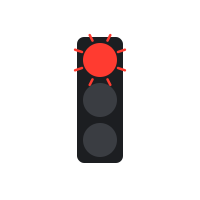
  6. Traffic signal with the red light lit and flash marks around it

    You come to this signal at an intersection. What must you do?

    Come to a complete stop, then go when the intersection is clear A flashing red light means the same as a STOP sign. You stop completely, look both ways and go only once the intersection is clear.
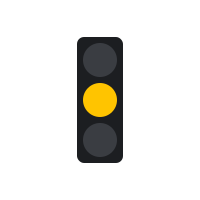
  7. Three-section traffic signal with the middle yellow light lit

    You're approaching an intersection and this signal comes on. What should you do?

    Slow down and get ready to stop, unless you can't stop safely A steady yellow light warns that red is about to appear. Slow down and prepare to stop. If you're already in the intersection or can't stop safely before it, keep going carefully.
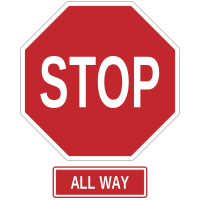
  8. STOP sign with a red ALL WAY plaque beneath it

    You come to this sign at an intersection. What does it mean?

    Every direction must stop, then drivers go in turn The ALL WAY plaque under the STOP sign means traffic from every direction has to stop. Every driver stops, then goes in turn. The manual says a traffic signal that isn't working is treated the same way, as a four-way STOP.
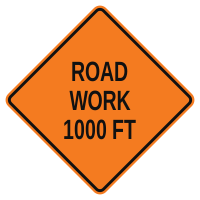
  9. Orange diamond reading ROAD WORK 1000 FT

    You pass this sign at noon on a sunny day, but you can't see any workers. What does Pennsylvania law say about your headlights?

    They must be on You must turn on your headlights in every posted work zone, at any time of day, whether or not anyone is working. Orange signs like this one mark a work zone.
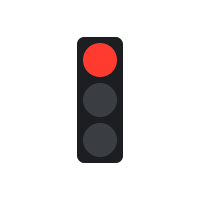
  10. Three-section traffic signal with the top red light lit

    You're stopped at this signal and want to turn right. There's no sign about turns. What can you do?

    Turn right after stopping and yielding to pedestrians and traffic In Pennsylvania you may turn right on a steady red light unless a NO TURN ON RED sign is posted. You must stop first and yield to pedestrians and other traffic.

  11. You're driving at 45 mph and plan to turn right. How far ahead must you start signaling?

    At least 300 feet Pennsylvania law says to signal at least 100 feet before a turn when you're going under 35 mph, and at least 300 feet before when you're going 35 mph or faster. At 45 mph, that's 300 feet.
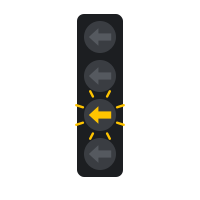
  12. Four-section left-turn signal with the flashing yellow arrow lit

    You want to turn left and see this signal. What does it mean?

    You may turn left, but first yield to oncoming traffic and pedestrians A flashing yellow arrow lets you turn with caution, but the turn is not protected. Oncoming traffic has a green light, so you must yield to it and to pedestrians first.

  13. When can you turn left on a steady red light in Pennsylvania?

    From a one-way street onto another one-way street, after stopping and yielding You may turn left on red after stopping if you're in the left lane, turning from a one-way street onto another one-way street, and no sign forbids it. You must still yield to pedestrians and traffic.

  14. On dry pavement, what following distance does the Pennsylvania Driver's Manual recommend?

    4 seconds The manual's space cushion rule is a 4-second following distance on dry pavement. That gives you time to steer or brake around a hazard. Leave more room in bad weather and behind buses and trucks that make sudden stops.

  15. The yellow lights on a school zone speed sign are flashing. What is the speed limit?

    15 mph In a Pennsylvania school zone, the limit is 15 mph when the lights on the sign are flashing or during the times shown on the sign. Speeding there puts 3 points on your record.

  16. You're driving at night with high beams on. When must you switch to low beams?

    Within 500 feet of an oncoming vehicle, and within 300 feet when following one Pennsylvania law requires low beams whenever you're within 500 feet of an oncoming vehicle and when you're following a vehicle within 300 feet. High beams can blind other drivers.

  17. Under Pennsylvania's child restraint law, what must a 6-year-old use in the car?

    A federally approved booster seat with a lap and shoulder belt Children aged 4 up to 8 must ride in a federally approved booster seat used with lap and shoulder belts, wherever they sit. Children under 4 need a child safety seat.

  18. A school bus ahead has stopped with red lights flashing and its stop arm out. You're behind it on the same road. What must you do?

    Stop at least 10 feet away and stay stopped until the lights stop and the children are safe You must stop at least 10 feet from the bus, whether you're behind it or coming toward it. Stay stopped until the red lights stop flashing, the stop arm is withdrawn and the children are safe. Failing to stop brings a 60-day suspension, 5 points and a fine.

  19. How close to a fire hydrant can you park?

    No closer than 15 feet You may not park within 15 feet of a fire hydrant. The same list bans parking within 20 feet of a crosswalk at an intersection and within 30 feet of a stop sign or flashing signal at the roadside.

  20. You're 19. At what blood alcohol concentration (BAC) are you considered to be driving under the influence?

    .02 percent or more A driver under 21 with a BAC of .02 percent or more is considered to be driving under the influence. The .08 limit is for drivers 21 and older. Pennsylvania has zero tolerance for drinking under 21.