Saskatchewan · Learner’s test

SGI learner’s test for a Class 7 licence

To get a Class 7 learner’s licence in Saskatchewan, you pass two written knowledge tests from Saskatchewan Government Insurance (SGI) and a vision test. The Basic test covers driving situations and the rules of the road. The Sign test covers sign identification. You can take the SGI learner’s test at 16, or at 15 if you’re in a high school driver education program.

  • 16Minimum age, or 15 in high school driver ed
  • 2Knowledge tests to pass: Basic and Sign
  • 12Months your passed results stay valid

Key facts

At a glance

Questions and pass mark
Not given in SGI’s Driver’s Handbook
Booking
Through a motor licence issuer or MySGI
Walk-in written tests
Regina and Saskatoon, 8 a.m. to 4 p.m., Monday to Saturday
Vision test
May check your field of vision, how sharp your sight is and distance judgment

How it works

How the SGI learner’s test works

  1. If you’re unsure what a question means, you can ask the examiner to help. Cellphones and other electronic devices aren’t allowed in the test area.
  2. If you pass the vision test only with glasses or contact lenses, your licence is restricted: it’s valid only while you wear them.
  3. Once you’ve passed, you buy your Class 7 licence at a motor licence issuer. You get a temporary paper licence until the card comes in the mail. That card isn’t an SGI photo ID card, and you need it to drive.

Topics

What’s on the test

01

Saskatchewan’s driver’s licence program

Licence classes, Graduated Driver Licensing (GDL), mandatory driver education and the tests for each licence.

Key points (4)
  • GDL has three stages: Learner (Class 7), Novice 1 and Novice 2.
  • A Class 7 learner can’t use any type of cellphone while driving, hand-held or hands-free.
  • No GDL driver may drive after any alcohol or drugs: the blood alcohol level must be zero.
  • A Class 7 licence doesn’t let you get a motorcycle endorsement or drive a three-wheeled vehicle as a learner.
02

Basic information and rules of the road

Speed, sharing the road, lanes, turns, right of way, interchanges and pedestrians.

Key points (4)
  • Where no sign is posted, the speed limit is 80 km/h.
  • Slow to 60 km/h when you pass a tow truck or emergency vehicle stopped with its lights flashing.
  • Each city or town sets its own school zone speed limits by bylaw, so watch for signs.
  • In a zipper merge, drivers use both lanes until the lane ends, then take turns into the open lane.
03

Traffic signs and signals

The six basic sign shapes, sign colours, and regulatory, warning, construction and guide signs.

Key points (4)
  • A stop sign is a red octagon with white letters.
  • Warning signs are diamond shaped, yellow or orange, with black letters or symbols.
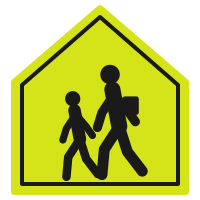
  • Orange signs mean construction and maintenance, and fluorescent yellow-green marks school zones and school crosswalks.
  • The railway crossbuck has the same colours as a yield sign and means the same thing.
04

Basic driving skills

Spotting hazards, judging time and distance, using your eyes and handling the car at low speed.

Key points (3)
  • IPDE stands for Identify, Predict, Decide and Execute, the four steps for handling hazards.
  • Keep a following distance of at least three seconds, which grows with your speed.
  • When your high beams are on, dim them at least 200 metres before an oncoming vehicle.
05

Advanced driving skills

Parking, highway driving, passing, gravel roads, winter driving, emergencies and collisions.

Key points (3)
  • In the first few snowfalls, drive very slowly and keep a five-second following distance.
  • A whiteout is when the sky, horizon and ground blend together, so you can barely see where the road ends.
  • Threshold braking means braking as hard as you can without locking the wheels.
06

Drinking, drugs and driving

How alcohol and drugs affect driving, and the risk of a crash.

Key points (2)
  • The handbook says the only truly safe blood alcohol level is zero.
  • Alcohol leaves the body at about .015% an hour, and only time removes it.
07

Complying with the law when driving

The Traffic Safety Act, Criminal Code driving offences, traffic tickets and SGI’s driver programs.

Key points (2)
  • Under the Criminal Code, a blood alcohol level of 80 mg or more per 100 ml of blood is impaired driving.
  • GDL drivers who are at fault in a collision or convicted of an offence enter the GDL Improvement program, starting with a warning letter or a Traffic Safety Education session.

Road signs

Road signs and what SGI’s handbook says they mean

Chapter 4 of SGI’s handbook starts with the six basic sign shapes and the standard sign colours. It says learning shapes and colours is the easiest way to identify a sign.

  • Red octagon with a white border and the word STOP in white.Stop: come to a full stop and be sure the way is clear before you go
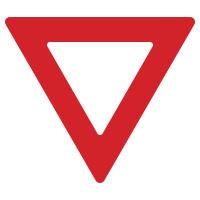
  • Downward-pointing triangle with a wide red border and white centre, no text.Yield: slow down, give the right of way and stop if you need to
  • Five-sided fluorescent yellow-green sign with a black border and two black schoolchildren walking.School zone: when a “Maximum Speed” or “km/h during School Days” tab is underneath, keep to the speed shown
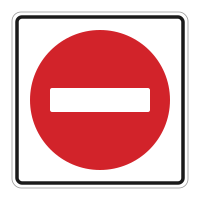
  • White square with a black border holding a red circle crossed by a white horizontal bar.Do not enter
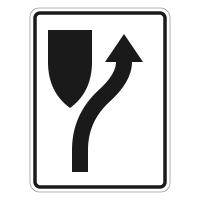
  • White vertical sign with a black island shape on the left and a black arrow curving around it to the right.Keep to the right of traffic islands or an obstruction
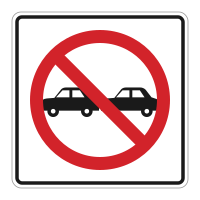
  • White square: two black cars side by side inside a red circle with a red slash.Passing not permitted
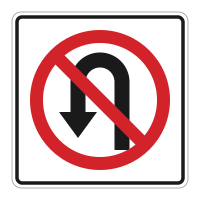
  • White square with a black U-shaped arrow inside a red circle with a red slash.No U-turn: don’t turn around in the roadway to go the opposite way
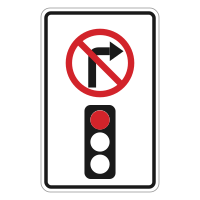
  • Vertical white sign: a right-turn arrow in a red circle and slash above a traffic-signal symbol with the red light lit.No right turn on red: wait for the green light before you turn right
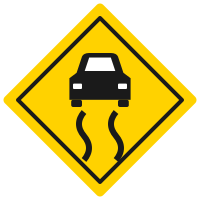
  • Yellow diamond with a black car and two wavy skid marks behind it.Road surface slippery when wet
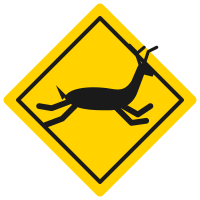
  • Yellow diamond with a black leaping deer.Section of roadway regularly crossed by deer
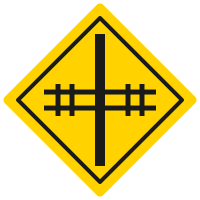
  • Yellow diamond: a vertical black road crossed by a horizontal railway track with short ties.Railway ahead: the road crosses rail tracks at the angle shown
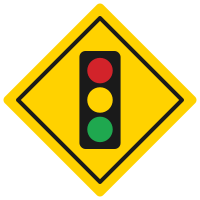
  • Yellow diamond with a black traffic-signal housing showing red, yellow and green lights.Traffic signals ahead: be prepared to stop

Test day

What to bring to the SGI learner’s exam

  • Original ID with your full name and date of birth, such as a birth certificate, passport or immigration documents. Photocopies aren’t accepted
  • A document with your signature, such as a Saskatchewan Health card, a passport or a driver’s licence from a Canadian province or territory
  • Proof of residency and of your right to be in Canada, the first time you apply for a Saskatchewan licence
  • The Signature/Guarantor Form, signed by a parent or guardian, if you’re a first-time driver between 15 and 18
  • Papers that show a change of name, for example after marriage, if your name has changed

Before you go

  1. Under 18 and no ID with your signature on it? A parent or guardian goes with you and shows photo ID.
  2. Take several pieces of original ID with you, not just one.
SGI: Book with MySGIBooks written tests and Class 5 road tests online. Miss an appointment without cancelling and you pay for the new one.

Study options

Where to study

SGI’s Saskatchewan Driver’s Handbook is the book to study, and it points you to SGI’s own practice quiz. The study page explains both, and covers high school driver education, SGI-certified instructors and an app from another company.

OptionPriceFree to useLinks
Official sources
SGI: Saskatchewan Driver’s HandbookOfficial · PDF and onlineAccurate as of September 2025, SGI says. The online version can be translated with a Google Translate tool.
No charge shown for the PDF or the online versionThe PDF and the online version
SGI: practice quizOfficial · webPractice test questions on SGI’s own website. SGI’s handbook points you to them.
Not listedNot stated
In person
High School Driver Education ProgramCourse at your high schoolRun through your high school, and it covers the mandatory driver education for the road test. SGI’s new drivers page has the Signature/Guarantor Form.
Not listed by SGINot stated
SGI-certified driver instructorsLessons, 16 and olderSGI keeps the list of certified instructors. Ask to see an instructor’s certification card before you book.
Not listed by SGINot stated
Apps and websites
SGI Driving Practice Test 2026 (Movil Softwares)iPhone and iPad appPractice questions, mock tests and a road sign guide. Its listing calls it a study aid, not a replacement for SGI’s resources or driver training. Rated 4.8 from 51 ratings on the Canadian App Store.
Free download; in-app purchases from $0.99, subscriptions from $3.99 a week, or $12.99 for lifetime accessThe download; the listing doesn’t say what’s free without a purchase

Prices and ratings checked November 2026.

Explore

Everything else, in one place

FAQ

Common questions

How much does the SGI learner’s test cost?

SGI’s Driver’s Handbook doesn’t give the fee for the written tests, so ask your motor licence issuer what it is when you book.

What happens if you fail the SGI learner’s test?

You rewrite only the test you failed, so if you pass the Sign test but not the Basic test, you write the Basic test again. You can write only once a day, so you can’t try again on the same day.

Do you need a parent’s signature for the SGI learner’s test?

Yes, if you’re a first-time driver under 18. A parent or guardian signs SGI’s Signature/Guarantor Form, and you won’t get a licence without it. Once they give that consent, it can’t be withdrawn. At 15, you also need to be in a certified High School Driver Education Program, or on its waiting list, and the same form confirms it.

Can you take the SGI learner’s test online?

SGI’s handbook gives one online route. Students in the High School Driver Education Program set up a free MySGI account at any motor licence issuer, showing their ID, and write the exam online. The handbook doesn’t describe an online option for anyone else.

Is the SGI learner’s test in other languages?

SGI’s handbook doesn’t say which languages the written tests are offered in, so ask your motor licence issuer before you book. You can read the online handbook in another language with its Google Translate tool, which SGI says is a third-party tool. Road tests are in English.

Who can supervise a Class 7 learner in Saskatchewan?

Someone with a Class 5 or higher licence, or the same from another Canadian province or territory or a U.S. state, who isn’t a novice driver and has held a valid licence for at least 365 days in the past three years. They sit in the seat next to you and must be able to take over driving at any time.

What comes after the learner’s licence?

You drive with a supervising driver for at least nine months and finish mandatory driver education with an SGI-certified instructor. Then you pass a road test for Class 5 and drive as a Novice 1 driver for six months, then as a Novice 2 driver for 12 months with no at-fault collisions, traffic convictions or suspensions. After that, you have an experienced Class 5 licence.

Sources: SGI and 7 more. Checked November 2026.

Rules and fees can change, so check the official site before your test.