South Carolina · Permit test

The SC DMV permit test

To get a beginner's permit in South Carolina, you pass a vision test and a knowledge test at an SCDMV branch, and you can do it from age 15. The permit test in SC costs $2 a try, and you don't need an appointment, but branches won't start a knowledge test after 4 p.m. SCDMV doesn't publish how many questions it asks or the score you need. Its Driver's Manual is free, and the 20 practice questions on this page are written from it.

  • $2Knowledge test fee, each try, as of October 2026
  • $2.50Beginner's permit fee, after you pass
  • 15Minimum age for a beginner's permit
  • 4 p.m.Branches give no knowledge tests after this time

Key facts

At a glance

Who gives it
SCDMV, the South Carolina Department of Motor Vehicles, at its branches or through authorized third-party testers
What's on it
Traffic laws, road signs and driving safety rules, from the SC Driver's Manual
Questions and pass mark
Not published by SCDMV
When
Walk in to any branch, no appointment, before 4 p.m.

How it works

How the SC permit test works: a walk-in knowledge test at an SCDMV branch

  1. You take the knowledge test at any SCDMV branch, and you don't need an appointment. Some driver training schools have SCDMV-authorized testers who can give it instead.
  2. SCDMV's Driver's Manual says the test covers traffic laws, road signs and driving safety rules.
  3. SCDMV doesn't publish how many questions there are or the score you need to pass. The manual's own 10 sample questions each have three answer choices.
  4. Arrive before 4 p.m. SCDMV says customers can't take knowledge tests after that time.
  5. You can't use the manual or any other testing aid, and phones, tablets and other devices aren't allowed in the test area. Leaving before you finish, talking to anyone, or bringing in anything that could help you means you fail.
  6. You also pass a vision test. SCDMV's screening checks for 20/40 vision or better, or your eye doctor can send results to SCDMV electronically.
  7. The test costs $2 each time. Once you pass, the beginner's permit is $2.50.

Topics

What’s on the test

01

Signs, signals and pavement markings

Section 6 of the SC Driver's Manual covers traffic signals, signs and the lines on the road. Shapes and colors give most signs away before you can read them.

Key points (4)
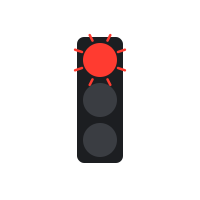
  • A flashing red light means a full stop, as at a stop sign. A flashing yellow means slow down and go with caution.
  • You may turn right on red after stopping, unless a sign prohibits it, and you must yield to pedestrians and other traffic.
  • Regulatory signs are white with black, red or green; warning signs are usually yellow diamonds; work zone signs are orange.
  • Two solid yellow center lines mean no passing in either direction.
02

Beginner's permits and teen license rules

Section 1 of the manual explains the beginner's permit and South Carolina's graduated license program for drivers aged 15 to 17.

Key points (4)
  • From 6 a.m. to midnight, a permit holder drives with a licensed driver 21 or older who has a year of experience in the front seat.
  • Under 18, you hold the permit at least 180 days before applying for a license. At 18 or older it's 30 days.
  • At 15 or 16 you need 40 hours of practice, 10 of them at night, plus driver's education: 8 hours in class and 6 driving.
  • Conditional and special restricted drivers may carry no more than two passengers under 21 without a licensed adult 21 or older, except family or students going to and from school.
03

Right-of-way and sharing the road

Sections 6, 7 and 10 cover who goes first, when to stop for a school bus, and how to share the road with pedestrians, bicyclists and emergency vehicles.

Key points (4)
  • At a four-way stop, if you arrive at the same time as another driver, yield to the driver on your right.
  • On a two-lane road you stop for a stopped school bus with flashing lights from either direction. You always stop when you're behind the bus.
  • Yield to pedestrians in an intersection even when your light is green, and stop completely for a person with a white cane or guide dog.
  • When you pass a stopped emergency vehicle, slow down and move to a lane away from it if it's safe.
04

Following distance, headlights and signals

Sections 8 and 11 give the numbers worth memorizing: following distance, headlight distances and how early to signal.

Key points (4)
  • Keep at least a 4-second following distance, and add at least one more second at night.
  • Dim your high beams 500 feet or more from an oncoming vehicle, and use low beams within 200 feet of a vehicle you're following.
  • Signal at least 100 feet before you turn, change lanes or merge.
  • When you park along a road, don't park more than 18 inches from the curb or edge of the pavement.
05

Alcohol, phones and child seats

Sections 3 and 4 cover the state laws on alcohol, phones, seat belts and child passengers.

Key points (4)
  • Under 21, a BAC of 0.02 percent or more means an immediate suspension of at least three months.
  • You can't hold a phone, text or watch moving images while driving. A first offense is a $100 fine.
  • South Carolina has a primary seat belt law: an officer can stop you for not wearing one.
  • Children seven and younger ride in a car seat in the back seat.

Road signs

Road signs from Section 6 of the SC Driver's Manual

Section 6 of the SC Driver's Manual sorts signs by color: regulatory signs are white, warning signs are mostly yellow diamonds, work zone signs are orange, and guide signs are green, brown or blue. It also explains the hurricane evacuation route sign, which marks roads used when an evacuation is ordered for the coast.

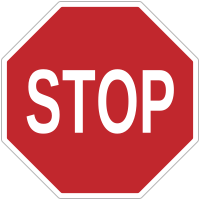
  • Red octagon with white border and the word STOP in whiteStop: eight sides, stop at the line or crosswalk
  • Downward-pointing red triangle with white center and the word YIELD in redYield: slow down and let traffic with the right-of-way go
  • Traffic signal with the red light lit and flash marks around itFlashing red: stop as you would at a stop sign
  • Two-way road divided by two solid yellow lines; no passing in either directionDouble solid yellow: no passing either way
  • Round yellow sign with a black X and two letters RRailroad ahead: slow down, look and listen
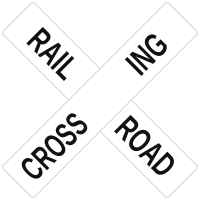
  • White X-shaped crossbuck reading RAILROAD CROSSINGRailroad crossbuck: stop if a train is coming
  • White sign reading CENTER LANE above two opposing left-turn arrows and the word ONLYCenter lane: left turns only, from either direction
  • Orange diamond with a black flagger symbol holding a flagFlagger ahead: follow the flagger's directions
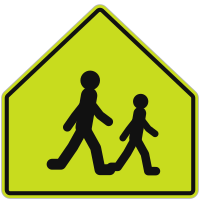
  • Fluorescent yellow-green pentagon with two children walkingSchool: watch for children
  • Fluorescent orange triangle with a red reflective borderSlow-moving vehicle: under 25 mph
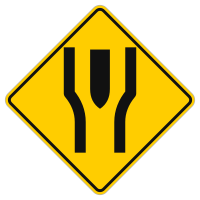
  • Yellow diamond showing a road splitting around a black median aheadDivided highway begins

Free practice test

20 practice questions from the SC Driver's Manual

These 20 questions are written from the South Carolina Driver's Manual, with three choices each, like the sample questions in its Section 12. SCDMV doesn't publish a pass mark for the knowledge test, so we use an 80% bar: get 16 of the 20 right and count it as a pass. If you miss one, the tutor explains it a second way and says what's wrong with the other two choices.

Question 1 of 20
Traffic signal with the red light lit and flash marks around it

You reach an intersection where this signal is flashing. What must you do?

20 practice questions in the style of the knowledge test.

Test day

What to bring for your beginner's permit

  • Your Social Security number
  • Your birth certificate, a government-issued one
  • Proof of your current physical South Carolina address, or two proofs for a REAL ID
  • A qualified adult if you're under 18, to sign the consent form at the branch with a picture ID
  • Your glasses or contacts, if you wear them
  • Money for the test and permit. Branches take cash, checks, and credit or debit cards

Before you go

  1. Read the SC Driver's Manual. It's a free PDF from SCDMV.
  2. Try the 10 sample questions in Section 12 of the manual and SCDMV's free online practice exam, then the 20 questions on this page.
  3. Check your documents against SCDMV's U.S. Citizens' Checklist (form MV-93), or form MV-94 if you're not a U.S. citizen.
  4. Decide whether you want a REAL ID. It needs two proofs of address instead of one.
  5. If you're under 18, bring a parent or another qualified adult to sign your consent.
  6. Go to the branch early enough to start the test before 4 p.m.
SCDMV: Beginner's PermitThere's nothing to book for the knowledge test: walk in to any SCDMV branch before 4 p.m. You'll use SCDMV's scheduler later, if you want an appointment for the road test.

Study options

Where to study

SCDMV gives away the Driver's Manual as a free PDF and runs a free online practice exam that draws new questions every time you start. Its own iPhone app still exists, though the App Store shows its last version came out in 2017. We've set those beside the private apps, sites and driver training schools South Carolina learners use.

OptionPriceFree to useLinks
Official and free
SC Driver's ManualOfficial · PDFSCDMV's own book for the Class D permit, in 12 sections from licensing rules to road signs and emergencies. Its cover calls it the Driver's License Manual. SCDMV's manuals page lists no Spanish or audio version.
FreeThe whole manual, including 10 sample questions with answers
SCDMV Driver's License Practice ExamOfficial · OnlineSCDMV's browser-based practice test. The questions change each time you start, and SCDMV encourages you to take it as often as you like. It restarts if you leave it idle for 3 minutes.
FreeUnlimited practice tests
SC DMV Driver ExamOfficial · iPhone appThe App Store listing says SCDMV created it to help you prepare for the written test, and the Driver's Manual points to it for practice. It's published by NICUSA. 2.9 stars from 65 App Store ratings, and the latest version shown, 1.7, is dated October 2017, so check anything surprising against the current manual.
FreeThe whole app
Motorcycle, CDL and RV manualsOfficial · PDFThe Motorcycle and Moped Operator's Manual for a Class M permit or moped license, the Commercial Driver License Manual for the CDL knowledge tests, and the Large Non-commercial and Recreational Vehicles Driver's Manual for Class E and F.
FreeAll three manuals
Apps and websites
SC DMV Permit Test Practice (Altaf Mogal)iPhone appCar, motorcycle and CDL practice, including air brakes and hazmat, with a mock exam, study mode, flashcards and a review of questions you got wrong. 4.9 stars from 33 App Store ratings. A private app, not from SCDMV.
Free with in-app purchases: $2.99 for 7 days, $7.99 for 30 days, or $14.99 for all features with no adsFree to download. The listing doesn't say which features are free
Driving-Tests.orgWebsiteTests grouped from the basics up to harder situations. The 30-question simulator is the site's own format: SCDMV doesn't publish a question count. Premium adds a larger question bank and a retest of the questions you missed.
Free tests, with a paid premium plan. The page doesn't show the priceSouth Carolina practice tests with no signup, including road sign tests and a 30-question exam simulator, plus a downloadable cheat sheet
In person
SCDMV-licensed driver training schoolsDriver's education, and at some schools, testingAt 15 or 16 you need driver's education before your first license: eight hours in the classroom and six hours of driving. The school gives you the PDLA form SCDMV asks for. Schools in SCDMV's One Stop program also have authorized testers who can give the knowledge or road test.
Set by each schoolNothing, these are paid courses
Motorcycle rider coursesMotorcycle trainingA course is optional unless you fail the SCDMV motorcycle skills test three times. Passing one with a Motorcycle Safety Foundation skills test from an SCDMV-approved tester can stand in for the SCDMV skills test. SCDMV's motorcycle page lists providers, including technical colleges and dealerships.
Set by each providerNothing, these are paid courses

Prices and ratings checked October 2026.

FAQ

Common questions

How many questions are on the SC permit test?

SCDMV doesn't say. Its website and Driver's Manual describe what the test covers, traffic laws, road signs and driving safety rules, but not how many questions there are or the score you need. If an app or site gives a number, it isn't one SCDMV publishes. The manual's own sample has 10 questions with three choices each. SCDMV's pages also don't say which languages the knowledge test is offered in, so ask at a branch if you need one other than English.

Can you take the permit test online in SC?

Not according to SCDMV's pages. They describe taking the knowledge test at an SCDMV branch, or with an authorized third-party tester at some driver training schools, and SCDMV's list of online services doesn't include it. What you can do online is practice with SCDMV's free practice exam, renew or replace a permit, and book a road test.

How much is the permit test in SC?

$2 for each knowledge test, and $2.50 for the beginner's permit once you pass, as of October 2026. Branches take cash, checks and cards. Paying by card adds a service fee of $1 plus 1.7%, which SCDMV says isn't its own fee.

How old do you have to be to get a permit in SC?

15, for a regular Class D or a motorcycle beginner's permit. If you're under 18, a qualified adult, such as a parent or legal guardian, has to give consent at the branch. Permits for the larger Class E and F vehicles start at 18.

What do I need to bring to the SC DMV for my permit?

Your Social Security number, a government-issued birth certificate and proof of your current physical South Carolina address, or two proofs if you want a REAL ID. If you're under 18, bring the adult who will sign your consent, with their picture ID. SCDMV's form MV-93 lists every document it accepts.

What happens if I fail the SC permit test?

You pay the $2 fee again for your next try. SCDMV's pages don't give a waiting period or a limit on tries for the regular knowledge test, so ask at the branch about coming back. Before you do, reread the manual sections behind the questions you weren't sure about.

Sources: SCDMV and 5 more. Checked October 2026.

Rules and fees can change, so check the official site before your test.

All 20 practice questions with answersA printable list of the practice test above
  1. Traffic signal with the red light lit and flash marks around it

    You reach an intersection where this signal is flashing. What must you do?

    Come to a complete stop, then go when it's safe, just as you would at a stop sign The SC Driver's Manual says a flashing red light means you stop behind the stop line, crosswalk or intersection and follow the same steps as at a stop sign. Look both ways and yield before you go.
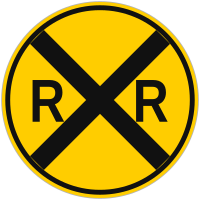
  2. Round yellow sign with a black X and two letters R

    You see this sign ahead. What should you do?

    Slow down, look and listen for a train, and be ready to stop This sign stands along the road before a railroad crossing. The manual says it tells you to slow down, look and listen for a train, and be prepared to stop if one is coming.
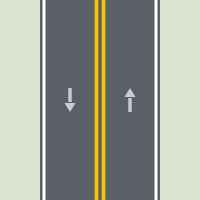
  3. Two-way road divided by two solid yellow lines; no passing in either direction

    You're on a two-way road with these lines down the middle. What do they mean?

    No one may pass, in either direction Two solid yellow center lines mark a two-direction road where passing is prohibited both ways. The manual's pavement marking pictures show this pattern under that heading.
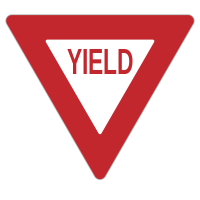
  4. Downward-pointing red triangle with white center and the word YIELD in red

    What does this sign tell you to do?

    Slow down and let traffic that has the right-of-way go before you enter A yield sign means you slow down and allow traffic with the right-of-way to cross before you enter. You stop only if you need to.
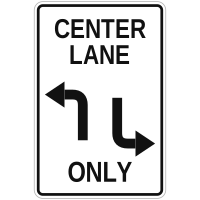
  5. White sign reading CENTER LANE above two opposing left-turn arrows and the word ONLY

    This sign marks the middle lane of a busy road. What is that lane for?

    Left turns, by drivers coming from either direction The manual says this sign shows a lane reserved for left-turning vehicles from either direction. It isn't for through traffic or for passing.
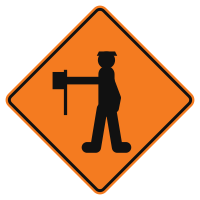
  6. Orange diamond with a black flagger symbol holding a flag

    You see this sign before a stretch of road work. What should you do?

    Slow down, be ready to stop, and follow the directions of the person with the sign or flag This is the flagger ahead sign. The manual says traffic in work zones may be controlled by a person with a sign or flag, and you must follow their instructions. It also tells you to reduce your speed and be prepared to stop suddenly in work zones.

  7. What is the youngest age at which you can get a regular (Class D) beginner's permit in South Carolina?

    15 You must be at least 15 for a Class D beginner's permit, and you have to pass the vision and knowledge tests. If you're under 18, a qualified adult has to consent.

  8. You're driving on a Class D beginner's permit at 3 p.m. Who must be in the front seat with you?

    A licensed driver who is at least 21 and has at least one year of driving experience From 6 a.m. to midnight, a permit holder may drive only with a licensed driver who is at least 21 and has at least one year of driving experience in the front seat. After midnight, the supervisor must be one of the people listed in SC Code §56-1-100(A).

  9. Before a 15- or 16-year-old can get a first license, how much supervised driving practice is required?

    At least 40 hours, with 10 at night If you're 15 or 16, you must practice for at least 40 hours, including ten hours of night driving, with a parent, guardian or another person listed in the law. You also need to hold the permit for more than 180 days and finish driver's education.

  10. You're 16 with a special restricted license and no adult in the car. Apart from family members, or students on the way to or from school, how many passengers under 21 can you carry?

    Two With a conditional or special restricted license, you can't have more than two passengers under 21 unless a licensed adult who is at least 21 is with you. The only exception is carrying family members or students to and from school.

  11. You're on a highway with two traffic lanes in each direction. A school bus on the other side of the road stops with its red lights flashing. What does the law require of you?

    You don't have to stop, because you're traveling the opposite way on a multi-lane highway The manual says you don't have to stop when you meet a stopped school bus while traveling in the opposite direction on a multi-lane highway, meaning one with at least two traffic lanes in each direction. On a two-lane road, or when you're behind the bus, you must stop.

  12. A pedestrian carrying a white cane starts across the street in front of you. What must you do?

    Come to a complete stop You must always yield to people who are visually impaired. The manual says that when a pedestrian is crossing guided by a dog or carrying a white cane, you must come to a complete stop.

  13. An ambulance with its siren and flashing lights on is coming up behind you. What should you do?

    Pull over to the edge of the road so it can pass You must yield to an emergency vehicle that has its flashing lights and siren on by pulling over to the edge of the road so it can pass. The manual also says to avoid blocking intersections, roadways or driveways.
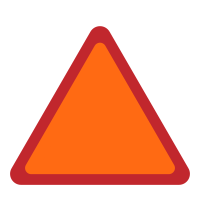
  14. Fluorescent orange triangle with a red reflective border

    You see this emblem on the back of a tractor ahead of you. What does it tell you?

    The vehicle is traveling less than 25 mph This orange and red triangle marks a slow-moving vehicle, such as farm or construction equipment or a vehicle drawn by animals. The manual says it means the vehicle is traveling less than 25 mph, so use caution and pass only when it's safe.

  15. What is the minimum following distance the SC Driver's Manual tells you to keep behind the vehicle in front?

    4 seconds The manual says you should always try to keep a minimum following distance of 4 seconds. Count from when the vehicle ahead passes a fixed point until you reach it. If you get there before 'one thousand four', you're too close.

  16. You're driving at night with your high beams on and a car is coming toward you. When should you dim them?

    While it's still at least 500 feet away The manual says to dim your high beams when you are 500 feet or more away from any oncoming vehicle. You also use low beams when you're following a vehicle less than 200 feet ahead.

  17. How far ahead does state law say you must use your turn signal before turning or changing lanes?

    At least 100 feet The manual says it is state law to use a turn signal 100 feet or more before changing lanes, turning left or right, or merging into traffic. Cancel the signal once you're done.

  18. You're 19, and a test shows a blood alcohol concentration of 0.02 percent. What happens to your privilege to drive?

    It's suspended right away for at least three months If you're under 21 and register a BAC of 0.02 percent or greater, your privilege to drive is suspended immediately for at least three months. Refusing the test means losing your privileges for at least six months.

  19. Under South Carolina's Hands-Free and Distracted Driving Act, which of these is allowed while you drive?

    Talking on a call through an earpiece The law bans holding or supporting a mobile device with any part of your body, reading or sending texts, and viewing moving images such as videos or video calls. It doesn't restrict earpieces or wrist-worn devices used for voice calls.

  20. Where must a child who is seven years old or younger ride?

    In a car seat in the back seat The manual says children age seven and younger must sit in a car seat in the back seat, to avoid injury from an air bag in a collision. It also says never to place a rear-facing child seat in front of an air bag.