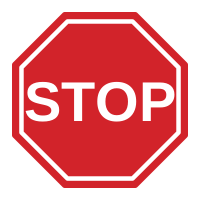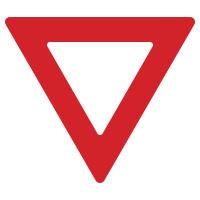
What does this sign tell you to do?
Give way to other traffic and pedestrians This sign means you yield the right of way to traffic not facing it, and to all pedestrians within the intersection or crosswalk. It’s one of the regulatory signs, and disobeying a regulatory sign is an offence.
What does a Class 7 licence allow?
Learning in a Class 5 or 6 vehicle A Class 7 licence permits you to operate any vehicle in Class 5 or 6 while you’re learning to operate it. Class 5 covers two-axle vehicles other than a motorcycle, bus, taxicab or ambulance, and Class 6 covers motorcycles.
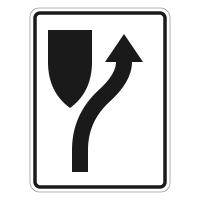
You see this sign on a traffic island. What must you do?
Keep to its right as you pass The keep right sign is placed on traffic islands and road obstructions. It requires you to pass to the right.
You’re about to enter a traffic circle. Who has to yield?
You, to traffic in the circle The manual says traffic entering a traffic circle must yield to traffic in the circle. Inside the circle, the vehicle on the right yields to the vehicle on the left.
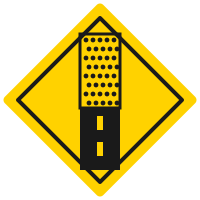
What does this sign warn you about?
Pavement ends; gravel ahead This sign warns that the pavement ends and the road continues with a gravel surface. The manual explains that gravel brings dust, flying stones, loose gravel and less traction, so be ready to change how you drive.
On a two-lane road, where should the yellow line be?
On your left side Yellow lines show the separation of traffic flowing in opposite directions. When you drive on a two-lane road, the yellow line should always be on your left.
Road and weather conditions turn poor. What should your following interval become?
Three seconds or more The time interval method counts the seconds between the car ahead passing a checkpoint and your car passing it. Two seconds or more is a reasonable interval, and under poor driving conditions the manual says to increase it to three or more seconds.
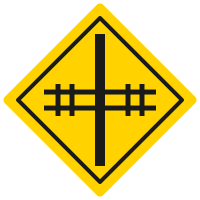
What does this sign tell you?
A railway crossing is ahead This is the railway crossing advance warning sign. The position of the tracks on the sign shows the angle at which the railway tracks cross the road.
On a gravel road, you meet a vehicle throwing up a heavy dust cloud. What should you do?
Turn on headlights and keep to your side Turn on your headlights well before you meet the vehicle, and get well over on your own side of the road. Slow down if necessary, to not more than 60 km/h, and hold steady.
A person carrying a white cane raises it at the curb. What does that tell you?
Stop and give them the right of way Blind and partially blind people carry white canes or are guided by guide dogs. A person often raises the cane when unsure of crossing the street in safety, and that’s your signal to stop and give the right of way.
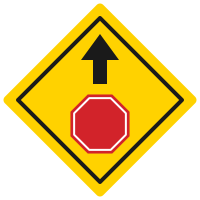
What does this sign warn you about?
A stop sign is ahead This sign warns of a stop sign ahead. Warning signs alert you to hazards not yet visible, so slow down and be ready to stop.
You pass the rules of the road part but fail sign identification. What do you rewrite?
The sign identification test The basic written examination has two parts: rules of the road and safe driving practices, and sign identification. If you fail any one part, you rewrite only the test or tests you failed.
A front tire blows out while you’re driving. What should you do first?
Hold the wheel and lift off the gas With a front-tire blowout, the car swerves toward the side of the blowout. Hold the steering wheel firmly and take your foot off the accelerator so the car slows down gradually, and brake only when your speed is low enough to keep control.
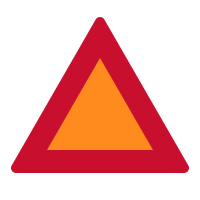
You see this sign on the back of a vehicle ahead. What does it tell you?
It’s going well below the posted speed This sign warns of a slow-moving vehicle ahead. It may be attached to the rear of a vehicle travelling substantially slower than the posted speed, so slow down as you come up behind it.
How close to a fire hydrant may you stop or park?
No closer than 3 m Unless a traffic officer or a traffic control device directs you, you may not stop, stand or park within 3 m (10 ft.) of a fire hydrant. The same list keeps you 6 m from a crosswalk and 15 m from the nearest rail of a railway crossing.
On a road with lane use signals, a lane shows a red X. What does that mean?
You must never drive in that lane Lane use signals control traffic by reversing a lane’s direction during different hours of the day. You must never drive in a lane under a red X, and you’re permitted to drive in a lane under a green arrow or a green X.
After a few drinks, what will sober you up?
Only time, as your body clears it Black coffee, food or a cold shower might wake you up, but they won’t sober you up. It takes time to eliminate alcohol, because it must be burned up by the liver and passed from the body through the kidneys and lungs.
Unless you drive another emergency vehicle, how close may you follow a fire engine?
No closer than 150 m No driver may follow within 150 m (500 ft.) of a fire engine unless he or she is the driver of another emergency vehicle. Emergency vehicles, fire engines included, have the right of way while showing flashing red lights and sounding a siren, bell or exhaust whistle.
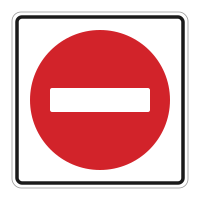
What does this sign mean?
You must not enter this street This is the Do Not Enter sign, one of the regulatory signs. When you’re confronted by it, you must not enter that street.
A vehicle on the highway ahead shows flashing blue lights. What is it, and what do you do?
A snowplow; give it right of way Flashing blue lights are reserved to identify snowplows, and no other vehicle may be so equipped. A snowplow on the highway must be given the right of way, and you pass one with caution, since visibility around it is usually poor.
 Nunavut · Learner’s test