Yukon · Knowledge test

Yukon driver’s test for a Class 7 learner’s licence

Your first step to driving in Yukon is a Class 7 learner’s licence, and to get it you pass a vision test and a written knowledge test. The Yukon driver’s test asks about road signs, the rules of the road and safe driving practices, and you study for it with the Yukon Driver’s Basic Handbook.

  • 15Youngest age for a learner’s licence
  • $20Fee for each written test
  • 80%Pass mark on the knowledge test

Key facts

At a glance

Run by
Motor Vehicles, Government of Yukon
Where
In person, at a Motor Vehicles office
Study book
The Yukon Driver’s Basic Handbook, free as a PDF
After you pass
A Class 7 learner’s licence and an information package on Graduated Driver Licensing (GDL)

How it works

How the Yukon driver’s test works

  1. You take a vision test on the same visit as the written test.
  2. The 2023 handbook says the test is multiple choice and the pass mark is 80 per cent. Neither the handbook nor the Government of Yukon’s licence page says how many questions it has.
  3. If you don’t pass the vision test, you’ll need more testing by an optometrist or ophthalmologist. If you need glasses or contact lenses to drive, your licence will show it, and the handbook says you must wear them when you drive.
  4. Pass both, and you get your Class 7 learner’s licence and start the learner stage.

Topics

The eight chapters you’re tested on

The handbook says you won’t be tested on chapters 9 and 10, which cover getting and keeping your licence. These are the other eight, with some of the rules each one teaches.

01

You in the driver’s seat

The choices every driver makes, from being fit to drive to taking responsibility for others.

Key points (3)
  • Feeling angry or frustrated can cloud your judgment and slow your reaction time.
  • Never drive when you’re overtired. Even if you don’t fall asleep, it’s hard to respond quickly.
  • Planning ahead means leaving enough time and knowing the shortest and safest route.
02

You and your vehicle

Adjusting your seat, head restraint and seatbelt, the controls, and checks before and between trips.

Key points (4)
  • Set your head restraint so its top is at least level with the top of your ears, and as close to the back of your head as you can.
  • Wear the seatbelt snug over your chest and low over your hips, not under your arm or behind your back.
  • The driver must make sure all passengers are secured with seatbelts or child restraints.
  • Never put a rear-facing child seat in front of an active airbag.
03

Signs, signals and road markings

Reading signs by shape, colour and message, then traffic lights, lane signals and lines on the road.

Key points (4)
  • A playground zone’s 30 km/h limit is in effect 24 hours a day, every day.
  • A flashing red light means stop, then go only when it’s safe, the same as a stop sign.
  • Yellow lines divide traffic going in opposite directions. White lines separate lanes going the same way.
  • It’s illegal to drive over freshly painted, wet pavement markings.
04

Rules of the road

Signalling, right-of-way at every kind of intersection, choosing and changing lanes, turning around and parking.

Key points (4)
  • At an uncontrolled intersection, if two vehicles arrive at the same time, the vehicle on the left yields to the one on the right.
  • At a four-way stop, the first vehicle to stop goes first. If two arrive together, the one on the right goes first.
  • Don’t park within 5 metres of a fire hydrant, crosswalk, intersection, stop sign or traffic light, or within 15 metres of the nearest rail of a railway crossing.
  • Facing downhill, turn your wheels to the right. Facing uphill with a curb, turn them to the left.
05

See-think-do

Observation, hazard perception and risk, then speed control, steering, space margins and communication.

Key points (4)
  • Keep at least 3 seconds of following distance, and at least 4 in bad weather, on uneven or slippery roads, or behind a large vehicle or a motorcycle.
  • The posted speed is the maximum for ideal conditions only.
  • Unless a sign tells you otherwise, speed limits are 50 km/h.
  • Leave at least one metre of space when you pass pedestrians, cyclists or other vehicles.
06

Sharing the road

Pedestrians, cyclists, motorcycles, large vehicles, buses, emergency vehicles, work zones, trains and animals.

Key points (4)
  • On a street or undivided highway, you must stop in either direction for a school bus with flashing red lights.
  • For an emergency vehicle with flashing lights and a siren, pull over to the right and stop, but not in an intersection.
  • At a railway crossing, stop no closer than 5 metres and no farther than 15 metres from the nearest rail.
  • In Yukon, bison and elk herds range freely, and horses may be ridden on most public roads.
07

Impairment and high risk behaviour

Fitness to drive, emotions, alcohol, drugs, fatigue, distraction, peer pressure and aggressive driving.

Key points (3)
  • Only time lowers your blood alcohol content. Food, coffee, cold showers and exercise don’t.
  • Researchers estimate that driving within three hours of using cannabis doubles your risk of a crash.
  • Drivers in graduated licensing may not use any electronic device while driving, even a hands-free one.
08

Preventing and handling emergencies

Weather and night driving, headlights, emergency braking, skids, breakdowns and what to do at a crash.

Key points (4)
  • The law says your headlights must be on at all times on Yukon highways.
  • Dim your high beams within 300 metres of an oncoming vehicle and within 150 metres of a vehicle you’re following.
  • In a skid, ease off the accelerator, steer smoothly where you want to go, and don’t brake.
  • Report a crash to the police if there’s an injury or the damage is over $1,000.

Road signs

Road signs from the handbook

Twelve signs from the handbook’s signs chapter, with what each one means. The handbook gives three ways to read a sign: by its shape, its colour and the message on it.

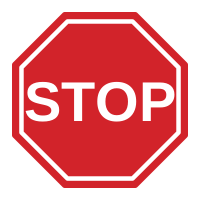
  • Red octagon with a white border and the word STOP in white.Stop completely, and go on only when it’s safe
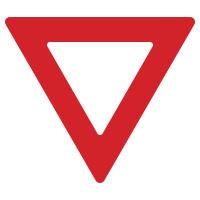
  • Downward-pointing triangle with a wide red border and white centre, no text.Yield: give the right-of-way to other vehicles and to crossing pedestrians
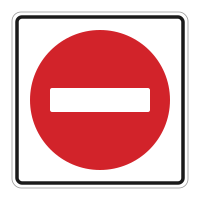
  • White square with a black border holding a red circle crossed by a white horizontal bar.Do not enter
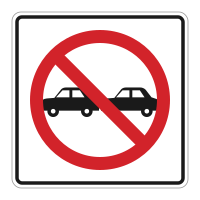
  • White square: two black cars side by side inside a red circle with a red slash.Do not pass
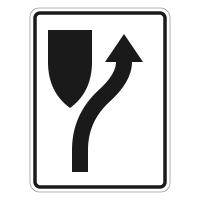
  • White vertical sign with a black island shape on the left and a black arrow curving around it to the right.Keep right of the divider
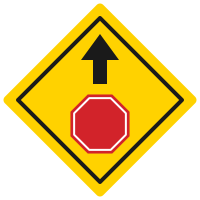
  • Yellow diamond with a black arrow pointing up above a red stop-sign octagon.Stop sign ahead
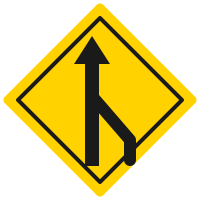
  • Yellow diamond: a black vertical road with a second road joining it diagonally from the right.Merging traffic ahead
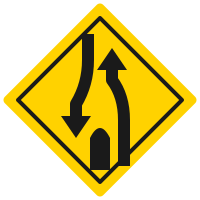
  • Yellow diamond: a black median shape at the bottom, an up arrow on the right and a down arrow on the left above it.Divided highway ends ahead: keep right
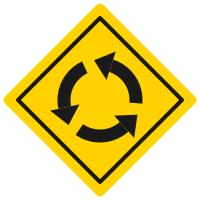
  • Yellow diamond with three black arrows chasing each other counter-clockwise in a circle.Roundabout ahead
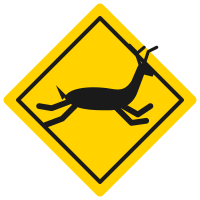
  • Yellow diamond with a black leaping deer.Watch for deer ahead
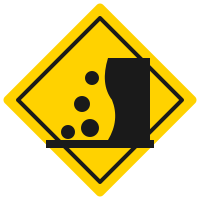
  • Yellow diamond: a black rock face on the right with rocks tumbling down to the road.Beware of falling rocks, and watch for rocks on the road
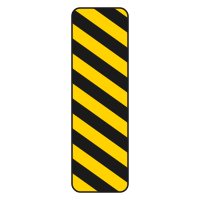
  • Tall narrow yellow board with black diagonal stripes sloping down to the right.Obstruction: keep right

Free practice test

20 practice questions on the Yukon Driver’s Basic Handbook

Get 16 of 20 right to pass here, the same 80% the handbook sets for the real knowledge test. The questions are written from rules in the Yukon Driver’s Basic Handbook, and six of them show a road sign or a traffic light. Each answer comes with a short reason, and the tutor can go through the wrong choices with you.

Question 1 of 20
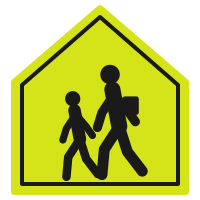
Five-sided fluorescent yellow-green sign with a black border and two black schoolchildren walking.

What does this sign tell you?

20 practice questions we wrote from the Yukon driver’s handbook.

Test day

What to bring to a Motor Vehicles office

  • Valid identification. The handbook says a first licence needs government-issued documents that show your photo, signature, date of birth and full legal name
  • Two documents that prove you live in Yukon
  • Under 18: a parent or legal guardian, who signs your application and shows proof of their own identity and Yukon residency
  • The fees for the knowledge test and for the Class 7 licence
  • Your glasses or contact lenses, if you’re prescribed them

Before you go

  1. Study chapters 1 to 8 of the handbook. The where-to-learn page has a plan for them.
  2. The handbook says the complete list of accepted documents is on yukon.ca. Check yours against it before you go.
Find a Motor Vehicles officePhone numbers for the offices in Yukon communities, from the handbook.

Study options

Where to study

The handbook is free from the Government of Yukon. The where-to-learn page goes through it chapter by chapter, with the books you use later for the road test and a motorcycle.

OptionPriceFree to useLinks
Official sources
Government of Yukon: Yukon Driver’s Basic HandbookOfficial · PDFThe book the Government of Yukon tells you to study for the written test. The handbook says it also helps you prepare for the Class 5 road test.
Free downloadThe whole handbook
Government of Yukon: Tuning Up for DriversOfficial · handbookFor the Class 5 road test. The Government of Yukon’s licence page says to study it once you have your learner’s licence.
Not listedNot listed
Government of Yukon: Learn to Ride SmartOfficial · handbookThe motorcycle handbook for the Class 6 knowledge test. After you pass, you get the Tuning Up for Riders guide book for the road test.
Not listedNot listed

Prices and ratings checked November 2026.

Explore

Everything else, in one place

FAQ

Common questions

Is the Yukon driver’s test the same as the road test?

No. The written knowledge test gets you a Class 7 learner’s licence. The Class 5 road test comes later, after the learner stage, and passing it gets you a novice licence.

Can you take the Yukon learner’s test online?

Not according to the Government of Yukon. Its licence page says to come to a Motor Vehicles office to take the written test.

What happens if you fail?

You can take the test again as early as the following day. You pay the $20 fee again each time you take it.

What do newcomers to Canada need to bring?

The handbook says to bring proof of citizenship, your record of landing, or your passport with your work, study or visitor permit, to show your status in Yukon. You also need the two documents that prove Yukon residency.

Once you pass, can you drive on your own?

Not yet. A co-driver must be with you every time you drive as a learner, and other limits apply, such as on hours and passengers. The driver’s licence page lists them.

All 20 practice questions with answersA printable list of the practice test above
  1. Five-sided fluorescent yellow-green sign with a black border and two black schoolchildren walking.

    What does this sign tell you?

    A school zone: slow down when children are present This sign marks a school zone, where you reduce speed when children are present. Watch for school patrols and crossing supervisors, and obey them at all times.

  2. Two vehicles reach an intersection with no signs or lights at the same time. Who must yield?

    The vehicle on the left yields to the one on the right At an uncontrolled intersection, when two vehicles arrive at the same time, the vehicle on the left must yield to the vehicle on the right. If another vehicle got there before you, slow down and yield to it.

  3. In good conditions, what following distance does the handbook say you need at the very least?

    At least 3 seconds You need at least 3 seconds of following distance. The handbook says to increase it to four seconds in bad weather or on uneven or slippery roads.
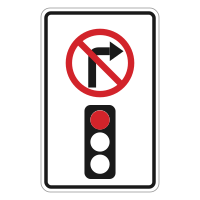
  4. Vertical white sign: a right-turn arrow in a red circle and slash above a traffic-signal symbol with the red light lit.

    You see this sign at an intersection with traffic lights. What does it mean?

    No right turn until the light turns green This sign means no right turn on a red light. Wait for the green light before you turn right, even when the way looks clear.

  5. You’re driving toward a school bus on an undivided highway, and its red lights are flashing. What must you do?

    Stop, even though you’re in the oncoming lane On a street or undivided highway, you must stop in either direction when a school bus shows flashing red lights. Don’t move again until the bus moves on or the driver turns off the lights and pulls in the stop sign.

  6. How high should your head restraint be?

    Its top at least level with the top of your ears Adjust the head restraint so its top is at least level with the top of your ears, and higher is even better. Keep it as close to the back of your head as you can.

  7. What’s the closest you may park to a fire hydrant?

    5 metres away It’s illegal to park within 5 metres of a fire hydrant, measured from the point at the curb beside it. The same 5 metres applies to a crosswalk, an intersection, a stop sign or a traffic light.

  8. What lowers your blood alcohol content (BAC)?

    Time, and only time Only time can sober you up or lower your BAC. Food, coffee, cold showers and exercise don’t speed up how fast your body gets rid of alcohol.
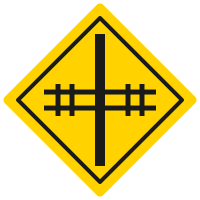
  9. Yellow diamond: a vertical black road crossed by a horizontal railway track with short ties.

    What should you do when you see this sign?

    Look, listen and slow down, ready to stop This sign warns of a railway crossing ahead. Look, listen and slow down, because you may have to stop.

  10. You park facing downhill next to a curb. Which way do you turn your front wheels?

    To the right, toward the curb Facing downhill, with or without a curb, turn your wheels to the right. Then set the parking brake and leave the vehicle in gear, in park for an automatic.

  11. An ambulance with its siren and lights on comes up behind you on a two-lane road. What should you do?

    Pull over to the right side and stop Emergency vehicles with flashing lights and sirens always have the right-of-way. Pull over to the right and stop, and don’t stop in an intersection.

  12. According to the handbook, how can anger or frustration affect your driving?

    It can cloud judgment and slow your reactions Feeling angry or frustrated can cloud your judgment and slow down your reaction time. You need to be alert and able to focus when you drive.
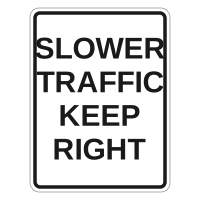
  13. White vertical sign with black words SLOWER TRAFFIC KEEP RIGHT.

    What does this sign tell you?

    Move right if you’re slower than other traffic This sign tells you to move into the right lane if you’re driving slower than regular traffic. That leaves the left lane for passing.
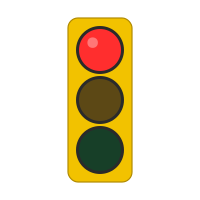
  14. Yellow traffic-signal head with the top red light lit.

    You’ve come to a full stop at this light, and the intersection is clear. Which move is allowed?

    Turning right, unless a sign forbids it At a steady red light, after a full stop and once the intersection is clear of vehicles, cyclists and pedestrians, you may turn right. You may also turn left onto a one-way street, but watch for signs that forbid these turns.

  15. When may a Class 7 learner use a hands-free phone?

    Only while safely and lawfully parked Drivers in the Graduated Driver Licensing (GDL) program may not use electronic devices while driving, even hands-free ones. Any driver who is safely and lawfully parked may use them.

  16. What does the posted speed limit mean?

    The highest speed, for ideal conditions only The posted speed is the maximum for ideal conditions only. If roads are slippery or you can’t see well, choose a slower speed.
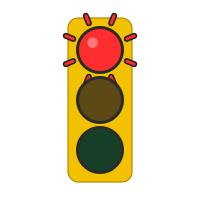
  17. Traffic-signal head with the red light lit and short rays showing it is flashing.

    What does this light tell you to do?

    Stop, then go when it’s safe, as at a stop sign A flashing red light means you come to a complete stop, then go on only when it’s safe. Treat it the same as a stop sign.

  18. A train is coming, and you have to stop at a railway crossing. Where do you stop?

    Between 5 and 15 metres from the nearest rail Stop no closer than 5 metres and no farther than 15 metres from the nearest rail. Trains always have the right-of-way, so wait until it’s safe to cross.

  19. At a four-way stop, you and an oncoming car arrive at about the same time. You want to turn left, and it’s going straight. Who goes first?

    The car going straight goes first When two vehicles facing each other arrive at a four-way stop at about the same time, the one turning left yields to the one going straight through. If you arrive at different times, the first vehicle to stop goes first.

  20. On ice, the back of your car starts to slide to the right. What should you do first?

    Ease off the gas and steer to the right Ease off the accelerator and steer smoothly in the direction you want to go, which here is to the right. Don’t brake, because that makes the skid worse.

Sources: Government of Yukon and 2 more. Checked November 2026.

Rules and fees can change, so check the official site before your test.