Newfoundland and Labrador · Learner’s test

NL permit test for a Class 5 learner’s licence

Your first step to driving in Newfoundland and Labrador (NL) is a written test. Pass it, and a vision test, and you get a Class 5 Level I learner’s licence, which Motor Registration also calls a learner’s permit. You can take the NL permit test online at home, but the vision test and ID check happen in person.

  • 16Minimum age to apply
  • $60Class 5I licence fee, which lasts 2 years
  • 6 monthsHow long a written test pass stays valid

Key facts

At a glance

What it covers
Rules of the road, safe driving practices and road sign recognition
Where
Online on MyGovNL, the province’s online services, or in person at a Motor Registration office
Consent
A parent or guardian signs your application if you’re under 19
Run by
The Motor Registration Division, Department of Government Services

How it works

How the NL permit test works

Written test
85%
To pass you need at least 85%.
  1. The questions are multiple choice. The handbook page explains which parts of the Driver’s Handbook they draw on.
  2. To take it in person, book an appointment at a Motor Registration office first.
  3. If you pass online, you then have an appointment where Motor Registration checks your result, tests your vision, examines your ID documents and takes your photo, and you pay the Class 5I licence fee. The fees policy has no separate line for the written test. If you test in person, it’s all one visit.
  4. At that appointment you get a temporary permit, and your card follows by mail.

Topics

What’s on the test

01

Licensing and Registration

Licence classes, graduated licensing, the written and road tests, and keeping your licence up to date.

Key points (3)
  • Driving with the wrong class of licence is against the law, and so is letting someone drive your vehicle without the right class.
  • Doctors and other medical professionals in the province must report patients whose medical conditions may affect their driving to the Registrar.
  • A lost, stolen or unreadable licence has to be replaced right away, and a stolen one reported to the police.

02

Road Safety

Seatbelts, speed, impaired and distracted driving, fatigue and looking after your vehicle.

Key points (3)
  • Where no limit is posted, it’s 100 km/h on paved parts of the Trans-Canada Highway, 80 km/h on other paved highways, 60 km/h on gravel roads and 50 km/h through communities.
  • Not wearing a seatbelt is illegal. Airbags are meant to work with seatbelts, not replace them.
  • The handbook says talking or texting on a cell phone while driving affects you much like impaired driving, and it brings fines and demerit points.
03

Traffic Signs and Pavement Markings

Sign shapes and colours, regulatory, warning and construction signs, traffic lights and road markings.

Key points (3)
  • Yellow lines separate traffic going opposite ways. White lines separate traffic going the same way.
  • A solid line on your left means it isn’t safe to pass. A broken yellow line on your left means you may pass if the way is clear.
  • At a solid red light you may turn right after a complete stop, yielding to pedestrians and traffic, unless a sign says you can’t.
04

Rules of the Road

Right of way, turns and lanes, parking, following distance and sharing the road.

Key points (4)
  • At a four-way stop, the first vehicle to stop goes first. If two arrive together, the one on the right goes first.
  • For a vehicle with its emergency lights or siren on, signal, pull over to the right edge clear of any intersection and stay stopped until it passes.
  • Traffic both ways stops for a school bus with its lights flashing or stop sign out. On a multi-lane undivided highway, every lane stops.
  • Don’t park within 6 metres of a crosswalk, 10 metres of a stop sign or 15 metres of a railway crossing.
05

Emergencies and Challenging Conditions

Skids, breakdowns, collisions, night driving, bad weather and winter.

Key points (3)
  • Use the three-second rule for following distance in ideal conditions, and leave more room when conditions are worse.
  • If you start to skid, keep your foot off the brake and look and steer where you want the front of the vehicle to go.
  • Dim your high beams within 150 metres of an oncoming vehicle, and within 150 metres when you come up behind one.

Road signs

Road signs from the Driver’s Handbook

A dozen signs to start with, in the handbook’s words. The road signs page sorts more of them by type, with traffic lights and road markings.

  • Red octagon with a white border and the word STOP in white.Stop: a red octagon. Stop at the stop line or crosswalk, and go when the way is clear
  • Downward-pointing triangle with a wide red border and white centre, no text.Yield: slow down, be ready to stop and give the right of way
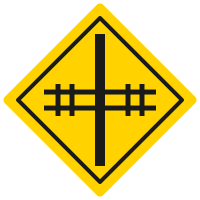
  • Yellow diamond: a vertical black road crossed by a horizontal railway track with short ties.Railway crossing ahead
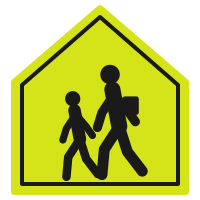
  • Five-sided fluorescent yellow-green sign with a black border and two black schoolchildren walking.School zone: slow down, take extra care and watch for children
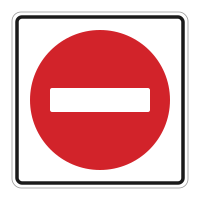
  • White square with a black border holding a red circle crossed by a white horizontal bar.Do not enter this street
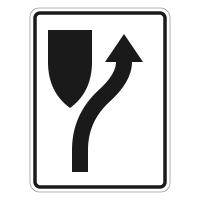
  • White vertical sign with a black island shape on the left and a black arrow curving around it to the right.Keep to the right of the island
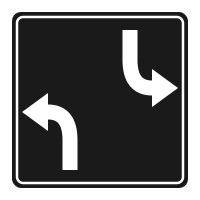
  • Black square with two white curved arrows turning left, one from each direction.The centre lane is a shared left turn lane
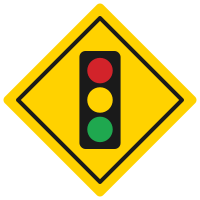
  • Yellow diamond with a black traffic-signal housing showing red, yellow and green lights.Traffic lights ahead
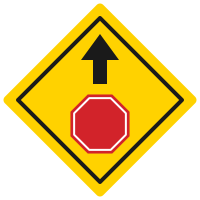
  • Yellow diamond with a black arrow pointing up above a red stop-sign octagon.Stop sign ahead: be prepared to stop
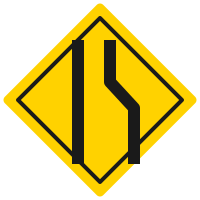
  • Yellow diamond with two black lines: the left one straight, the right one bending in to show the right lane ending.Right lane is ending
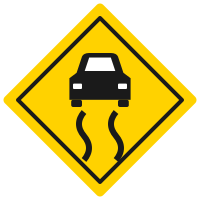
  • Yellow diamond with a black car and two wavy skid marks behind it.Road surface is slippery when wet
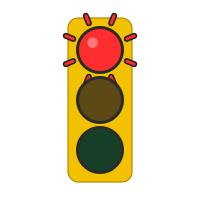
  • Traffic-signal head with the red light lit and short rays showing it is flashing.Flashing red signal: come to a complete stop, and go only when it’s safe

Test day

What to bring to Motor Registration

  • At least 2 ID documents that, between them, show your full legal name, date of birth, legal presence in Canada and a photo. Bring originals or certified copies, not photocopies
  • Proof of your address with your full name on it, such as a utility bill no older than 2 months, a bank statement or a signed lease
  • Your parent or legal guardian, if you’re under 19. A guardian shows proof of guardianship
  • A way to pay: Visa, Mastercard, debit or cash at the counter, or a cheque or money order

Before you go

  1. Work through the Driver’s Handbook. The handbook page shows what each chapter covers.
  2. If you need help reading or writing during the test, contact the office ahead of time and book an appointment.
  3. Check your documents against Motor Registration’s ID page, which lists the documents it accepts and what each one proves.
Motor Registration: Book an appointmentBook here to take the test in person, or for the vision test and ID check after you pass online. Road tests are booked the same way.

Study options

Where to study

Motor Registration’s study material is the Driver’s Handbook, a free PDF. The study page lists the driving schools it has approved and where a course fits around the test.

OptionPriceFree to useLinks
Official sources
Government of Newfoundland and Labrador: Driver’s HandbookOfficial · PDFFree to download from Motor Registration. It was called the Road User Guide, and you’ll see that name on some pages.
Free downloadThe whole handbook
Government of Newfoundland and Labrador: MyGovNLOfficial · online servicesWhere the Class 5 written test runs online. The same account pays for road tests and requests your driver record.
Not listed on the pageNot stated
In person
Approved driving schools (Motor Registration list)Lessons and driver education programsSchools approved to deliver the Graduated Driver Licensing Program, with a phone number and the areas each one serves. An approved course shortens the wait before your road test.
Set by each schoolNot stated

Prices and ratings checked November 2026.

FAQ

Common questions

Can you take the NL permit test online?

Yes. The Class 5 written test is on MyGovNL, in English. You register with the photo ID card Motor Registration issues, or with your email and Medical Care Plan card if you don’t have one.

Can you take the test in French or another language?

French and Ukrainian, yes, at any Motor Registration office. Book an appointment online first. The Driver’s Handbook adds that written tests can be given in other languages through an interpreter the Registrar approves, and you pay any interpreter costs.

Is a learner’s permit the same as a Class 5I licence?

Yes. Motor Registration’s pages and the handbook use all of these names for it: learner’s permit, learner’s licence, Class 5 Level I and Class 5I. It’s Level I of the Graduated Driver Licensing Program.

Is the NL permit test the same as the driving test?

No. The permit test is the written test that gets you a learner’s licence. The road test, a drive with an examiner, comes after your time as a learner, and passing it moves you up to Class 5 Level II.

Can you drive right after you pass?

Not until your appointment is done. From then on you drive under the Class 5I rules, which start with having an accompanying driver beside you. The driver’s licence page sets out the rest.

Sources: Government of Newfoundland and Labrador and 8 more. Checked November 2026.

Rules and fees can change, so check the official site before your test.