Your first licence in the Northwest Territories (NWT) is a Class 7 learner’s licence. To get it, you pass a vision screening and a written knowledge test. The learner’s test in NWT is really two tests, one on the rules of the road and one on road signs, and both come from the NWT Driver’s Manual.
Updated November 2026 · Written from the NWT Driver’s Manual
Key facts
At a glance
Questions
20 multiple-choice questions in each test, 40 in all
Where
In person, at a driver and vehicle office
Study book
The NWT Driver’s Manual, free as a PDF
Run by
Driver and Vehicle Services, Department of Infrastructure, Government of the Northwest Territories
How it works
How the learner’s test in NWT works
Road rules test · 16 to pass
Road signs test · 16 to pass
To pass you need 16 of 20 on the road rules test, and 16 of 20 on the road signs test.
Start by applying, with the application form and your documents. Then book the written test and pay for it before your test day.
A driver examiner also screens your vision. The Driver’s Manual says that if you don’t meet the standard, you’re asked for a Northwest Territories Report of Visual Functions from a vision specialist.
If you fail either part, you book and pay for another test. Pass both, and the vision screening, and you hold a Class 7 learner’s licence. The licence has its own fee, separate from the test; the driver’s licence page lists it.
Topics
What’s on the test
01
Information about Driver’s Licences
Graduated licensing, licence classes, applying, vision and medical rules, and the written and practical examinations.
Key points (4)
Learning to drive without a driver’s licence isn’t permitted.
Conditions such as corrective lenses or daylight driving only can be placed on a licence. The back of the card explains the condition codes.
Driving with the wrong class of licence is against the law, and so is letting someone use your vehicle without the right class.
All motor vehicles must be insured with public liability insurance of at least $200,000.
02
Traffic Controls
Sign shapes and colours, regulatory, warning, guide and construction signs, school and playground zones, signals and pavement markings.
Key points (4)
Unless a sign says otherwise, the limit is 90 km/h on a primary highway outside a settlement or municipality, and 50 km/h inside one.
School and playground zones are generally 30 km/h. Unless times are posted, the limit applies 24 hours a day, 7 days a week.
At a steady red light you may turn right after a full stop, unless a sign prohibits it.
Directions from a police officer overrule traffic signs and signals.
03
Starting Your Vehicle
Starting, steering, accelerating, stopping and braking, reversing, and parallel, angle and hill parking.
Key points (3)
Don’t park within 3 metres of a fire hydrant, within 5 metres in front of a stop sign, yield sign or traffic light at the side of the road, or within 6 metres of the near side of a marked crosswalk.
Facing downhill, turn your front wheels to the right. Facing uphill with a curb, turn them to the left and let the right front tire touch the curb.
On a hill, always set the park brake and put the vehicle in park, or in low gear with a manual transmission.
04
Intersections and Turns
Stop and yield signs, right of way, traffic circles, controlled and uncontrolled intersections, signals, turns and U-turns.
Key points (4)
At a four-way stop, the vehicle that arrived first goes first. If two arrive together, the vehicle on the right goes first.
At an intersection with no signs or signals, yield the right of way to the vehicle on your right.
With no stop line or crosswalk, stop within 3 metres of the intersecting road.
In urban areas, U-turns aren’t allowed between intersections, where a sign prohibits them, or at an intersection with traffic lights.
05
Lane Driving
Lane position, shoulders, blind spots, passing, merging, exiting, weave zones, curves and hills.
Key points (3)
Use your mirrors, but shoulder check to make sure your blind spots are clear.
Don’t pass vehicles or cut corners on curves, and don’t pass near the top of a hill until you can see what’s ahead.
You must not pass a vehicle that has stopped for a pedestrian at a marked or unmarked crosswalk.
06
Handling Emergency Situations
Breakdowns, brake, steering, tire and headlight failure, skids, night and poor weather driving, animals and collisions.
Key points (4)
If you start to skid, keep your foot off the brake and steer in the direction you want the front of the vehicle to go.
Turn your headlights on at night, or whenever you can’t clearly see 150 metres ahead.
Switch to low beams within 150 metres behind a vehicle you’re following, and within 300 metres of an oncoming vehicle.
Report a collision to the police right away if the damage is over $2,000, or if any traffic control device or public property is damaged.
07
The Responsible Driver
Defensive driving, following distance, fatigue, cellphones, child restraints, fuel efficiency and traffic laws.
Key points (3)
Keep at least a two-second following distance in normal conditions, and more when weather or roads are poor.
The driver must make sure every passenger under 15 is properly restrained.
A child under 6 who weighs 18 kg (40 lb) or less must ride in a child safety seat.
08
Sharing the Road
Pedestrians, cyclists, motorcycles, off-highway and large vehicles, school buses, emergency vehicles, snowplows and railway crossings.
Key points (3)
When a school bus stops with its alternating red lights flashing, you stop before you reach it, in any lane, unless you’re coming toward it on a highway divided by a median.
For an emergency vehicle with its siren and lights on, move clear of any intersection, pull over to the right edge and stop until it passes.
Don’t follow within 150 metres of an emergency vehicle with its siren or lights on.
09
Driving Within the Law
Impaired driving and the ignition interlock program, distracted driving, suspensions, reinstatement and demerit points.
Key points (3)
If you’re caught driving while suspended, the vehicle is seized and impounded for 30 days, whether you own it or not.
A driver charged with a breath or blood sample over .08, or who refuses to give one, gets an automatic 90-day suspension.
Using a restricted electronic device while driving, such as holding a phone, brings 3 demerit points.
10
Towing a Trailer
Towing safely, trailer lights, chains and brakes, backing and turning with a trailer.
Key points (2)
A trailer needs working tail lights, brake lights and turn signals that work from the towing vehicle.
Trailers with a gross vehicle weight rating of 1,360 kg or more, or 50% or more of the towing unit’s weight, must have brakes.
Road signs
Road signs from the Driver’s Manual
Twelve of the signs in the manual’s Traffic Controls chapter, with what each one means. The chapter has more, from lane signs to construction signs.
Stop: come to a complete stop, and don’t go until it’s safe
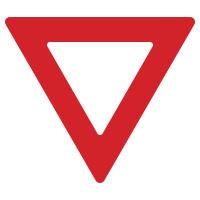
Yield: give the right of way to traffic not facing the sign and to pedestrians in the crosswalk
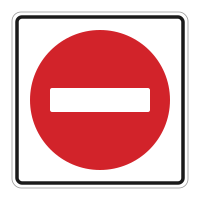
Do not enter
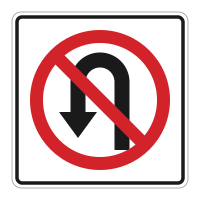
No U-turn
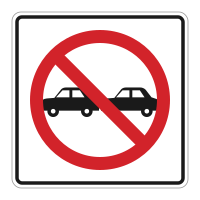
Do not pass
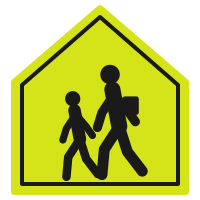
School area: a school is near, so drive with extra caution
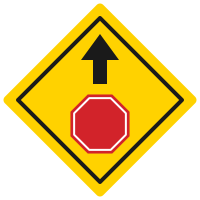
Stop sign ahead
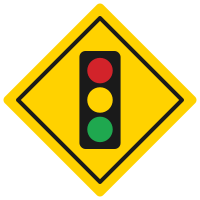
Traffic control signals ahead
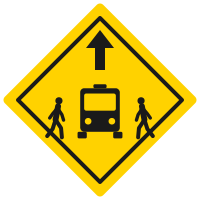
School bus stop ahead
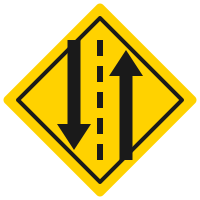
Two-way traffic ahead
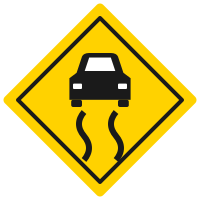
Slippery when wet
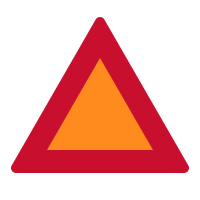
Slow-moving vehicle, built for speeds under 40 km/h: reduce your speed
Test day
What to bring to a driver and vehicle office
The Driver’s Licence or General Identification Card Application form, filled in. Offices have copies
A document that shows your legal name and date of birth, such as a birth certificate or passport
Photo ID
Proof that you live in the Northwest Territories, such as a utility bill or a residential lease
Your glasses or contact lenses, if you wear them to drive
Before you go
Check your documents against the list of acceptable documents. Each one has to be valid, in good condition, and an original or a certified copy.
Work through the Driver’s Manual, signs chapter included.
Three official options, all from Driver and Vehicle Services. The where-to-learn page goes through the manual chapter by chapter, with a study plan for both tests.
Option
Price
Free to use
Links
Official sources
Government of the Northwest Territories: Driver’s ManualOfficial · PDFThe study book for the Class 7 test, for cars and light trucks. Printed copies are sold at driver and vehicle offices.
Government of the Northwest Territories: Motorcycle Operator’s Licence InformationOfficial · PDFA supplement to the Driver’s Manual, for learning to ride a motorcycle, moped or power bicycle.
Driver and Vehicle Services flash cardsOfficial · printed cardsSold at driver and vehicle offices. Driver and Vehicle Services lists them beside its manuals.
No. Driver and Vehicle Services lists getting a first licence as available in person only. What you can do online is book the test, pay for it and cancel or rebook it.
Do you have to live in the NWT to get a learner’s licence?
Yes. The Driver’s Manual says an NWT licence may only be issued to residents of the territory. People with a student or work visa can apply as residents, but only for the time their visa covers.
Do you pay separately for the signs test?
No. Driver and Vehicle Services lists one fee for the Class 6 or 7 written examination, and it includes the signs test. Seniors aged 60 and over pay $17 for any written examination.
Is a learner’s permit the same as a Class 7 licence?
Yes. Driver and Vehicle Services calls it a learner’s licence, or Class 7, and its page for foreign nationals calls it a learner’s permit. It’s Stage 1 of the Graduated Licence Program.
Can you drive alone once you pass?
No. A Class 7 learner must drive with a supervisor, and other limits apply. The driver’s licence page sets them out.
Sources: Government of the Northwest Territories and 7 more. Checked November 2026.
 Northwest Territories · Learner’s test