Illinois · Written exam

The Illinois permit test: the written exam and vision screening

Before you can practice behind the wheel, you pass a vision screening and a written exam on the Rules of the Road. The Illinois Secretary of State (SOS) gives the Illinois permit test at its facilities, and the questions cover signs, signals, pavement markings and traffic laws.

  • 3Tries at each exam within a year
  • 20/40Vision needed, glasses allowed
  • 30 daysWait to retest if caught cheating

Key facts

At a glance

Who runs it

The Illinois Secretary of State (SOS), through its Driver Services facilities

What it covers

Signs by shape, color or symbol, signals and pavement markings, then multiple-choice and true-or-false questions on traffic laws, safety rules, crash prevention and vehicle equipment

Book to study

The Illinois Rules of the Road, the SOS handbook for the written exam

What it leads to

An instruction permit, which lets you practice with a qualified adult beside you

How it works

How the Illinois permit test works

  1. The exams happen when you apply, at a Secretary of State facility. Every permit, first-time or renewed, needs a vision screening and a written test.
  2. For the vision screening you need at least 20/40, with or without glasses or contacts, and at least 140 degrees of side vision. Between 20/41 and 20/70, you’re limited to daylight driving.
  3. Instead of the screening, you can bring a Vision Specialist Report from a licensed optometrist, ophthalmologist or physician, dated within six months of your visit. If you wear glasses or contacts, your license will say you must wear them to drive.
  4. You get three attempts at each exam within one year from the date you paid your application fee. Pass the written exam for a permit, and the result counts until the permit expires.
  5. Staff will warn you if you do something that looks suspicious, such as checking a phone or having an open book in view. Anyone found cheating fails and can’t retake the exam for 30 days.
  6. Taking any part of the exam for someone else is a crime, punished by a fine and at least seven days in jail.

Topics

What the Rules of the Road covers

The handbook’s 13 chapters, in eight groups, with some of the rules each one teaches. Page numbers are the handbook’s.

01

Your license, permit and the exams

Who needs an Illinois license, the instruction permit, the Graduated Driver Licensing (GDL) phases and the vision, written and driving exams.

Key points (4)
  • You must be at least 16 to get an Illinois driver’s license (p. 4).
  • From 15 until 17 and 3 months, an instruction permit needs proof that you’re enrolled in an approved driver education course, or will start one within 30 days (p. 16).
  • Under 18, you hold the permit for at least nine months and log 50 hours of supervised driving, 10 of them at night (p. 16, 18).
  • Tell the Secretary of State about a change of address within 10 days of a move (p. 6).
02

Traffic laws and right of way

Traffic stops, distracted driving, safety belts and child seats, speed limits, work zones, emergency vehicles and who goes first.

Key points (4)
  • Unless a sign says otherwise, the limit is 30 mph in a city or town and 15 mph in an alley (p. 24).
  • In a school zone, slow to 20 mph on school days from 6:30 a.m. to 4 p.m. when children are present and signs are posted (p. 24).
  • At a four-way stop, the first driver to stop goes first; if two arrive together, the one on the left yields to the one on the right (p. 26).
  • Everyone 8 and older wears a safety belt in the front and back seats, and children under 8 ride in a child safety restraint (p. 23).
03

Passing, turns, special stops and parking

Passing and lane use, signals, turns, roundabouts, school buses, railroad crossings, and where you may and may not park.

Key points (4)
  • Signal at least 100 feet before a turn in a business or residential area, and 200 feet elsewhere (p. 30).
  • Enter a roundabout by turning right, and use your right turn signal to show you’re leaving it (p. 32).
  • If your car stalls on railroad tracks, everyone gets out, calls 911 and moves away at a 45-degree angle in the direction of the train (p. 33).
  • Don’t park or stand within 15 feet of a fire hydrant or within 30 feet of a stop sign, yield sign or traffic signal (p. 35-36).
04

Sharing the road

Pedestrians, children, motorcycles, bicycles and e-bikes, scooters and mopeds, large vehicles, slow-moving vehicles and horseback riders.

Key points (4)
  • Pass a bicyclist slowly, leaving at least 3 feet from the edge of your side mirror (p. 43).
  • A motorcyclist is entitled to the whole lane, so don’t share it (p. 41).
  • Slow-moving vehicles normally travel at 5 to 20 mph (p. 46).
  • Never sound your horn near a horse, as the noise may frighten it (p. 47).
05

Driving under the influence

Blood-alcohol concentration (BAC), cannabis and other drugs, implied consent, suspensions and the rules for drivers under 21.

Key points (4)
  • Driving with a BAC of .08% or more is illegal, and you can be convicted of driving under the influence (DUI) below that if your driving is impaired (p. 48).
  • Time is the only way to remove the effects of alcohol; food, coffee and showers don’t speed it up (p. 48).
  • Cannabis may only be carried in a vehicle in a sealed, odor-proof, child-resistant container (p. 48).
  • A first DUI conviction means at least a one-year revocation, or at least two years if you’re under 21 (p. 50, 52).
06

Crashes, violations and losing your license

What to do at a crash, reports, insurance and financial responsibility, and suspension, revocation, cancellation and denial.

Key points (4)
  • A driver must file a crash report when a crash involves death, bodily injury or more than $1,500 of property damage (p. 54).
  • If you damage an unattended vehicle and can’t find the owner, leave your name, address, phone number and plate number on it, and notify police (p. 55).
  • Three traffic violation convictions in 12 months can suspend your license, or two in 24 months if you’re under 21 (p. 60).
  • Illinois requires liability insurance of at least $25,000 per person, $50,000 per crash and $20,000 for property (p. 98).
07

Signs, signals and pavement markings

Sign shapes and colors, regulatory, warning, work zone and guide signs, traffic lights and arrows, and the lines on the road.

Key points (4)
  • A five-sided sign means a school zone or school crossing (p. 64).
  • A pennant-shaped yellow sign marks the start of a no passing zone, on the left side of the road (p. 64).
  • When traffic signals aren’t working, treat the intersection as an all-way stop (p. 77).
  • Crossing a double solid white line is prohibited (p. 79).
08

Safe driving, emergencies and equipment

Following distance, speed, drowsy driving, weather, expressways, night driving, emergencies and the equipment your car must have.

Key points (4)
  • Use the three-second rule on a good road in good weather, and leave more room when conditions aren’t good (p. 83).
  • If your brake pedal sinks to the floor, pump it; if that fails, use the parking brake and shift to a lower gear (p. 89).
  • If power lines fall on your car after a crash, stay inside until help arrives, unless fire forces you to jump clear (p. 88).
  • Your car needs two brake systems, two headlights, two red taillights and a horn that can be heard from 200 feet (p. 92).

Road signs

Road signs in the Rules of the Road

The handbook tells signs apart by shape and color: red signs are regulatory, yellow and yellow-green ones warn, orange ones mark work zones, and green and blue ones guide you. Here are 12 of them.

  • Red octagon with white border and the word STOP in whiteStop: a full stop at the line, crosswalk or intersection
  • Downward-pointing red triangle with white center and the word YIELD in redYield: let traffic and pedestrians go first
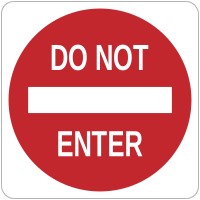
  • Red circle with a white horizontal bar on a white square, reading DO NOT ENTERDo not enter
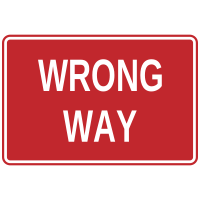
  • Red rectangle with white border reading WRONG WAYWrong way
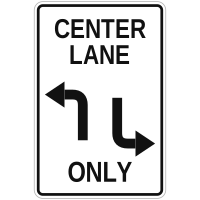
  • White sign reading CENTER LANE above two opposing left-turn arrows and the word ONLYTwo-way left turn lane in the center
  • Yellow pennant pointing right reading NO PASSING ZONENo passing zone begins
  • Fluorescent yellow-green pentagon with two children walkingSchool zone or school crossing
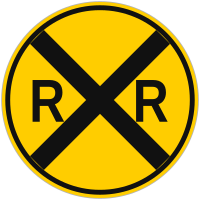
  • Round yellow sign with a black X and two letters RRailroad crossing ahead
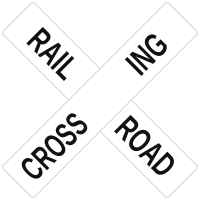
  • White X-shaped crossbuck reading RAILROAD CROSSINGCrossbuck: treat it as a yield sign
  • Orange diamond with a black flagger symbol holding a flagFlagger ahead: obey the flagger’s signals
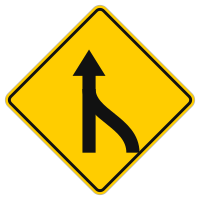
  • Yellow diamond with an upward arrow for the main road and a second road merging into it from the rightMerging traffic
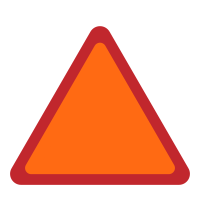
  • Fluorescent orange triangle with a red reflective borderSlow-moving vehicle

Free practice test

20 practice questions on the Rules of the Road

These 20 questions are ours, written from rules in the Illinois Rules of the Road, and five of them are about signs and road markings. The handbook doesn’t publish a pass mark, so 15 of 20 is our own target here. Pick an answer to see why it’s right, and ask the tutor for another explanation if it doesn’t click.

Question 1 of 20

You’re 15 with an instruction permit, practicing outside driver education. Who may sit beside you?

20 practice questions we wrote from the Illinois Rules of the Road.

Test day

What to bring when you apply

  • From 15 until 17 and 3 months: the proof of driver education enrollment the instruction permit page describes
  • Documents from the handbook’s Acceptable Identification Documents chart that prove your date of birth, Social Security number, residency and signature (originals: photocopies aren’t accepted)
  • For a REAL ID, proof of identity and lawful status too, plus a second residency document; the state ID page explains the difference
  • A valid mailing address, which you must give when you apply
  • The instruction permit fee (the driver’s license page lists every fee)

Before you go

  1. Read the Rules of the Road, then try the study questions at the end of its chapters.
  2. Leave your phone and notes out of sight during the exam.
  3. Need help with language, reading or hearing? Read the oral exam and interpreter answer first.
Read the permit stepsThe Rules of the Road doesn’t describe an appointment system for the written exam. You apply at a Secretary of State facility, and the instruction permit page lists what you need.

Study options

Where to study

The Rules of the Road is the book for the written exam. Under 18, you also take driver education, and the driver’s ed page explains the courses for each age.

OptionPriceFree to useLinks
Official sources
Illinois Rules of the Road 2026Official · PDFThe Secretary of State’s handbook for the written exam, in 13 chapters from your license to owning a car.
Free downloadThe whole handbook, with 86 study questions and their answers
In person
High school driver educationIn person · high schoolsAt least 30 hours in class and six behind the wheel. A combined A or B may exempt you from the SOS driving exam where the school district takes part.
Set by each schoolNot listed
Commercial driver training schoolsIn person · schools licensed by the SOSSchools licensed by the Secretary of State teach the teen course. For first-time drivers 21 and older, the handbook suggests a driving school for adults.
Set by each schoolNot listed
Adult Driver Education CourseIn person or online · SOS certified providersThe six-hour course first-time drivers aged 18 to 20 need. Only SOS certified providers count, and some teach it online.
Set by each providerNot listed

Prices and ratings checked November 2026.

FAQ

Common questions

How many questions are on the Illinois permit test?

The Rules of the Road doesn’t say, and it doesn’t give a passing score either. It describes what the exam asks: identifying signs, signals and pavement markings, and answering questions on traffic laws and safe driving.

Is the Illinois permit test multiple choice?

Partly. Some questions are multiple choice and some are true or false, and part of the exam asks you to name signs from their shape, color or symbol.

Can I take the Illinois permit test online?

The handbook doesn’t describe an online written exam. It lists the services you can do online, such as some renewals, duplicates and driving records, and the exams aren’t among them.

Can I take the written exam orally or with an interpreter?

Yes. You can ask for an oral exam in person at any Secretary of State driver’s license facility, Monday through Thursday, if you have a language barrier or a reading or learning disability. If you’re deaf or hard of hearing, request an interpreter before your visit by calling 312-814-5683 or 888-261-5238 (TTY).

Do I have to take the written exam again when I renew?

Every driver takes it every eight years, unless they have no traffic convictions. A crash or moving violation on your record may also mean taking the written or driving exam again.

All 20 practice questions with answersA printable list of the practice test above
  1. You’re 15 with an instruction permit, practicing outside driver education. Who may sit beside you?

    A licensed adult 21 or older with a year of driving Outside the behind-the-wheel part of driver education, a permit holder drives with a parent, legal guardian or responsible adult who is 21 or older, has a valid license and has at least one year of driving experience. That person sits in the front passenger seat beside you.

  2. You’re in the permit phase of the Graduated Driver Licensing (GDL) program. On a Saturday night, when does the driving restriction begin?

    11 p.m. In the permit phase, you may not drive from 10 at night to 6 in the morning, Sunday through Thursday. On Friday and Saturday the restriction runs from 11 at night to 6 in the morning, and local curfews may differ.

  3. No speed limit sign is posted. What is the limit in an alley?

    15 mph The handbook lists the limits that apply unless a sign says otherwise, and for alleys the limit is 15 mph. Cities and towns are 30 mph, and local governments may post different limits.

  4. Two cars on different roads reach a four-way stop at the same time. Which one goes first?

    The car on the right At a four-way stop, the first driver to stop is the first to go. When two vehicles on different roads arrive at the same time, the vehicle on the left yields to the vehicle on the right.

  5. You park facing downhill on a street with a curb. Which way should your front wheels point?

    Toward the curb Parked facing downhill on a street with a curb, turn the front wheels toward the curb so the car will roll toward it. Put the gear selector in park and set the parking brake if necessary.

  6. How close to a fire hydrant may you stand or park a vehicle?

    No closer than 15 feet Standing or parking a vehicle, whether occupied or not, is prohibited within 15 feet of a fire hydrant. The same list bans it in front of a driveway and within 30 feet of a stop sign, yield sign or traffic signal.

  7. You’re about to leave a roundabout at your exit. What should you do?

    Use your right turn signal The handbook says to use your vehicle’s right turn signal to let other drivers know you are exiting the roundabout. Before you change lanes or take an exit, check for vehicles that may be going on around.

  8. Your car stalls on railroad tracks and won’t restart. After everyone gets out and calls 911, which way should you move?

    Off at an angle, toward the train If your vehicle stalls on the tracks, everyone should get out at once, call 911 and move away from the tracks at a 45-degree angle in the direction of the train. That keeps everyone clear of the debris thrown forward if the train hits the car.

  9. You’re passing a bicyclist on a two-lane road. How much space must you leave?

    At least 3 feet from your mirror When passing a bicyclist, do it slowly and leave at least 3 feet of passing space from the edge of your vehicle’s side mirror. If there isn’t 3 feet, wait to pass until you can do it safely.

  10. You’re about to pass a horseback rider on a country road. What should you avoid doing?

    Sounding your horn Never sound a horn near a horse or other livestock, as the sound may frighten it and cause a crash. Meet or pass a horseback rider with caution and be prepared to stop.

  11. You’ve been drinking. What will remove the effects of the alcohol from your body?

    Only time Time is the only way to remove the effects of alcohol. Food, coffee and showers don’t speed up the elimination of alcohol from your body.

  12. You’re 21 and carrying cannabis in your car. How must it be carried?

    Sealed, odor-proof and child-resistant Cannabis may only be transported in a vehicle in a sealed, odor-proof and child-resistant container. No driver or passenger may use cannabis in a motor vehicle.

  13. You back into a parked car with no one in it, and you can’t find the owner. What must you do?

    Leave your details, tell police If you damage an unattended vehicle, stop away from traffic and leave your name, address, phone number and license plate number on the vehicle if the owner can’t be found. Then notify police and complete all required crash reports.
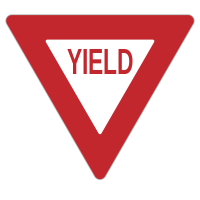
  14. Downward-pointing red triangle with white center and the word YIELD in red

    What does this sign tell you to do?

    Let traffic and pedestrians go first This three-sided sign means yield the right of way. Slow down to a safe speed, stop if necessary, and let all traffic and pedestrians go before you proceed.
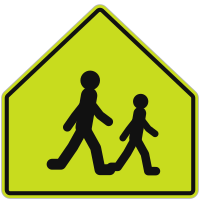
  15. Fluorescent yellow-green pentagon with two children walking

    You see this sign ahead on a city street. What does it tell you?

    There’s a school nearby A five-sided sign means a school zone or school crossing. With two children walking, it tells you a school is nearby; with a downward-pointing arrow added, you are at the school crossing itself.
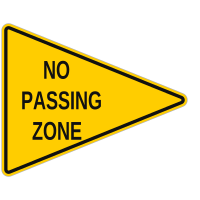
  16. Yellow pennant pointing right reading NO PASSING ZONE

    You see this sign on the left side of a two-lane road. What does it mean?

    A no passing zone begins here This three-sided yellow sign marks a no passing zone. It appears on the left side of a two-lane, two-way road at the beginning of the area where no passing pavement markings are also used.
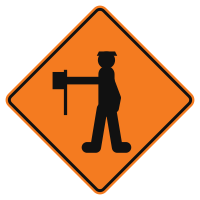
  17. Orange diamond with a black flagger symbol holding a flag

    You pass this sign in a road work area. What should you do?

    Slow down and follow the flagger This sign warns that there is a flagger ahead, working close to traffic. Slow down and be prepared to obey the flagger’s signals, and you must stop if signaled to do so.
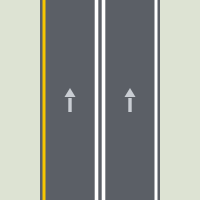
  18. Two same-direction lanes separated by double solid white lines; crossing prohibited

    This marking separates two lanes going the same way. May you cross it?

    No, crossing it is prohibited White lines separate lanes of traffic moving in the same direction. Broken white lines may be crossed to change lanes or turn, a solid white line calls for special care, and crossing a double solid white line is prohibited.

  19. Your brake pedal suddenly sinks to the floor. What should you try first?

    Pump the pedal to build pressure If the brake pedal suddenly sinks to the floor, pump it to build pressure. If that doesn’t work, use the emergency or parking brake, and shift to a lower gear to slow down.

  20. After a crash, power lines have fallen onto your car. There is no fire. What should you and your passengers do?

    Stay in the car until help arrives If power lines fall on your vehicle in a crash, there is a danger of electrical shock, so you and your passengers should stay in the vehicle until help arrives. Only if fire is an immediate danger do you jump clear, without touching the car and the ground at the same time.

Sources: Illinois Secretary of State. Checked November 2026.

Rules and fees can change, so check the official site before your test.