Missouri · Permit test

Missouri permit test

You need 20 right out of 25 multiple-choice questions to pass the Missouri permit test, and every question comes from the Missouri Driver Guide. The Missouri State Highway Patrol gives it free at its driver examination stations, along with a vision test and a road sign test, from age 15. What people call the Missouri DMV is really two agencies: the Highway Patrol tests you, and a Department of Revenue license office sells you the permit for $10. Try the 20 free practice questions on this page first.

  • 25Multiple-choice questions on the written test
  • 20Right answers you need to pass (80%)
  • 15Minimum age for an instruction permit
  • $0Test fee at the Highway Patrol. The permit itself is $10

Key facts

At a glance

Who gives it
The Missouri State Highway Patrol, at its driver examination stations. The permit comes from a Department of Revenue license office
To pass
80%, which is 20 of 25. You can try twice a day if you fail
Cost
The test is free. The permit is $10 at a license office, as of October 2026
Languages
20, including Spanish, French, Chinese, Vietnamese and an American Sign Language video

How it works

How the Missouri permit test works at the Highway Patrol

  1. The Missouri State Highway Patrol gives the test at its driver examination stations, not at license offices.
  2. To get a permit, you pass three parts of the four-part exam: a vision test, a road sign test and the written test. The driving test comes later.
  3. The written test is 25 multiple-choice questions on the Missouri Driver Guide, and you need 20 right. It isn't open book.
  4. Most stations take walk-ins. Getting there before closing time doesn't guarantee you'll be tested that day.
  5. You can take the test on a touch screen or tablet, on paper, as an oral test on the computer, or read aloud by an examiner.
  6. The Class F test comes in 20 languages, including Spanish, French, Chinese, Vietnamese and an American Sign Language video version.
  7. If you fail, you can take the written test up to two times a day, statewide.

Topics

What’s on the test

01

Signs, signals and pavement markings

Chapter 7 of the Missouri Driver Guide covers sign colors and shapes, traffic lights, left-turn arrows and lane lines. The road sign test is a separate part of the exam, so learn these well.

Key points (4)
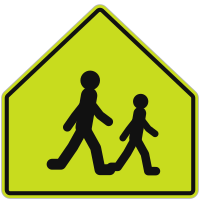
  • Yellow-green signs are for schools, and orange is for work zones. Speeding or passing in a Missouri work zone carries a minimum $250 fine for a first offense.
  • A flashing red light means the same as a stop sign. A signal that's dark works as a four-way stop.
  • The crossbuck means yield to trains. Flashing red lights or a lowered gate mean stop 15 to 50 feet from the tracks.
  • Yellow lines separate traffic going opposite ways. White lines separate traffic going the same way.
02

Instruction permits and Missouri's graduated license

Chapter 1 explains the three steps for drivers under 18: the instruction permit at 15, the intermediate license at 16 and the full license at 18.

Key points (4)
  • Under 16, a permit driver needs a parent, stepparent, grandparent, legal guardian, qualified instructor or an approved driver 25 or older in the front seat. From 16, any licensed driver 21 or older can supervise.
  • You need the permit for at least 182 days and 40 hours of practice, 10 of them at night, before an intermediate license.
  • With an intermediate license, you can't drive alone from 1 a.m. to 5 a.m. except for school activities, work or emergencies.
  • For the first six months, you can carry only one passenger under 19 who isn't immediate family. After that, three.
03

Right-of-way, school buses and emergency vehicles

Chapter 3 sets out who must yield at intersections, four-way stops and roundabouts, and when you must stop for a school bus.

Key points (4)
  • At an intersection with no signs or signals, yield to vehicles coming from the right. Roundabouts are the exception: yield to traffic already in the circle.
  • Traffic in both directions stops for a school bus on a two-lane road. On four or more lanes, oncoming traffic doesn't have to stop.
  • For a siren and flashing lights, pull to the right and stop. If you're in an intersection, clear it first.
  • You must always yield to a person who is blind, guided by a dog or carrying a white cane.
04

Speed, following distance, headlights and railroad crossings

Chapters 6 to 9 cover speed limits, the three-second rule, night driving and how to handle rain, ice and fog.

Key points (4)
  • The speed limit in a city, town or village is 25 mph unless posted. You may not drive slower than 40 mph on an interstate in normal conditions.
  • Keep at least three seconds behind the car ahead, and about eight to ten seconds on snow or ice.
  • Headlights go on from half an hour after sunset to half an hour before sunrise, and whenever you need your wipers.
  • Dim your high beams within 500 feet of an oncoming car and within 300 feet of a car you're following.
05

Alcohol, phones and the point system

Chapters 10, 11 and 16 cover blood alcohol limits, the Abuse and Lose law, points on your record and Missouri's hands-free phone law.

Key points (4)
  • It's illegal to drive at 0.08% BAC or more, 0.04% in a commercial vehicle and 0.02% if you're under 21.
  • 8 or more points in 18 months suspends your license. 12 points in 12 months revokes it for a year.
  • You can't hold a phone, type or read texts, or watch or record video while the vehicle is moving. Hands-free calls and GPS are allowed.
  • Refusing a chemical test for alcohol takes your license away for one year.
06

Signaling, turns, lanes and parking

Chapters 3 and 5 cover how to signal and turn, which lane to use, and where you can't park.

Key points (4)
  • Signal at least 100 feet before you turn.
  • You may not travel more than 500 feet in a two-way left-turn lane.
  • Don't park in an intersection, on a crosswalk or sidewalk, on a bridge, by a yellow curb, blocking a fire hydrant or facing against traffic.
  • When you park on a hill, turn your wheels sharply toward the side of the road and set the parking brake.

Road signs

Signs, signals and lines from Chapter 7 of the Driver Guide

Chapter 7 of the Missouri Driver Guide covers the signs, lights and lines you're tested on. The road sign test is a separate part of the exam, and you take it again every time you renew, so it's worth learning these properly.

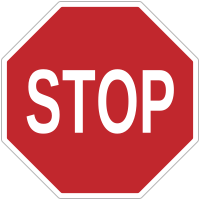
  • Red octagon with white border and the word STOP in whiteStop: a full stop at the line, crosswalk or intersection edge
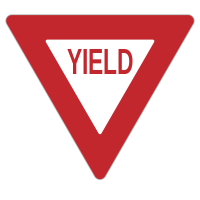
  • Downward-pointing red triangle with white center and the word YIELD in redYield: slow down and give way
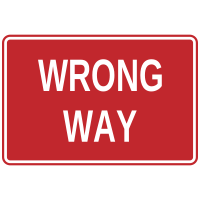
  • Red rectangle with white border reading WRONG WAYWrong way: pull off, turn around and go back
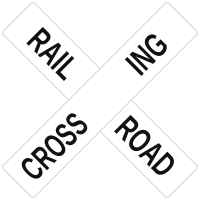
  • White X-shaped crossbuck reading RAILROAD CROSSINGCrossbuck: yield to trains
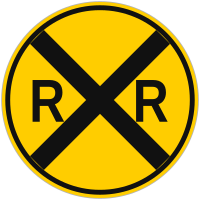
  • Round yellow sign with a black X and two letters RRailroad ahead: slow down and look for a train
  • Yellow pennant pointing right reading NO PASSING ZONENo passing zone starts here
  • Fluorescent orange triangle with a red reflective borderSlow-moving vehicle: under 25 mph
  • Yellow diamond reading LANE ENDS MERGE LEFTLane ends: merge left and yield
  • Yellow diamond with a straight road and a second lane joining from the right and continuing alongsideAdded lane: no merging needed
  • Fluorescent yellow-green pentagon with two children walkingSchool: yellow-green pentagon
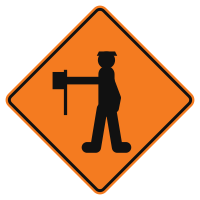
  • Orange diamond with a black flagger symbol holding a flagFlagger ahead: be ready to stop
  • Four-section left-turn signal with the flashing yellow arrow litFlashing yellow arrow: turn after a safe gap

Free practice test

20 practice questions for the Missouri permit test

These 20 questions are written from the Missouri Driver Guide, revised August 2026, in the same multiple-choice style as the real test. The real one has 25 questions and you need 80%, so here 16 right out of 20 is a pass. After each answer, the tutor can explain it another way or tell you why the other choices are wrong.

Question 1 of 20
White X-shaped crossbuck reading RAILROAD CROSSING

You reach a railroad crossing marked only with this sign. There are no lights or gates. What does the sign mean?

20 practice questions in the style of the written test.

Test day

What to bring to the exam station

  • A certified birth certificate, a valid U.S. passport, or a Missouri ID that hasn't been expired more than six months
  • Proof of any name change, such as a marriage license or court order
  • Glasses or contacts if you wear them, for the vision test
  • For the license office afterward: your examination record, proof of your Social Security number and proof of your Missouri address
  • A parent or legal guardian at the license office if you're under 18
  • $10 for the instruction permit, paid at the license office, as of October 2026

Before you go

  1. Read the Missouri Driver Guide, revised August 2026. It's free as a PDF from the Department of Revenue.
  2. Spend extra time on Chapter 7. The road sign test is its own part of the exam.
  3. Try the 20 practice questions on this page and reread the chapters behind any you miss.
  4. Check the Highway Patrol's station list for your nearest site and its days. Some sites are open only one or two days a week.
  5. Bring a document the Patrol accepts. School IDs, Social Security cards and laminated birth certificates aren't.
  6. Arrive early in the day so there's time for all three parts.
Missouri State Highway Patrol: Driver examination stationsNo appointment is needed for the written test. Find a station, check its days and hours, and go in with your ID.

Study options

Where to study

Every question on the written test comes from the Missouri Driver Guide, which the Department of Revenue gives away free as a PDF and as an audio playlist. We've compared it with the apps and courses Missouri learners use, and noted which official extras are out of date.

OptionPriceFree to useLinks
Official and free
Missouri Driver Guide (revised August 2026)Official · PDFThe Department of Revenue's guide and the source of every written test question. The Driver Guide page links the full PDF and each of its 16 chapters separately, which helps if you're studying one topic at a time. Chapter 7 covers the road sign test.
FreeThe whole guide
Driver Guide audio versionOfficial · YouTube playlistThe department's own audio reading of the guide, linked from its Driver Guide page. Useful on the bus or for anyone who finds a long PDF hard going in English.
FreeThe whole playlist
DOR sample test questionsOfficial · PDFSample questions for the Class F and Class E written tests. The sheet says they aren't the real test questions, and it dates from 2015: its answer for the permit fee is $3.50, but the 2026 guide lists $10. Good for rules of the road, not for fees.
Free44 questions with an answer key
Teen driving log sheet (Form 4901)Official · PDF formNot study material for the written test, but you need it next: a sheet for logging the 40 hours of practice, 10 at night, that you must show before an intermediate license.
FreeThe form
Missouri Commercial Driver License ManualOfficial · PDFThe book the CDL knowledge tests come from, linked from the Highway Patrol's driver examination page. All CDL written tests are in English only.
FreeThe whole manual
Apps and websites
Driving-Tests.org and DMV GenieWebsite and appsOne company runs both. The Missouri section groups 140 essential questions, 325 harder ones and 93 on fines, alcohol and distraction, plus four road sign quizzes. The site shows 4.7 out of 5 from more than 16,700 Trustpilot reviews, and its DMV Genie app at 4.7 on Google Play.
Free tests. The premium price isn't shown on the pageFive Missouri permit practice tests, sign tests and a 25-question exam simulator
ZutobiWebsite and appsLists more than 600 Missouri questions with short lessons and quizzes, plus a pass guarantee whose terms aren't on the page. Its Missouri page describes the real test in two different ways, so go by the Driver Guide's 25 questions and 20 to pass.
Not shown on the Missouri pageA free trial
Missouri MO DOR Permit Test (Nilu Rathod)iPhone appCar, motorcycle and CDL practice tests based on the Missouri manual, with bookmarks and progress tracking. 4.7 stars from 128 App Store ratings, last updated July 2025. It's a private app, not from the state.
Free with in-app purchases: $3.99 for 7 days, $8.99 for 30 days or $14.99 lifetimeFree to download. The listing doesn't say what premium unlocks
Missouri DMV Permit Test (Appisode)iPhone appPractice tests, a road sign reference, study cards and a section on the driving test. 4.6 stars from 30 App Store ratings, last updated December 2024, before the latest Driver Guide.
Free with in-app purchases: $1.99 a week, or $4.99 to remove adsFree to download, with ads
In person
Approved motorcycle rider training coursesMotorcycle Safety Foundation courses with private instructorsRequired for a motorcycle permit at 15 and a half. At 16 or older, passing an approved course can replace the Highway Patrol's motorcycle skills test. Out-of-state course cards aren't accepted.
Set by each courseNot stated

Prices and ratings checked October 2026.

FAQ

Common questions

How many questions are on the Missouri permit test?

25 multiple-choice questions, and you need 20 right, which is 80%. The questions cover the laws and driving methods in the Missouri Driver Guide, but not Chapter 15, which is about commercial vehicles. You also take a vision test and a road sign test on the same visit.

Who gives the Missouri permit test, the DMV or the Highway Patrol?

The Missouri State Highway Patrol gives the test at its driver examination stations. Missouri has no separate DMV: driver licensing is part of the Department of Revenue, which runs its online services under the name MyDMV. Once you pass, you take your examination record to a Department of Revenue license office, which issues the permit.

How much does the Missouri permit test cost?

The test is free. The Highway Patrol doesn't charge for non-commercial written or driving tests. You pay $10 for the instruction permit when you buy it at a license office, as of October 2026.

What happens if I fail the Missouri permit test?

You can take the written test again the same day. The Highway Patrol allows up to two written tests a day, statewide, until you pass. There's no fee for trying again.

Can I take the Missouri permit test online?

No. The written test is only given in person at a Highway Patrol driver examination station. You can study online and, for the later driving test, schedule a slot online at some stations.

Do I need an appointment for the Missouri permit test?

No. Most written and driving tests are walk-in. Stations have set days and hours, and arriving before closing doesn't guarantee you'll be tested, so go early in the day.

Sources: Missouri Driver Guide, Missouri State Highway Patrol, Missouri Department of Revenue and 1 more. Checked October 2026.

Rules and fees can change, so check the official site before your test.

All 20 practice questions with answersA printable list of the practice test above
  1. White X-shaped crossbuck reading RAILROAD CROSSING

    You reach a railroad crossing marked only with this sign. There are no lights or gates. What does the sign mean?

    Yield to any train at the crossing The white X-shaped crossbuck stands at the crossing itself. The Missouri Driver Guide says it has the same meaning as a yield sign, so you must yield to trains. Slow down, look and listen, and be ready to stop.
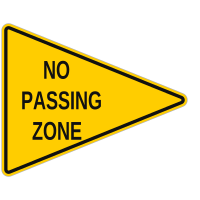
  2. Yellow pennant pointing right reading NO PASSING ZONE

    This sign is on the left side of a two-lane road. What does it tell you?

    You're entering a no passing zone The pennant shape is used only for the no passing zone sign. It's placed on the left side of the road where a no passing zone begins. Finish any pass before you reach it.
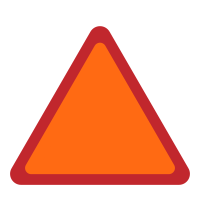
  3. Fluorescent orange triangle with a red reflective border

    You see this emblem on the back of a farm vehicle ahead. What does it mean?

    The vehicle is traveling less than 25 mph The reflective orange triangle is the slow-moving vehicle emblem. The Missouri Driver Guide says it means the vehicle is traveling less than 25 mph. You'll see it on farm and construction equipment, so slow down early.
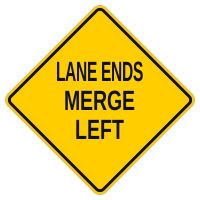
  4. Yellow diamond reading LANE ENDS MERGE LEFT

    You're in the right lane and see this sign. What should you do?

    Merge left, yielding to traffic in the left lane This is the Lane Ends/Merge Left sign. Two lanes will soon become one. The Driver Guide says that if you're in the right lane, you must merge left and yield to traffic already driving in the left lane.
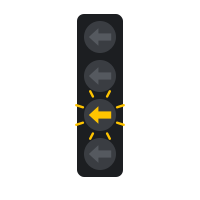
  5. Four-section left-turn signal with the flashing yellow arrow lit

    You want to turn left and this signal is showing. What does it mean?

    You may turn left, but you must wait for a safe gap in oncoming traffic A flashing yellow arrow lets you turn in the direction of the arrow, but oncoming traffic may still be coming. The Driver Guide says you must wait for an adequate gap in opposing traffic and yield to pedestrians.
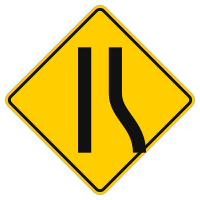
  6. Yellow diamond with a straight road and a second lane joining from the right and continuing alongside

    You're on a highway and see this sign. What does it tell you?

    Traffic from another road is joining in a lane of its own, so no merging is needed This is the Added Lane sign. Traffic from another road will enter, but a lane has been added for it, so nobody needs to merge. Still watch for those drivers changing lanes later.

  7. What is the youngest age at which you can get a Missouri instruction permit?

    15 The instruction permit is the first step of Missouri's Graduated Driver License program, and you can get it at 15. You must pass the vision, road sign and written tests first.

  8. With a Missouri intermediate license, when may you not drive alone?

    From 1 a.m. to 5 a.m., unless it's for school, work or an emergency Intermediate license holders may not drive alone between 1:00 a.m. and 5:00 a.m. The exceptions are driving to or from a school activity, a job or an emergency. Otherwise, a licensed driver 21 or older must ride with you.

  9. During your first six months with an intermediate license, how many passengers under 19 who aren't immediate family may ride with you?

    One For the first six months, you may not drive with more than one passenger under 19 who isn't a member of your immediate family. After six months, the limit goes up to three.

  10. Before you can get an intermediate license, how much supervised driving must you complete?

    40 hours, including at least 10 at night The Driver Guide says you must complete 40 hours of driving instruction, and at least 10 of them must be at night. A parent, stepparent, grandparent, legal guardian or certified trainer goes with you to the license office to confirm the hours.

  11. You're driving on a highway with four lanes. A school bus coming the other way stops with red lights flashing. What must you do?

    You don't have to stop, but drive with care The Driver Guide says you don't have to stop when you're traveling the opposite direction of a school bus on a highway with four or more lanes. On a two-lane road, traffic both ways must stop. Either way, watch for children.

  12. You're about to enter a roundabout. Who has the right-of-way?

    Traffic already in the roundabout Roundabouts have yield signs at every entrance. You must yield to traffic already in the circle and to pedestrians in the crosswalks, then enter when there's a gap. Never turn left to enter.

  13. An ambulance with its siren and flashing lights is coming up behind you. You're not in an intersection. What should you do?

    Pull over to the right edge of the road and stop until it passes You must yield to emergency vehicles using a siren or air horn and red or blue lights. Pull over to the right edge of the road and stay stopped until it passes. If you're in an intersection, drive through it first.

  14. In a Missouri city or town, what is the speed limit if no sign is posted?

    25 mph The Driver Guide says the speed limit in any city, town or village is 25 mph unless it's posted otherwise. Slow down further when conditions demand it.

  15. You're driving at night with your high beams on. When must you switch to low beams for an oncoming vehicle?

    Within 500 feet of it The Driver Guide says to use your low beams when you come within 500 feet, about one block, of an oncoming vehicle. Use them too when you're following another vehicle within 300 feet.

  16. Red lights are flashing at a railroad crossing. Where must you stop?

    Between 15 and 50 feet from the tracks You must stop if the red lights are flashing or the gate is down. The Driver Guide says to stop within 15 to 50 feet of the railroad tracks. Don't go around a gate, and look for a second train on multiple tracks.

  17. If you're under 21, what blood alcohol content (BAC) makes it illegal for you to drive in Missouri?

    0.02% or more The Driver Guide says it's illegal to drive with a BAC of 0.08% or more, 0.04% for commercial drivers, and 0.02% if you're under 21. At 0.02%, an officer takes your license and gives you a notice of suspension or revocation.

  18. Under Missouri law, what may you do with your phone while your car is moving?

    Talk hands-free, for example over Bluetooth The electronic communication device law bans holding or supporting a phone with any part of your body, typing or reading texts, recording or posting video, and watching videos. Hands-free calls, voice-to-text and GPS navigation are allowed.

  19. How far before a turn should you signal?

    At least 100 feet The Driver Guide says to get into the proper lane and signal at least 100 feet before you turn. If there are driveways or streets between you and your turn, wait until you've passed them to signal.

  20. You use the center two-way left-turn lane to turn left into a store. How far may you drive in that lane?

    No more than 500 feet A two-way left-turn lane is only for slowing down or stopping before a left turn. The Driver Guide says it isn't a travel lane, and a vehicle may not travel in it for more than 500 feet.