Maine · Permit test

Maine permit test: the BMV written knowledge test

It’s the written knowledge test that the Bureau of Motor Vehicles (BMV) gives before it issues a learner’s permit, and you take it at a BMV branch on a date the BMV mails to you. The BMV’s study guide for the Maine permit test is the Maine Driver’s License Manual, so that’s the book to work through.

  • 30Questions on the knowledge test
  • $35Exam fee, first road test included
  • Within 3 weeksWhen your test notice comes by mail

Key facts

At a glance

Who runs it
The Bureau of Motor Vehicles (BMV), part of the Maine Department of the Secretary of State
Where you take it
At a BMV branch office, on a date the BMV sets
What it covers
Rules of the road, road signs, pedestrian and bicycle safety, Maine’s operating under the influence (OUI) laws and the dangers of distracted driving
Vision screening
Free when you arrive for the written test, or from your own eye doctor on the BMV’s eye examination form

How it works

How the Maine permit test works

Knowledge test · 24 to pass
24 to pass
To pass you need 24 of 30 right.
  1. You send the Bureau of Motor Vehicles (BMV) your learner’s permit application, by mail or at a branch office. The driver’s permit page has the mailing address.
  2. Once the application is processed, the BMV books your written test at the location closest to your mailing address and mails you the appointment notice.
  3. At the branch, you get a free vision screening. It checks how clearly you see and how far you can see to either side while looking straight ahead.
  4. Pass, and the BMV can issue your learner’s permit, so you can start supervised driving. The road test comes later, once you’ve met the permit rules for your age.

Topics

Maine driving laws on the test

The manual’s sections, with some of the Maine driving laws each one covers.

01

Licenses, permits and points

Section 1 of the manual covers the license classes, permits, the tests and the ways a license can be suspended or revoked.

Key points (4)
  • Maine has three license classes: A and B are commercial, and Class C covers any vehicle that isn’t in Class A or B.
  • With a learner’s permit, you drive with a licensed driver who is at least 20, has held a valid license for at least 2 years and sits beside you.
  • State law bans a permit holder from using a handheld phone while driving, even when stopped in traffic, unless the car has pulled off the road and stopped safely.
  • A warning comes at 6 demerit points and a suspension at 12 or more, and points drop off once they’re a year old.
02

Alcohol, drugs and distractions

Section 3 covers fitness to drive: vision, fatigue, distractions and Maine’s operating under the influence (OUI) laws, which the written test emphasizes.

Key points (4)
  • Under 21, you may not drive after drinking any amount of alcohol.
  • Driving at 0.08 or more is OUI, and a first conviction at 0.08 to 0.14 means losing your license for at least 150 days.
  • Refusing an alcohol test suspends your license for up to six years, and that suspension stands even if you’re later found not guilty of OUI.
  • Time is what sobers you up: the body clears alcohol at a constant rate that coffee, a cold shower or exercise can’t change.
03

Seat belts, children and car control

Sections 4 and 5 cover the driver’s seat and mirrors, safety belts, air bags, child seats and the basics of starting, steering and backing.

Key points (4)
  • Everyone in the car needs a fastened safety belt or a child safety seat.
  • A child who weighs less than 55 pounds rides in a child safety seat, and a child under 12 who weighs less than 100 pounds rides in the back seat if possible.
  • Leave 10 inches between your chest and the steering wheel, and hold the wheel at 9 and 3 or at 8 and 4.
  • To warn the driver behind you of a stop they won’t expect, tap the brake pedal three or four times.
04

Right-of-way and traffic signals

Section 6 sets out who goes first, what each light and arrow means, and how lanes, crosswalks and stop lines work.

Key points (4)
  • After stopping at a red light, you may turn right unless a sign says otherwise, yielding to pedestrians and all other traffic.
  • At a flashing red light, stop and look both ways before you go on.
  • For a person with a white cane or a guide dog, stop at least 10 feet away and wait until they’re out of danger.
  • Vehicles already in a traffic circle, and drivers already on an interstate, have the right-of-way over those entering.
05

Signs and pavement markings

The manual teaches signs by color and shape: warning, railroad, work zone, regulatory and guide signs, then the yellow and white lines on the road.

Key points (4)
  • Warning signs are usually yellow diamonds, work zone signs are orange, and speeding fines double in a work zone.
  • A yield sign means slow down and give the right-of-way to traffic and pedestrians who have it.
  • The shared center lane sign marks a lane for left turns only, used by traffic from either direction.
  • A solid white line between lanes discourages lane changes, and a broken white line allows them when it’s safe.
06

Turns, passing, school buses and parking

Section 7 covers turns, intersections, roundabouts, lane changes, passing, school buses, parking and turning around.

Key points (4)
  • Finish any pass before you reach the start of a no-passing zone, whose pennant sign stands on the left side of the road.
  • Leave at least three feet between your car and a bicyclist as you pass.
  • On an undivided road, stop for a school bus with its red lights flashing, from either direction, and wait until it moves or its driver signals you on.
  • Park no more than 18 inches from a curb, and turn your wheels to the left when you park uphill next to one.
07

Speed, space and lights

Section 8 covers speed, stopping distance, following distance, headlights and signals.

Key points (4)
  • Unless signs say otherwise, the limit is 45 mph outside built-up areas, 25 mph in business, residential and built-up areas, and 15 mph passing a school during recess or opening and closing times.
  • Keep at least 4 seconds behind the vehicle ahead, and more on slippery roads, at night and behind motorcycles.
  • Headlights must be on from sunset to sunrise, when you can’t see 1,000 feet ahead and whenever your wipers are in constant use.
  • Dim your high beams within 500 feet of an oncoming vehicle and within 300 feet of one you’re following, and signal at least 100 feet before a turn.
08

Sharing the road and driving hazards

Sections 9 to 11 cover emergencies and crashes, pedestrians, bicyclists, motorcycles, large vehicles, emergency vehicles, night driving, work zones, bad weather and wildlife.

Key points (4)
  • Pull to the right and stop for an emergency vehicle with its lights and siren on, and don’t follow within 500 feet of a fire truck answering a fire alarm.
  • A slow-moving vehicle emblem on the back of a vehicle means it’s moving at less than 25 mph.
  • Moose collisions peak in May and June. If a crash with an animal can’t be avoided, brake, steer straight and let up on the brake just before impact.
  • Don’t drive across a flooded road: as little as six inches of water can float some small cars.

Road signs

Road signs in the Maine Driver’s License Manual

In the manual, warning signs are usually yellow diamonds and work zone signs are orange. Regulatory signs are white with black, red or green, and guide signs are green, brown or blue.

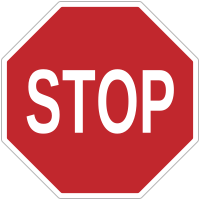
  • Red octagon with white border and the word STOP in whiteStop: stop behind the stop line or crosswalk
  • Downward-pointing red triangle with white center and the word YIELD in redYield: slow down and give way to traffic and pedestrians who have the right-of-way
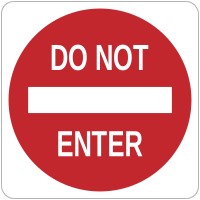
  • Red circle with a white horizontal bar on a white square, reading DO NOT ENTERDo not enter
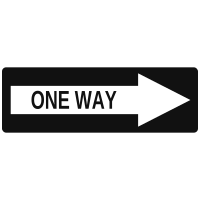
  • Black rectangle with a white arrow pointing right containing ONE WAYOne way: traffic moves only in the direction of the arrow
  • White sign reading CENTER LANE above two opposing left-turn arrows and the word ONLYShared center lane, for left turns only
  • Yellow pennant pointing right reading NO PASSING ZONENo passing zone, on the left side of the road
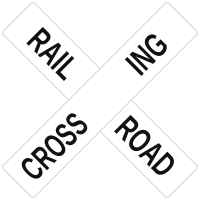
  • White X-shaped crossbuck reading RAILROAD CROSSINGRailroad crossing: stop if a train is coming
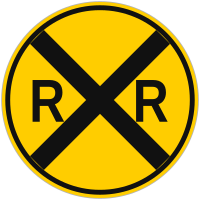
  • Round yellow sign with a black X and two letters RRailroad crossing ahead: slow down, look and listen
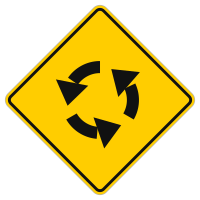
  • Yellow diamond with three black arrows forming a counter-clockwise circleTraffic circle ahead
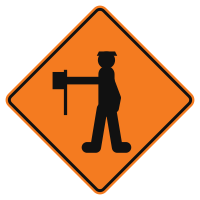
  • Orange diamond with a black flagger symbol holding a flagFlagger ahead: do as the flagger directs
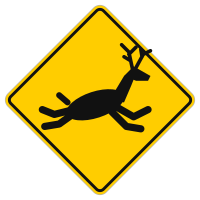
  • Yellow diamond with a black leaping deerDeer crossing
  • Fluorescent orange triangle with a red reflective borderSlow-moving vehicle, going under 25 mph

Free practice test

20 practice questions from the Maine Driver’s License Manual

These 20 questions are written from the Maine Driver’s License Manual. The BMV’s knowledge test has 30 questions and you need 24 right, which is 80%. The bar here is the same 80%: 16 of 20. Four questions show a sign. After each answer, the tutor can explain it another way or tell you why the other choices are wrong.

Question 1 of 20

You have a learner’s permit. Who may sit beside you as your supervising driver?

20 practice questions in the style of the permit test.

Test day

What to send with your permit application

  • A completed learner’s permit application form, from the BMV’s forms page
  • Payment for the exam fee
  • Two forms of identification. The manual gives a birth certificate and a Social Security card as an example
  • Proof of Maine residency with your name and the physical address where you live, such as a tax return, W-2 form, pay stub, utility bill or government document. A post office box isn’t enough
  • Under 18: your driver education completion certificate, and the signature of a parent or legal guardian on the application
  • Under 23: your birth certificate. A photocopy with the issuing agency’s embossed stamp is accepted, but a notarized copy isn’t

Before you go

  1. Work through the manual with the study plan on the where-to-learn page.
  2. If you can’t make your test, use the contact details on your notice. Rescheduling is free up to 48 hours before the start; state law adds another $35 when you rebook a missed test without that notice.
  3. If state offices close for severe weather, written and road exams are rescheduled automatically at no fee.
  4. Bring the originals of your identity documents. You can mail copies with the application, but the BMV checks the originals at the exam.
Read the BMV’s permit stepsThe BMV’s page lists what the application needs and where to mail it.

Study options

Where to study

Work through the Maine Driver’s License Manual first. Under 18, an approved driver education course comes before the permit application too.

OptionPriceFree to useLinks
Official sources
Maine Driver’s License ManualOfficial · PDFThe BMV’s study guide for the written knowledge test, in 12 sections. Section 12 is a short self-test with an answer key.
FreeThe whole manual, with practice questions after each section
Guides
BMV information for parents of teensOfficial · web pageFor parents guiding the supervised practice: the intermediate and provisional license rules, the zero tolerance alcohol law and tips for the family car.
FreeA driving contract for families, plus the teen license rules
In person
Approved driver education coursesIn person · schools and licensed driving schoolsRequired under 18 before the learner’s permit. The BMV posts a list of driver education schools and its approved textbooks.
Set by each schoolNothing free
Motorcycle rider education coursesIn person · licensed rider schoolsClassroom and hands-on riding courses approved by the Secretary of State. The motorcycle permit page explains when you need one.
Set by each schoolNothing free

Prices and ratings checked November 2026.

FAQ

Common questions

How many questions are on the Maine permit test?

30, and you need at least 24 right to pass, which is 80%.

Can I take the Maine permit test online?

The BMV’s pages give it only at a branch office and mention no online version. The manual is a free PDF, so you can study for it online.

What happens if I fail the Maine permit test?

State law sets a $35 fee for each reexamination, the same as the first exam fee (Title 29-A, section 1307). The BMV’s pages don’t give a waiting time before another try, so ask the BMV’s Examination Section when you rebook, at 207-624-9000, ext. 52119.

Can I take the Maine permit test in another language?

Yes. The BMV’s digital testing system gives it in Arabic, Canadian French, English, French, Lingala, Portuguese, Somali, Spanish and Swahili. For any other language, the BMV provides a professional interpreter free of charge, a service that began on February 1, 2026. Say which language you need on the exam application form; scheduling with an interpreter may take 4 weeks or more.

Do I need driver’s ed before the Maine permit test?

Under 18, yes. State law says you finish an approved driver education course before you apply for the permit, and the completion certificate goes in with your application. At 18 or older you don’t need one. The where-to-learn page explains the courses.

All 20 practice questions with answersA printable list of the practice test above
  1. You have a learner’s permit. Who may sit beside you as your supervising driver?

    A licensed driver 20 or older, licensed for at least 2 years Maine requires your supervising driver to be at least 20 years old and to have held a valid license for at least 2 years. They must sit in the seat next to you.

  2. How many demerit points on your record lead to a license suspension in Maine?

    12 points or more Once your total reaches 12 points or more, the Secretary of State suspends your license. A warning comes first, at 6 points.

  3. A driver’s first conviction for operating under the influence (OUI) is at an alcohol level of 0.10. How long do they lose their license?

    At least 150 days A first OUI conviction with an alcohol level of 0.08 to 0.14 means losing your license for at least 150 days. It also brings a fine of at least $500 and an alcohol and drug education and treatment program.

  4. After drinking, what will sober a person up?

    Only time, as the body clears alcohol at a steady rate Your body clears alcohol at a constant rate, and nothing speeds it up. Coffee, a cold shower or exercise just leave a drunk person awake, wet or sweaty.

  5. You’re driving on a learner’s permit. When may you use a handheld phone?

    Once you’ve pulled off the road and safely stopped With a learner’s permit, Maine law bans using a handheld phone or other handheld device while driving, even when you’re stopped in traffic or at a light. You may use one once you’ve pulled off or to the side of the road and stopped where the car can safely stay.

  6. A child who weighs less than 55 pounds rides in your car. How must the child be secured?

    In a child safety seat Maine law says a child who weighs less than 55 pounds must be properly secured in a child safety seat. The seat must meet the federal safety standards.

  7. A crash with a moose is about to happen and you can’t avoid it. What does the manual tell you to do?

    Brake, steer straight, then ease off just before impact Apply the brakes and steer straight, then let up on the brakes just before impact so the front of the car rises slightly. Aim for the animal’s tail end and duck down to protect yourself from windshield debris.

  8. You’re stopped at a red light and want to turn right. No sign forbids it. What may you do?

    Turn after stopping, yielding to pedestrians and traffic A right turn on red is allowed after you stop, unless a sign says otherwise. You must yield to pedestrians and all other traffic before you turn.

  9. A person with a white cane is crossing the road ahead of you. What must you do?

    Stop 10 feet or more away and wait for them A person using a white cane or a guide dog always has the right-of-way. Stop at least 10 feet away and wait until the person is out of danger.
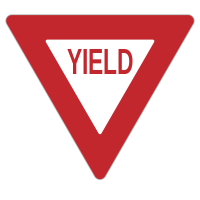
  10. Downward-pointing red triangle with white center and the word YIELD in red

    What must you do at this sign?

    Slow down and give the right-of-way to those who have it At this sign, slow down and wait for traffic to clear on the road you’re entering or crossing. Yield to vehicles and pedestrians that have the right-of-way before you go on.
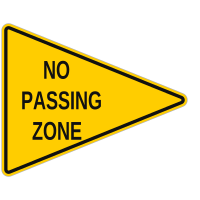
  11. Yellow pennant pointing right reading NO PASSING ZONE

    You see this sign on the left side of a two-lane road. What does it tell you?

    A no-passing zone starts here, so finish passing This sign marks the start of a no-passing zone. Maine law requires you to complete a pass before you reach the beginning of the zone.
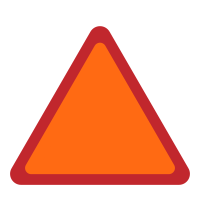
  12. Fluorescent orange triangle with a red reflective border

    You see this on the back of a farm tractor ahead. What does it tell you?

    It’s moving at less than 25 mph This emblem on the back of a vehicle means it’s moving at less than 25 mph. Slow down early, and pass only when it’s safe.
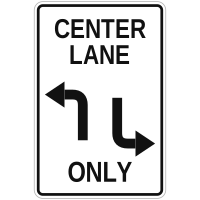
  13. White sign reading CENTER LANE above two opposing left-turn arrows and the word ONLY

    What is the lane marked by this sign for?

    Left turns, by traffic from either direction This sign marks a shared center lane for left turns only. Traffic from either direction may use it, but not to drive through or to pass.

  14. On an undivided road, a school bus has stopped with its red lights flashing. You’re coming from the other direction. What must you do?

    Stop and wait until it moves or its driver signals you on On an undivided road, you must stop for a school bus with its red lights flashing, whichever direction you’re coming from. Wait until the bus moves again or its driver signals you to go.

  15. You’re parking next to a curb. What’s the farthest your car may be from it?

    18 inches When there’s a curb, park as close to it as you can and no more than 18 inches away. When you parallel park, aim for about 6 inches.

  16. You park facing uphill next to a curb. Which way should you turn your front wheels?

    To the left, away from the curb Facing uphill with a curb, turn your wheels to the left. Then, if the car rolls back, the curb stops the wheels.

  17. In normal conditions, how far behind the vehicle ahead should you stay?

    At least 4 seconds Keep at least 4 seconds between your car and the vehicle in front. Count from when its rear passes a fixed point, and leave more on slippery roads or at night.

  18. Apart from sunset to sunrise, when must your headlights be on under Maine law?

    Whenever your wipers are in constant use Maine law requires headlights whenever your wipers are in constant use, or when you can’t see 1,000 feet ahead. They’re also required from sunset to sunrise.

  19. Unless a sign says otherwise, what’s the speed limit when you pass a school during recess?

    15 mph Maine’s limit is 15 mph when you pass a school during recess, or while children are going to or from school at opening and closing times. The fine for speeding in a school zone is doubled.

  20. A fire truck is heading to a fire alarm. How close behind it may you follow?

    No closer than 500 feet It’s against the law to follow within 500 feet of a fire truck responding to a fire alarm. Give it room, and pull over and stop if it comes up behind you with lights and siren on.

Sources: Maine Bureau of Motor Vehicles · Maine Legislature, Office of the Revisor of Statutes and 4 more. Checked November 2026.

Rules and fees can change, so check the official site before your test.