You’re practicing with your aunt, who is 30 and licensed, in the seat beside you. You roll through a stop sign. Who does the law hold liable for the violation?
Your aunt, as the adult with you Under New Hampshire’s Revised Statutes Annotated (RSA) 263:25, the adult who accompanies a person learning to drive is liable for any motor vehicle violation the learner commits. That’s one reason the adult must hold a valid license and sit beside you.
You hold a Youth Operator License and get your second speeding ticket in your first two years of driving. What will you be required to get?
An SR-22 insurance policy for three years A youth operator with two or more speeding tickets in the first two years of the license must get an SR-22 insurance policy. It lasts three years from the date of the second hearing.
You’re 17 and driving alone. When may you use your phone while driving, hands-free or not?
To report an emergency to 911 Drivers under 18 may not use a phone or other mobile electronic device while driving, hands-free or not, even when stopped in traffic. The one exception is reporting an emergency to 911 or another public safety agency.
You’ve been awake for 18 hours in a row. The manual compares your driving to someone with which blood alcohol concentration?
0.05% The manual says a driver who has been up for 18 hours straight typically performs like someone with a blood alcohol concentration of 0.05%. After 21 hours it’s like 0.08%, and after 24 hours like 0.10%.
You took an allergy pill and aren’t sure it’s safe to drive. What does the manual tell you to do?
Read its label and ask your doctor or pharmacist Over-the-counter drugs for colds, hay fever or other allergies can make you drowsy. Before you drive, read the label for warnings, and if you’re unsure, ask your doctor or pharmacist about side effects.
A 6-year-old who is 50 inches tall rides with you. How must the child be secured?
In a child passenger restraint New Hampshire law requires a child under 7 who is less than 57 inches tall to be fastened in a child passenger restraint that meets U.S. Department of Transportation standards. A 6-year-old at 50 inches meets both conditions.
How should you set your head restraint?
Touching the back of your head, not below your ears Head restraints are there to prevent whiplash in a crash. The manual says to adjust yours so it touches the back of your head, but not below your ears.
You’re turning left at an intersection with no light or sign. A car coming the other way is close to the intersection. What must you do?
Yield, and let it pass before you turn RSA 265:29 says a driver turning left must yield to any vehicle coming from the opposite direction that is in the intersection or close enough to be an immediate hazard. Wait for it to pass, then turn when it’s clear.
You’re driving at night on a road you’ve never driven before. How should you change your following distance?
Add at least two seconds to it The manual says to add at least one extra second to your following distance at night, and at least two extra seconds on unfamiliar roads at night. Your headlights limit how far ahead you can see.
When should you slow down for a curve?
Before you enter it The manual says to slow to a safe speed before entering a curve, so you can keep a slight, steady acceleration through it. Hard braking after you’re in the curve could make the tires lose traction.
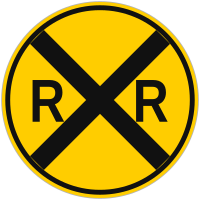
You see this sign beside the road ahead. What should you do?
Slow down and look and listen for a train This sign stands along the road before a railroad crossing. It tells you to slow down or stop, and to look and listen for a train before you go on.
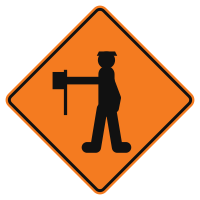
You pass this sign as you drive into a work zone. What should you do?
Slow down and do as the flagger directs This sign warns of a flagger ahead. In a work zone, a person with a sign or flag may tell you which way to go, to slow down or to stop, and you must follow their instructions.
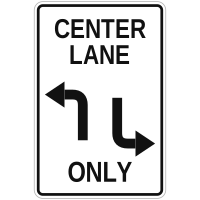
A lane on the road you’re on is marked with this sign. What may you use that lane for?
Turning left, from either direction This sign marks a shared center lane reserved for vehicles turning left from either direction. It isn’t for through traffic or for passing other vehicles.
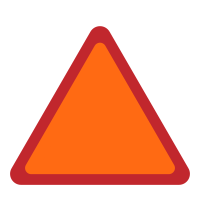
A hay wagon pulled by a tractor shows this on its back. What does it tell you?
It’s traveling at less than 25 mph The manual says this emblem on the rear of farm equipment, construction equipment or animal-drawn vehicles means the vehicle is traveling at less than 25 mph. Approach with caution and pass only when it’s safe.
You’re inside a multi-lane roundabout when an emergency vehicle with its siren on comes up. What should you do?
Exit first, then pull over to the right The manual says never to stop inside a roundabout when an emergency vehicle approaches. Move through, exit, then pull over to the right and let it pass.
You want to park near a railroad crossing. How close to the nearest rail may you park?
No closer than 50 feet The manual lists places where parking is illegal even without a sign, and one is within 50 feet of the nearest rail of a railroad crossing. Others include within 15 feet of a fire hydrant and on any bridge.
Your car starts to skid, and the rear is sliding to the right. Which way should you steer?
Right, the way the rear is sliding If your car skids, ease up on the accelerator and steer in the direction the rear of the car is sliding. That lets the car go straight instead of sideways.
Your right wheels drop off the edge of the pavement onto the shoulder. What should you do?
Ease off and steer back once it’s safe Uneven drop-offs can cause serious crashes if you react the wrong way. Avoid panic steering back onto the pavement: slow down gradually and turn back on when it’s safe.
You’re passing a bicyclist while driving at 50 mph. How much space does New Hampshire law treat as reasonable?
At least 5 feet The law presumes at least 3 feet is reasonable at 30 mph or less, plus one more foot for every 10 mph above 30. At 50 mph, that’s 3 feet plus 2, or 5 feet.
You’re driving beside a large truck and can’t see the driver’s face in its side mirror. What does that tell you?
The driver can’t see you either Large trucks have big blind spots, called No-Zones, on both sides. If you can’t see the truck driver’s face in the side mirror, the driver can’t see your car, so don’t stay alongside longer than you need to.
 New Hampshire · Knowledge test