Oregon · Permit test

Oregon DMV permit test

To get an instruction permit in Oregon, you pass DMV's Class C knowledge test: 35 multiple-choice questions, and the Oregon Driver Manual's testing section says you need 28 right. Teens can start at 15. You can take the Oregon permit test online at home, with a webcam, or at any DMV office, and each try costs $7. DMV says the free Oregon Driver Manual covers everything you need to pass. Try the 20 practice questions on this page before you test.

  • 35Multiple-choice questions
  • 28Right answers needed to pass, 80%
  • $7Fee for each try, as of October 2026
  • 8Languages, online and in DMV offices

Key facts

At a glance

Who gives it
Oregon DMV (Driver & Motor Vehicle Services), part of the Oregon Department of Transportation
Where
Online at home on a computer with a webcam, or at a DMV office
Minimum age
15 for an instruction permit, 16 for a provisional license

How it works

How the Oregon permit test works: 35 questions, 28 to pass

  1. The Class C knowledge test has 35 multiple-choice questions on road signs, traffic laws and safe driving. DMV says the Oregon Driver Manual covers what you need to pass.
  2. You need 28 right to pass, which is 80%.
  3. You can take it online at home on a laptop or desktop with a webcam, or at a DMV office on a touch-screen computer.
  4. If you're under 18 and testing online, an adult 21 or older has to register as your proctor and watch you take it.
  5. Offices stop giving the test one hour before closing. You can walk in for standby service or book an appointment.
  6. It's offered in English, Spanish, Arabic, Chinese, Japanese, Korean, Russian and Vietnamese, and you can listen to the questions.
  7. Each try costs $7. If you fail at an office, you may retest the same day if there's room. Online, it's two tries in 24 hours and four in all.

Topics

What’s on the test

01

Signs, signals and pavement markings

Section 1 of the Oregon Driver Manual covers signs and signals, and Section 2 the lines on the road. Expect questions on what a flashing or dark signal means.

Key points (4)
  • A flashing red signal, or a signal that's dark, is treated as a stop sign.
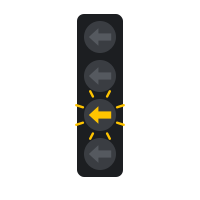
  • A flashing yellow arrow lets you turn after yielding to oncoming traffic and pedestrians.
  • Two solid yellow center lines mean no passing in either direction.
  • When a train is coming and there's no stop line, stop at least 15 feet from the nearest rail.
02

Instruction permits and Oregon's teen license rules

What your permit lets you do, who can sit beside you, and the limits on a provisional license until you turn 18.

Key points (4)
  • Your supervisor must be licensed, at least 21 and sitting beside you.
  • Teens need 100 hours of supervised driving, or 50 with an approved driver education course.
  • For the first 6 months of a provisional license, no passengers under 20 who aren't immediate family.
  • Drivers under 18 can't use a phone while driving, not even hands-free.
03

Right-of-way, school buses and emergency vehicles

Who goes first at intersections and roundabouts, and when you must stop for pedestrians, school buses and emergency vehicles.

Key points (4)
  • At an uncontrolled intersection, yield to vehicles already in it or coming from your right.
  • Enter a roundabout only after yielding to traffic already in it and traffic leaving.
  • Stop for a school bus with flashing red lights until the driver turns them off.
  • For an emergency vehicle, pull to the right and stop, never in an intersection, then stay 500 feet behind.
04

Speed limits, following distance and headlights

Oregon's basic speed rule, its default speed limits, how much space to leave and when to use and dim your headlights.

Key points (4)
  • Default limits: 15 mph in alleys, 20 in business districts and school zones, 25 in residential districts, 55 elsewhere.
  • Keep 2 to 4 seconds behind the car ahead, and 4 or more above 30 mph.
  • Headlights go on from sunset to sunrise, and when you can't see 1,000 feet ahead.
  • Dim high beams within 500 feet of an oncoming car and 350 feet of a car you're following.
05

Alcohol and handling emergencies

Oregon's alcohol limits and implied consent law, safety belts and child seats, and what to do in a skid, a blowout or a brake failure.

Key points (4)
  • Drivers under 21 fail with any measurable alcohol. Drivers 21 and over fail at 0.08% or more.
  • Children stay in a child seat until age 8 or 4 feet 9 inches tall, and infants ride rear-facing until 2.
  • In a skid, stay off the brakes and steer where you want to go.
  • If your brakes fail, pump them, shift to a lower gear and use the parking brake slowly.
06

Signaling, turns and parking

When to signal, which turns are legal on a red light, where U-turns are banned and where you can't park.

Key points (4)
  • Signal at least 100 feet before a turn or lane change.
  • You can't turn left on a red light onto a two-way road.
  • No parking within 10 feet of a hydrant or 20 feet of a crosswalk at an intersection.
  • Parallel park no more than 12 inches from the curb.

Road signs

Signs and signals from the Oregon Driver Manual

Section 1 of the Oregon Driver Manual covers signs and signals. Two that catch people out: a flashing red light, or a signal that's gone dark, means you stop as you would at a stop sign, and a flashing yellow arrow means you yield before you turn.

  • Red octagon with white border and the word STOP in whiteStop: full stop at the line or crosswalk
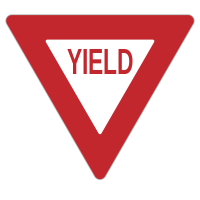
  • Downward-pointing red triangle with white center and the word YIELD in redYield: slow down and give way
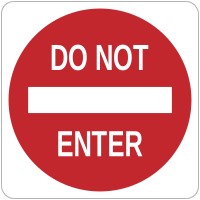
  • Red circle with a white horizontal bar on a white square, reading DO NOT ENTERDo not enter
  • Traffic signal with the red light lit and flash marks around itFlashing red: treat it as a stop sign
  • Four-section left-turn signal with the flashing yellow arrow litFlashing yellow arrow: turn after yielding
  • Two-way road divided by two solid yellow lines; no passing in either directionDouble solid yellow: no passing either way
  • White sign: SCHOOL on fluorescent yellow-green, SPEED LIMIT 20, WHEN FLASHINGSchool zone: 20 mph while flashing
  • White X-shaped crossbuck reading RAILROAD CROSSINGRailroad crossbuck: stop 15 feet back if a train is coming
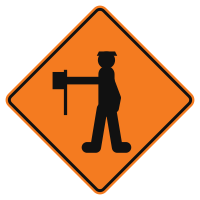
  • Orange diamond with a black flagger symbol holding a flagFlagger ahead: fines double in work zones
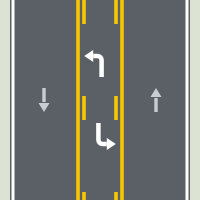
  • Center lane bordered by solid yellow outer lines and broken yellow inner lines, with opposing left-turn arrowsCenter turn lane: left turns only, never for passing

Free practice test

20 practice questions from the Oregon Driver Manual

These 20 questions are written from the Oregon Driver Manual, with three answer choices like DMV's own sample questions. The real test has 35 questions and you need 28, which is 80%, so 16 right out of 20 here is a pass. After each answer, the tutor can explain it another way or tell you why the other choices are wrong.

Question 1 of 20
Four-section left-turn signal with the flashing yellow arrow lit

You want to turn left and this signal is showing. What does it mean?

20 practice questions in the style of the knowledge test.

Test day

What to bring to DMV for your instruction permit

  • Proof of identity and date of birth, such as a U.S. birth certificate or passport. Originals only, no photocopies
  • One proof of your Oregon home address, such as a utility bill from the last six months
  • Your Social Security number, or you'll certify that you don't have one
  • A parent or legal guardian if you're under 18, to sign your application
  • Your glasses or contacts for the vision test
  • Money for the test and the permit, paid separately: $7 for the test, $30 for a standard permit

Before you go

  1. Read the Oregon Driver Manual. It's free online, as a PDF and as audio, in English and Spanish.
  2. Take DMV's free sample questions, then the 20 questions on this page.
  3. Decide whether you want a REAL ID permit. It costs $30 more and needs extra documents.
  4. Check your documents against DMV's proof of identity and address list.
  5. Choose online testing or an office visit. Online needs a computer with a mouse, keyboard and webcam, not a phone or tablet.
  6. If you're under 18, line up a proctor for the online test and a parent or guardian for the office visit.
Oregon DMV: Online knowledge testingTake the knowledge test online at any time, or book an office visit through DMV2U. After an online pass you still visit an office to finish your permit.

Study options

Where to study

DMV says the Oregon Driver Manual covers what you need to pass the knowledge test, and it's free online, as a PDF and as an audio book, in English and Spanish. DMV also posts 20 sample questions. We've compared those with the apps and driver education options Oregon learners use.

OptionPriceFree to useLinks
Official and free
Oregon Driver ManualOfficial · Online, PDF and audioDMV's own manual, which DMV says covers what you need to pass the knowledge test. Read it online section by section, print the PDF (form 37, or 37s in Spanish), or listen to the audio version. DMV's manuals page shows a 2026-2027 cover.
FreeThe whole manual, in English and Spanish
DMV practice knowledge testOfficial · OnlineTwenty three-choice questions, each linked to the manual section it comes from. It's in English and Spanish and doesn't affect your driving record. Short, so use it as a check rather than your only practice.
Free20 sample questions
How to Guide Your Teen Driver and the practice logOfficial · Online and PDFDMV's guide for parents who supervise a teen on a permit, in English and Spanish, plus a log for the 50 or 100 practice hours a provisional license needs. Useful once the permit is in your hand.
FreeThe whole guide and a printable log
Motorcycle and commercial driver manualsOfficial · Online, PDF and audioThe Oregon Motorcycle and Moped Manual (form 6367) for the 25-question motorcycle test, and the Oregon Commercial Driver Manual (form 36m) for the CDL knowledge tests.
FreeBoth manuals
Apps and websites
Oregon DMV Permit Practice (S Mehta)iPhone appCar, motorcycle and CDL practice, a signs test, a fines and limits section and a marathon mode. 4.7 stars from 257 App Store ratings, last updated July 2025. A private app, not from DMV.
Free with in-app purchases: $3.99 a week, $8.99 a month or $17.99 lifetime, plus $2.99-$3.99 to remove adsFree to download, with ads. The listing doesn't say what premium unlocks
Oregon DMV Knowledge Test (Nilu Rathod)iPhone appCar, motorcycle and CDL practice tests with bookmarks and saved progress. 4.8 stars from 46 App Store ratings, last updated July 2025. A private app, not from DMV.
Free with in-app purchases: $2.99 for 7 days, $7.99 for 30 days or $12.99 lifetimeFree to download. The listing doesn't say what premium unlocks
Driving-Tests.org and DMV GenieWebsite and appTests grouped from the basics up to signs and rules that trip people up. Its exam simulator copies the real test's length but uses its own questions.
Free tests, with a paid premium plan. The site doesn't show the price up frontAbout 20 Oregon practice tests and quizzes, including a 35-question exam simulator, and a cheat sheet
In person
ODOT-approved driver educationClassroom and behind-the-wheel courses for ages 15-17Passing an approved course cuts your practice log from 100 hours to 50, and DMV can waive the drive test if you passed it in the past two years. ODOT lists providers by region, including bilingual ones, and says a listing isn't an endorsement.
Set by each providerNothing, these are paid courses
TEAM OREGON rider coursesMotorcycle trainingA course is required for a two-wheel motorcycle endorsement. The in-person Basic course covers both DMV's knowledge and skills tests, while the online Basic and the Intermediate courses cover only the skills test.
Set by TEAM OREGONNothing, these are paid courses

Prices and ratings checked October 2026.

FAQ

Common questions

How many questions are on the Oregon permit test?

35 multiple-choice questions, and you need 28 right to pass. That's the Class C knowledge test for cars. The motorcycle knowledge test is shorter, at 25 questions.

Can I take the Oregon DMV permit test online?

Yes. You can take it at home at any time on a laptop or desktop with a keyboard, mouse and webcam. Phones and tablets don't work. If you're under 18, an adult 21 or older has to register as your proctor and watch. You still visit a DMV office afterward to get the permit.

How much is the permit test in Oregon?

$7 for each try, online or at an office, as of October 2026. When you pass, the instruction permit itself costs $30, or $60 as a REAL ID. A failed test is charged again on the next try.

How old do you have to be to get a permit in Oregon?

15. DMV's teen permit is for drivers aged 15, 16 and 17, and a parent or legal guardian has to sign. At 18 or older you can get an instruction permit too, but you don't need one before the drive test.

What happens if I fail the Oregon permit test?

Pay the $7 again and retake it. At an office you may be able to retest the same day if there's room. Online, you get two tries in 24 hours and four tries in all, then you have to test at an office.

Is there a free Oregon DMV practice test?

Yes. DMV posts 20 sample questions, in English and Spanish, and taking them doesn't affect your record. The 20 questions on this page are free too, with an explanation for every answer.

Sources: Oregon DMV, Oregon Driver Manual and 3 more. Checked October 2026.

Rules and fees can change, so check the official site before your test.

All 20 practice questions with answersA printable list of the practice test above
  1. Four-section left-turn signal with the flashing yellow arrow lit

    You want to turn left and this signal is showing. What does it mean?

    You may turn, but first yield to oncoming traffic and pedestrians A flashing yellow arrow lets you make the turn it points to, but it doesn't protect you. The Oregon Driver Manual says oncoming traffic has a steady green at the same time, so you yield to it and to pedestrians before you turn.
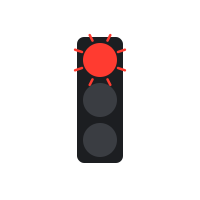
  2. Traffic signal with the red light lit and flash marks around it

    What should you do when you reach an intersection where this signal is flashing?

    Stop completely, then go when it's safe, as you would at a stop sign The manual says a flashing red signal is treated the same as a stop sign. You come to a full stop, yield to traffic and pedestrians, and go when it's safe. A signal that's dark, for example in a power cut, works the same way.
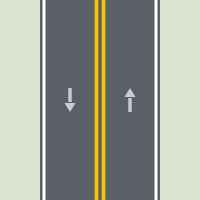
  3. Two-way road divided by two solid yellow lines; no passing in either direction

    What do these center lines tell you?

    No passing in either direction Two solid yellow center lines mean passing isn't allowed in either direction. A broken yellow line on your side is what allows passing.
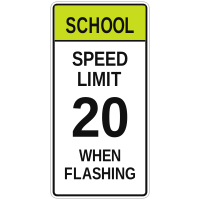
  4. White sign: SCHOOL on fluorescent yellow-green, SPEED LIMIT 20, WHEN FLASHING

    What does this sign mean?

    Drive no faster than 20 mph while the yellow light is flashing This school speed sign has a light, and the 20 mph limit applies while it's flashing. The manual also says 20 mph applies in a school zone any time children are present, so slow down if you see kids near the crosswalk.
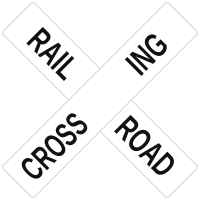
  5. White X-shaped crossbuck reading RAILROAD CROSSING

    A train is coming as you reach this sign, and there's no stop line. Where should you stop?

    At least 15 feet from the nearest rail This is a railroad crossbuck. The manual says that when you must stop and there's no stop line, you stop at least 15 feet from the nearest rail. It also says trains are closer than they look and can't stop quickly.

  6. Who can supervise you while you drive with an Oregon instruction permit?

    A licensed driver who is at least 21 and sits in the seat beside you DMV's permit rules say you may drive only with a person who has a valid driver license, is at least 21 years old and is sitting beside you. That applies to permits at any age.

  7. For your practice hours to count toward a provisional license, how long must your supervising driver have held a license?

    At least 3 years DMV says the supervising driver must have been licensed for at least 3 years for the practice to count toward the 50 or 100 hours you need. They also have to be 21 or older.

  8. You're 16 and haven't taken an approved driver education course. How many hours of supervised driving do you need before a provisional license?

    100 hours Teens need 100 hours of supervised driving, or 50 hours if they've passed an approved driver education course. You also need to have held your instruction permit for 6 months.

  9. In your first 6 months with a provisional license, which of these passengers can't ride with you?

    A 17-year-old friend For the first 6 months you can't carry a passenger under 20 who isn't in your immediate family. Your brother is family, and the passenger rules don't apply when a parent is with you.

  10. At an intersection with no signs or signals, another car is arriving from your right at the same time as you. What should you do?

    Yield to the car on your right The manual says to yield the right of way to any vehicle already in the intersection or approaching from your right. Look left first, then ahead and to the right.

  11. A school bus ahead of you on a two-lane road turns on its flashing red lights. What must you do?

    Stop before you reach the bus and stay stopped until the driver turns the red lights off When a school bus's red lights are flashing, you stop before reaching it and stay stopped until the driver turns the lights off. On a two-lane road that applies in both directions.

  12. You hear a siren and see an ambulance with flashing lights coming up behind you. What should you do?

    Pull as close to the right side of the road as you safely can and stop, but not in an intersection The manual says to drive as close as you safely can to the right side of the road and stop, and not to stop in an intersection. Once it has passed, stay at least 500 feet behind it.

  13. You're about to enter a roundabout. Who do you yield to?

    Traffic already in the roundabout and traffic leaving it Traffic in a roundabout moves counterclockwise around the center island. Before you enter, you yield to traffic already circling and to traffic leaving. Signal right when you exit.

  14. Unless a sign shows a different limit, what's the speed limit in an Oregon residential district?

    25 mph Oregon's default speed limit is 25 mph in residential districts, public parks and on ocean shores where vehicles are allowed. Business districts and school zones are 20 mph, and alleys and narrow residential roadways are 15 mph.

  15. You're driving faster than 30 mph. How much following distance does the Oregon Driver Manual tell you to keep?

    4 seconds or more The manual defines a safe following distance as 2 to 4 seconds, and says to keep 4 seconds or more above 30 mph. Count from when the car ahead passes a fixed point until you reach it.

  16. When must you dim your high beams for a car coming toward you?

    When it's within 500 feet The manual says to dim your high beams when an oncoming vehicle is within 500 feet. When you're following a vehicle, dim them within 350 feet.

  17. You're 19. What blood alcohol level counts as a failure for you in Oregon?

    Any measurable amount Oregon has a zero tolerance law for drivers under 21: any measurable blood alcohol is a failure. The 0.08% level applies to drivers 21 and over, and they can be arrested below it too.

  18. Your car starts to skid on an icy road. What should you do?

    Stay off the brakes and steer in the direction you want to go The manual says to stay off the brakes until the car slows, because brakes don't work well in a skid. Steer where you want to go, then straighten the wheel as the car comes back in line.

  19. How far before a turn or lane change must you signal?

    At least 100 feet The manual says to signal at least 100 feet before you turn or change lanes. Hand signals are only allowed in daylight, when you can see clearly for 1,000 feet.

  20. How close to a fire hydrant can you park?

    No closer than 10 feet You may not park within 10 feet of a fire hydrant. The manual also bans parking within 20 feet of a crosswalk at an intersection and within 50 feet of the nearest rail at a railroad crossing.