Vermont · Permit test

Vermont permit test

You take Vermont's learner's permit test online through myDMV, not at a DMV office. It has 20 multiple-choice questions with four choices each, and you need 16 right to pass. You can sit the Vermont permit test from age 15, and until you're 18 a parent or guardian signs your application first. Each try costs $39, and passing doesn't issue the permit on its own: you apply for it afterwards and pay $24 more.

  • 20Multiple-choice questions, four answers each
  • 16Correct answers needed to pass
  • $39 + $24Test fee plus permit fee
  • 1 dayWait before a retake

Key facts

At a glance

To pass
16 correct, so you can miss 4
Where
Online through myDMV, not at an office
Minimum age
15, with a parent's or guardian's signature until 18
Languages
English, American Sign Language and 14 more

How it works

How the Vermont permit test works: online, 16 of 20 to pass

Knowledge test
16 to pass
To pass you need 16 of 20 right.
  1. You take the permit test online through myDMV, the DMV's online services site. The manual says it's no longer given at DMV offices.
  2. It has 20 multiple-choice questions, each with four choices and one correct answer, and you need 16 right to pass.
  3. You must be 15 or older. From 15 to 17, a parent or legal guardian signs the application before you can take the test.
  4. The $39 test fee is charged each time you take it, whether you pass or fail.
  5. If you fail, wait at least one day before trying again. There's no limit on attempts.
  6. Passing doesn't issue the permit by itself. You then apply for it and pay $24, and your payment receipt works as a temporary permit for 90 days.
  7. The test comes in English, American Sign Language and 14 other languages.

Topics

What’s on the test

01

Learner's permits, junior licenses and the GDL law

Chapters 4 and 5 of the manual: who can get a learner's permit, who must ride with you, and the steps and limits of Vermont's Graduated Driver's License program.

Key points (4)
  • You must be at least 15 to take the permit test, and a parent or guardian signs for anyone 15 to 17.
  • With a permit, a licensed and unimpaired parent or guardian, driver education instructor, or person 25 or older must ride beside you.
  • You hold the permit at least one year and log 40 hours of practice, 10 of them at night, before a junior license.
  • For the first three months of a junior license you drive alone unless one of those supervisors is in the front seat. In months four to six you may carry siblings and parents.
02

Signals, turns, following distance and speed

The first part of Chapter 7: getting ready to drive, stopping distance, signaling, turns, the 4-second rule and Vermont's speed limits.

Key points (4)
  • Signal at least 100 feet before a turn or lane change. Signaling 3 to 5 seconds ahead covers it.
  • Keep at least 4 seconds behind the vehicle ahead, and more in bad weather, poor visibility or at higher speeds.
  • The top speed on any Vermont road is 50 mph unless posted, and 65 mph on an interstate unless posted.
  • It takes the average driver about three quarters of a second to start braking after seeing danger.
03

Right-of-way, roundabouts and parking

Who goes first at intersections and four-way stops, how to drive a roundabout, where you may not park, and what to do for police and emergency vehicles.

Key points (4)
  • At a four-way stop the first to arrive goes first. If two arrive together, the driver on the left yields to the driver on the right.
  • In a roundabout, traffic moves counterclockwise, you yield to vehicles already in it, and you may not change lanes inside it.
  • Don't park within 6 feet of a fire hydrant, 20 feet of a crosswalk at an intersection, or 50 feet of the nearest rail at a railroad crossing.
  • When an emergency vehicle with flashing lights or a siren approaches, pull to the right and stop until it has passed.
04

Traffic lights, signs and road markings

What each signal and arrow means, how to read signs by shape and color, work zone signs and flaggers, and what the lines on the road tell you.

Key points (4)
  • If a signal is dark, as in a power cut, stop as if there were stop signs in every direction.
  • A flashing yellow arrow means you may turn left after yielding to oncoming traffic and pedestrians.
  • Warning signs are usually diamond-shaped and yellow or green. Work zone signs are orange, and speeding fines double in a work zone.
  • If the edge line on your right is yellow on a divided highway, you're going the wrong way.
05

Sharing the road and railroad crossings

Pedestrians, school buses, bicyclists, motorcycles and large trucks, and the stopping rules at railroad crossings.

Key points (4)
  • Never pass a school bus that has stopped with its red lights flashing. In Vermont that brings a fine and five points.
  • Leave at least four feet between your car and a bicyclist you pass.
  • Stop at least 15 feet from the nearest rail when lights flash, gates are down, a train is coming or there's a stop sign.
  • If you can't see a truck's side mirrors, its driver can't see you.
06

Winter, night and interstate driving

Floods, storms and winter roads, skids and anti-lock brakes, headlights at night, and using interstate ramps and lanes.

Key points (4)
  • Headlights must be on from half an hour after sunset to half an hour before sunrise, and whenever you can't see people or vehicles 500 feet ahead.
  • In a skid, don't hit the brakes. Steer in the direction you want the car to go.
  • With anti-lock brakes, keep steady pressure on the pedal and don't pump it.
  • If you miss an interstate exit, never back up or use the emergency turnaround. Go on to the next exit.
07

Alcohol, drugs, drowsiness and phones

Vermont's alcohol limits and implied consent law, drowsy driving, and the ban on portable electronic devices while driving.

Key points (4)
  • A driver with a blood alcohol concentration of .08 or more is under the influence. Under 21, .02 or more is a civil violation and a suspension.
  • Refusing a test when an officer asks means losing your license for at least six months.
  • It takes at least an hour per drink for alcohol to leave your body. Coffee or a cold shower doesn't help.
  • You may not use a portable electronic device while driving on a public highway, even when stopped. A first offense is a $100 to $200 fine.
08

Points, insurance, crashes and your vehicle

Chapters 7 to 9: what to do after a crash, yearly inspection, the point system and Vermont's insurance minimums.

Key points (4)
  • Report a crash to the DMV in writing within 72 hours if anyone is hurt or the damage is over $3,000.
  • Your vehicle must be inspected once a year, and within 15 days of registration unless it has a valid Vermont sticker.
  • At 10 points you get a letter saying your license is to be suspended.
  • Liability insurance must be at least $25,000 for one person, $50,000 for two or more and $10,000 for property damage.

Road signs

Signs from Chapter 7 of the Vermont Driver's Manual

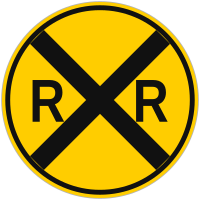
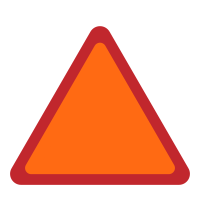
The Vermont Driver's Manual says you should know a sign's general meaning from its shape alone, in case snow or dirt covers the words. Two shapes in its sign pages are easy to mix up: a round sign with an X and RR warns of a railroad crossing ahead, and a triangle with its points cut off marks a slow-moving vehicle, such as a tractor.

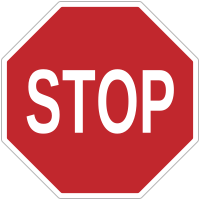
  • Red octagon with white border and the word STOP in whiteStop: eight sides. Stop before the stop line, the crosswalk or the road, whichever comes first
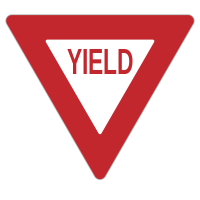
  • Downward-pointing red triangle with white center and the word YIELD in redYield: an upside-down triangle, so slow down and go only when the way is clear
  • Round yellow sign with a black X and two letters RRailroad crossing ahead: round, with an X and RR
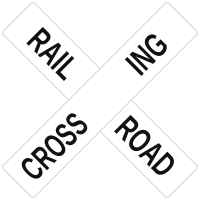
  • White X-shaped crossbuck reading RAILROAD CROSSINGCrossbuck: it marks the tracks. Slow down, look both ways and listen for trains
  • Fluorescent orange triangle with a red reflective borderSlow-moving vehicle: a triangle with its points cut off, often on farm vehicles
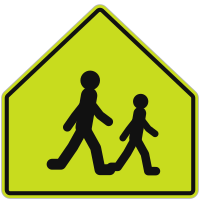
  • Fluorescent yellow-green pentagon with two children walkingSchool: watch for children and buses, and check for a lower school speed limit
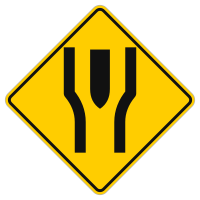
  • Yellow diamond showing a road splitting around a black median aheadDivided highway ahead: a warning sign from the manual's Chapter 7
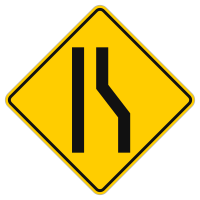
  • Yellow diamond with two lines; the right line angles in as the right lane endsLane ends: the right lane ends ahead, so merge left when it's safe
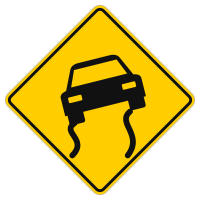
  • Yellow diamond with a car and two S-shaped skid marksSlippery when wet: slow down, since braking distance grows on wet roads
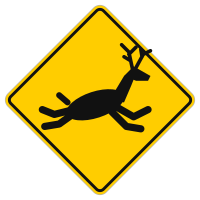
  • Yellow diamond with a black leaping deerDeer crossing: some warning signs add a distance, such as next 3 miles
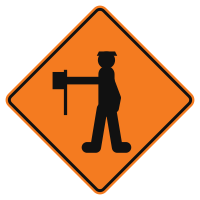
  • Orange diamond with a black flagger symbol holding a flagFlagger ahead: work zone signs are orange, and a flagger must be obeyed
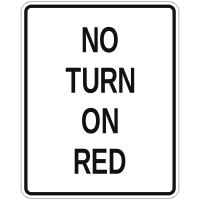
  • White sign reading NO TURN ON REDNo turn on red: don't turn right on red while this sign applies

Test day

What you need to apply for your Vermont learner's permit

  • An original or certified birth certificate, or a valid passport
  • The License/Permit Application, form VL-021, signed by a parent or guardian if you're under 18
  • Two pieces of mail showing your name and Vermont street address
  • Your Social Security number, if you have one
  • A way to pay the $39 test fee and the $24 permit fee

Before you go

  1. Read the whole Vermont Driver's Manual. Chapter 7 is the part written for the permit test, and you can't use the manual during the test.
  2. Work through DriveVermont, the DMV's free web tutorial, and take the DMV's practice exam at the end of it.
  3. If you're 15, 16 or 17, get a parent or guardian to sign the application first.
  4. Under 18, check that your driving record has been clean for the last two years. If you've had a recall or suspension, contact the DMV first.
  5. If you have a medical condition that can cause a loss of consciousness, call the DMV's Driver Improvement Section at 802-828-2000 before you test.
  6. If reading is hard for you, ask the DMV about the audio and interactive versions of the manual.
Vermont DMV: Learner's PermitThere's no appointment for the permit test: you take it online through myDMV, linked from this page. Road tests are by appointment.

Study options

Where to study

The Vermont Driver's Manual is free from the DMV as a PDF, as audio files and in translations from Arabic to Ukrainian, and Chapter 7 is the part written to get you ready for the permit test. The DMV's DriveVermont web tutorial adds quizzes and ends with the DMV's practice exam, which the manual says looks very similar to the real one. Apps, websites and driving schools are compared on this page by price and what you get free.

OptionPriceFree to useLinks
Official and free
Vermont Driver's ManualOfficial · PDFForm VN-007, with 2025 on the cover. Chapter 7, Driving Safely and Studying for Your Permit, is written to prepare you for the permit test. You can't use it during the test.
FreeThe whole manual
DriveVermont and the DMV's practice examOfficial · Web tutorialThe DMV's interactive version of the manual, with images, videos and quizzes. It ends with the DMV's practice exam, which the manual says looks very similar to the real test. The manual sends you to dmv.vermont.gov to start it.
FreeThe lessons, quizzes and practice exam
Audio and translated manualsOfficial · MP3 and PDFMP3 files of Chapters 4, 5 and 7, last updated January 12, 2022, and translations of the manual from Arabic to Ukrainian. The permit test comes in English, ASL and 14 other languages.
FreeEvery file
Motorcycle and CDL manualsOfficial · PDFThe Motorcycle Manual (VN-008) for the motorcycle permit test, and the Commercial Driver's License Manual (VN-111, August 2025) for the CDL knowledge tests.
FreeBoth manuals in full
Apps and websites
Driving-Tests.org and DMV GenieWeb and app · all statesOne company runs both. The Vermont section groups 140 essentials questions, 305 harder ones and 93 on fines, distraction and drinking, plus a 20-item exam simulator. DMV Genie is rated 4.8 on the App Store from about 184,000 ratings across all states.
Vermont tests on the website marked free. DMV Genie app purchases from $9.99Five Vermont permit practice tests, plus sign and topic tests
ZutobiApp and web · all statesShort lessons and quizzes that play like a game. The Vermont page claims more than 600 Vermont questions based on the Driver's Manual and gives the same 16-of-20 pass mark the manual does.
Free to try, then paid plans. Its page lists no pricesA free start; the rest needs a paid plan
Vermont DMV VT Permit test ed (Driver-Start.Com)App · iPhoneNot from the DMV, despite the name. Works offline and includes a copy of the manual. Rated 4.2 from 23 ratings, and its last App Store update was in October 2017, so check its answers against the current manual.
Free, with $0.99 purchases to remove adsAll the questions, flashcards and a mock test
In person
DMV-licensed driving schoolsLocalPrivate schools licensed by the DMV teach the 30-hour driver education course teens need, and adult 6+6 courses. Some also give the road test. The DMV lists them by county and on a map.
Set by each school
Vermont Rider Education Program (VREP)Official · Motorcycle courseThe DMV's motorcycle courses. Passing the Basic RiderCourse or the Intermediate RiderCourse exempts you from the motorcycle endorsement's written and skills tests. You sign up through myDMV.
Not listed on the DMV's pageMotorcycles provided

Prices and ratings checked October 2026.

FAQ

Common questions

How many questions are on the Vermont permit test, and how many can you miss?

There are 20, and you need at least 16 right, so you can miss 4. The Vermont Driver's Manual says each question has four answers to choose from and only one is correct.

Can I take the Vermont permit test online?

Yes, and it's the only way. The DMV moved the learner's permit test online, through myDMV, and the manual says it's no longer taken in a DMV office. If reading is hard for you or you have a disability, tell the DMV, and it will work with you on an accommodation.

How old do you have to be to get a learner's permit in Vermont?

You must be at least 15 to take the test. From 15 to 17 you need a parent's or legal guardian's permission, and they sign the application before you test. Under 18, your driving record also has to be clean for the previous two years.

What happens if I fail the Vermont DMV permit test?

You wait at least one day and try again. There's no limit on how many times you can take it, but the $39 test fee is due on every attempt. Before you retake it, go back over the manual, Chapter 7 especially.

Do I get my permit as soon as I pass?

No. Passing the exam doesn't issue the permit, so you still have to apply and pay the $24 permit fee. After you pay, your receipt works as a temporary permit for 90 days, and you carry it whenever you drive. If you passed and heard nothing, the DMV asks you to email DMV.eServices@vermont.gov and allow up to 48 business hours, or call 802-828-2000.

Who can ride with me on a Vermont learner's permit?

A licensed and unimpaired parent or guardian, a licensed or certified driver education instructor, or a licensed and unimpaired person 25 or older, in the front seat, at any age. The rest of the permit rules, including driving in other states, are on the driver's license page.

Is the Vermont permit test the same as the driving test?

No. The permit test is the online knowledge test. The driving test, which the DMV calls the road test, comes later, by appointment, after you've held the permit for at least a year.

Sources: Vermont DMV and 5 more. Checked October 2026.

Rules and fees can change, so check the official site before your test.