Massachusetts · Permit test

Massachusetts permit test: the RMV learner’s permit exam

It’s the learner’s permit exam of the Registry of Motor Vehicles (RMV), and you pass it before your first Class D or Class M license. The Massachusetts permit test starts with a visit to an RMV Service Center by appointment, and its questions come from the Massachusetts Driver’s Manual, so that’s the book to study.

  • 25Multiple-choice questions on each exam
  • 25 minutesTime limit, with no pausing
  • About 1 minuteTime per question, in the Driver’s Manual

Key facts

At a glance

Who runs it
The Registry of Motor Vehicles (RMV), part of the Massachusetts Department of Transportation
Where you take it
At an RMV Service Center during your appointment, or online at home afterward
What it covers
Rules of the road, road signs, alcohol and drug misuse, suspensions and junior operator violations, and sharing the road with bicyclists, pedestrians and people with visual impairments
Vision screening
At your appointment, for field vision and basic colors, or a vision screening certificate from your medical practitioner

How it works

How the Massachusetts permit test works

Learner’s permit exam · 18 to pass
18 to pass
To pass you need 18 of 25 right.
  1. You start your application online on myRMV, the RMV’s online service center, then book a learner’s permit appointment at an RMV Service Center. AAA members can book at a AAA branch instead.
  2. At the appointment, staff check your identity documents, take your photo and screen your vision, and you tell them whether you’ll take the exam there or online at home.
  3. At a Service Center you answer on a touch-screen testing station.
  4. Manuals, notes, phones and other electronic devices aren’t allowed, and neither are hats unless you wear one for medical or religious reasons. Using a manual, notes or a device counts as cheating.
  5. If you pass, the permit lets you start supervised driving. The learner’s permit page sets out what you may and may not do with it.

Topics

Massachusetts driving rules in the manual

The exam’s questions come from these parts of the Driver’s Manual, revised April 2026.

01

Licenses, permits and restrictions

Chapter 1 of the Driver’s Manual explains who needs a license, the license classes, the junior operator law, ID rules and the steps from permit to license.

Key points (4)
  • A learner’s permit becomes a license only after you pass the road test and pay the license fees.
  • If you pass the vision test wearing glasses or contact lenses, your license carries restriction code B and you must wear them to drive.
  • Restriction code I, Junior Operator, goes on the license of everyone under 18.
  • If the RMV denies your permit, license or ID application, you can appeal within ten days of the written denial.
02

Seat belts, phones and defensive driving

Chapter 2 covers the equipment every passenger vehicle needs, seat belt and child seat rules, the hands-free law and how to keep space around your car.

Key points (4)
  • Children ride in an approved child restraint until they’re 8 years old or at least 57 inches tall, and wear a seat belt after that.
  • Never put a rear-facing child seat in the front passenger seat if that seat has an air bag.
  • Drivers 18 and older may use a phone only in hands-free mode: mounted, and touched only to turn hands-free on.
  • Follow at least three seconds behind the vehicle ahead in good conditions, and at least four seconds behind a motorcycle.
03

Violations, suspensions, alcohol and drugs

Chapter 3 explains civil and criminal violations, surchargeable events, the suspension charts and the alcohol and drug laws.

Key points (4)
  • Three surchargeable events, such as at-fault crashes or moving violations, within two years mean a Driver Retraining course within 90 days.
  • Seven surchargeable events within three years bring an automatic 60-day suspension.
  • Out-of-state violations go on your Massachusetts record as if they happened in Massachusetts.
  • Every driver fails a chemical test at a blood alcohol content of 0.08 or more, and drivers under 21 face penalties from 0.02.
04

Speed limits, signals and lights

The speed laws, traffic signals and turn signals from chapter 4, with the headlight rules from chapter 2.

Key points (4)
  • Unless signs say otherwise: 20 mph in a school zone, 30 mph in a thickly settled or business district, 40 mph outside one and 50 mph on a highway outside one.
  • Interstates and other limited-access highways have limits from 50 to 65 mph, and the Massachusetts Turnpike has a 40 mph minimum.
  • Switch to low beams within 500 feet of an oncoming vehicle and within 200 feet of a vehicle you’re following.
  • Signal at least 100 feet before a turn, or at least 500 feet before a turn on a highway.
05

Signs and pavement markings

The manual teaches signs by color and shape, then covers work zones and the white and yellow lines on the road.

Key points (4)
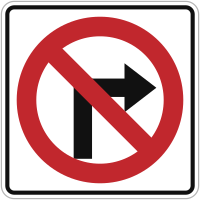
  • Regulatory signs have a red or white background and set out traffic laws, and a red circle with a slash means the action shown isn’t allowed.
  • A 4-WAY or ALL WAY sign under a STOP sign means all traffic coming to the intersection must stop.
  • At a STOP sign, come to a complete halt before the crosswalk or stop line.
  • Green signs give highway directions, and blue signs list services such as gas, food and lodging.
06

Lanes, rotaries and right-of-way

How to use lanes and highways, how rotaries work in Massachusetts, turns and backing, and who goes first.

Key points (4)
  • Traffic in a rotary travels counter-clockwise, and you yield to vehicles already in it and to pedestrians.
  • In a single-lane rotary, enter from the right lane and exit onto the right lane.
  • At an intersection with an all-way stop, the first vehicle in the intersection has the right-of-way.
  • Leave at least four feet when you pass a vulnerable road user, such as a pedestrian, a bicyclist or a roadside worker.
07

Sharing the road and special situations

Pedestrians, bicyclists, school buses and emergency vehicles, and what to do if a police officer stops you.

Key points (4)
  • Stop for a school bus with flashing red lights and its stop sign out, whichever side of the road you’re on, and stay stopped until the lights stop.
  • Slow down to a safe speed for a stopped emergency or highway maintenance vehicle with its lights flashing.
  • Look behind you before you open a car door, so you don’t open it into a bicyclist.
  • Don’t drive by or park within 800 feet of a fire.
08

Parking, crashes and emergencies

Where you may not park, what to do in a driving emergency and the steps after a crash.

Key points (3)
  • Don’t park within 20 feet of an intersection or within ten feet of a fire hydrant or fire lane.
  • Don’t park in a bicycle lane, a crosswalk, in front of a driveway or facing the wrong way against traffic.
  • Don’t park in a posted bus stop or a taxi stand, or during a posted street cleaning time.

Road signs

Road signs in the Massachusetts Driver’s Manual

The manual teaches signs by color first. Red means stop or a ban, yellow a general warning, black and white a rule, orange road work, and fluorescent yellow-green a school zone, bicycle, pedestrian or curve warning.

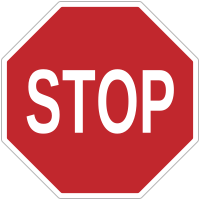
  • Red octagon with white border and the word STOP in whiteStop: just slowing down isn’t enough
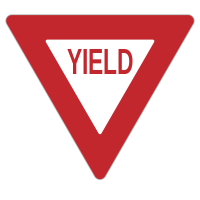
  • Downward-pointing red triangle with white center and the word YIELD in redYield: slow down, be ready to stop and let vehicles, bicyclists and pedestrians go first
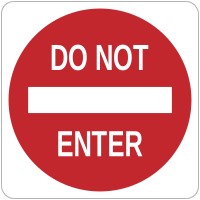
  • Red circle with a white horizontal bar on a white square, reading DO NOT ENTERDo not enter
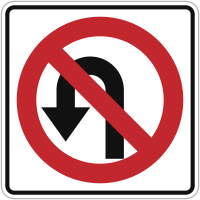
  • Black U-turn arrow inside a red circle with a red slashNo U-turn
  • Black right-turn arrow inside a red circle with a red slashNo right turn
  • White sign reading NO TURN ON REDNo turn on red: you may not turn after stopping at a red light
  • Fluorescent yellow-green pentagon with two children walkingSchool zone: look for children crossing and crossing guards
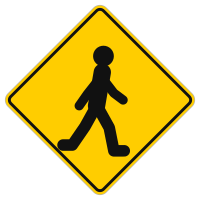
  • Yellow diamond with a black walking personPedestrian crossing
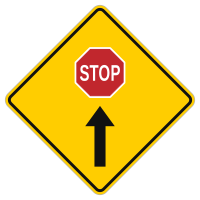
  • Yellow diamond with a red octagon and a black arrow pointing up toward itStop ahead: slow down and get ready to stop
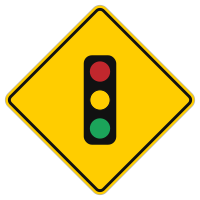
  • Yellow diamond with a black traffic signal showing red, yellow and green lightsTraffic signal ahead
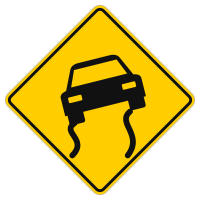
  • Yellow diamond with a car and two S-shaped skid marksRoad slippery when wet
  • Yellow diamond with three black arrows forming a counter-clockwise circleCircular intersection ahead
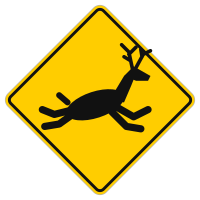
  • Yellow diamond with a black leaping deerDeer crossing
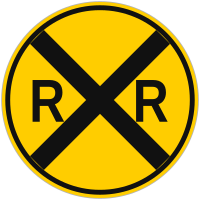
  • Round yellow sign with a black X and two letters RRailroad crossing ahead

Free practice test

20 practice questions from the Massachusetts Driver’s Manual

These 20 questions are written from the Massachusetts Driver’s Manual. The real learner’s permit exam has 25 questions and you need 18 right, which is 72%. Here we use our own bar, 15 of 20, which is close to that. Four show a sign. After each answer, the tutor can explain it another way or tell you why the other choices are wrong.

Question 1 of 20

You pass the vision test wearing glasses. What does your license carry?

20 practice questions in the style of the permit test.

Test day

What to bring to your permit appointment

  • Your completed license and ID application, started online on myRMV
  • For a REAL ID permit: 1 document proving lawful presence in the U.S., 1 proving your Social Security number and 2 proving Massachusetts residency
  • For a Standard permit: 1 or 2 documents proving your identity and date of birth, 1 proving Massachusetts residency, and your Social Security number or one of the RMV’s accepted alternatives
  • Original documents, not photocopies or laminated ones. The RMV’s Spanish appointment guide adds that documents not in English need a certified translation
  • Under 18: your parent or guardian’s signature on the application, and proof of authority if the person signing isn’t a parent
  • Headphones, if you want the audio version of the exam

Before you go

  1. Study the Massachusetts Driver’s Manual. The RMV tells you to study all of it.
  2. Choose a REAL ID or a Standard permit, and check your documents against the RMV’s list for that card.
  3. If a disability makes the standard exam hard, ask the Service Center manager about extended time or a paper exam. An oral exam has to be booked ahead by phone at 857-368-8105.
  4. Bring money for the exam fee; the fees page has the amount and the payment methods.
Massachusetts RMV: Apply for a Class D learner’s permitThe page links the online application and the Service Center appointment booking.

Study options

Where to study

Study from the Driver’s Manual first, then use the RMV’s practice exam to check yourself. For supervised driving, the RMV points families to a parents’ program and its RoadReady app.

OptionPriceFree to useLinks
Official sources
Massachusetts Driver’s ManualOfficial · PDF and printThe RMV’s study book for the Class D and Class M learner’s permit exam, revised April 2026.
Free PDF, or $5 printedThe whole manual, in English and 15 other languages
RMV learner’s permit practice examOfficial · online, in myRMVLinked from the RMV’s First Time Driver guide, under the study section.
No price listedPractice runs of the learner’s permit exam
Guides
Parent’s Supervised Driving ProgramRMV partner program · web and PDFThe RMV links it for parents and guardians guiding the supervised driving hours. Published by J.F. Griffin Publishing.
FreeThe whole program, with driving skill lessons and a supervised driving log
Apps and websites
RoadReady appRMV partner app · phoneThe RMV announced a 2026 update that scores each supervised drive and suggests coaching.
FreeLogging supervised drives and making a state-approved log
In person
RMV-licensed driver educationIn person · high schools and driving schoolsRequired under 18 for a Class D or M license. Public high school and private driving school programs meet the same RMV criteria, and the RMV posts a list of certified schools.
Set by each schoolNothing free
Massachusetts Rider Education ProgramIn person · motorcycle coursesRMV-approved rider courses. For riders 18 and older, the Basic Rider Course, Basic Rider Course 2 and 3 Wheel course waive the Class M road test; under 18, the Basic Rider Course is required.
Set by each schoolNothing free

Prices and ratings checked November 2026.

FAQ

Common questions

How many questions are on the Massachusetts permit test?

25 multiple-choice questions, and you need 18 right to pass. The RMV’s permit FAQ says the online exam is the same as the one at a Service Center, with the same number of questions and the same time. Commercial permit exams are longer; the commercial driver’s license page lists them.

Can I take the permit test online in Massachusetts?

Yes, for a Class D or Class M permit, once your Service Center appointment is done. You take it at home in myRMV, and the online permit test page has the steps and the computer and room rules.

Can I take the exam in another language?

Yes. The RMV’s list includes Spanish, Portuguese, Haitian Creole, Cape Verdean Creole, Chinese, Vietnamese, Arabic and Russian, and the online exam comes in the same languages. American Sign Language (ASL) is the exception: the ASL exam is given only at a Service Center, so book that appointment for 2:30 p.m. or earlier. Anyone can choose an audio exam read through headphones, and RMV Interpreter Services takes email requests for an oral exam in another language.

What happens if I fail the permit test?

You can take it again after paying the exam fee again. After an online exam, the retake starts from your myRMV profile; the online permit test page shows the steps. After an exam at a Service Center, you book another appointment.

Do I need driver’s ed before the permit test?

No. The RMV’s permit FAQ says you don’t have to sign up for driver’s education first. It matters later: under 18, you need an RMV-approved course before you can get your license.

All 20 practice questions with answersA printable list of the practice test above
  1. You pass the vision test wearing glasses. What does your license carry?

    Restriction code B: you must wear them to drive If you pass the vision test wearing glasses or contact lenses, your license carries restriction code B, and you must wear them to drive. Code B stands for corrective lenses.

  2. The RMV denies your learner’s permit application. How long do you have to appeal?

    Ten days after the written denial If the RMV denies your permit, license or ID application, you can appeal within ten days after you receive the written denial. Asking for an informal review doesn’t give you more time.

  3. Until when must a child ride in an approved child passenger restraint?

    Until 8 years old or 57 inches tall Children ride in an approved child restraint until they’re at least 8 years old or at least 57 inches tall. After that, they wear a seat belt.

  4. If you’re 18 or older, how may you use a phone while driving?

    Hands-free only, with the phone mounted Drivers 18 and older may use a phone only in hands-free mode. It must be mounted, and you may touch it only to turn hands-free on.

  5. How much following distance should you keep behind a motorcycle?

    At least four seconds Follow at least three seconds behind the vehicle ahead in good conditions, and keep more space, at least four seconds, behind a motorcycle. Count more for added safety when traffic allows.

  6. What happens after three surchargeable events within two years?

    You must take a Driver Retraining course Three surchargeable events, such as at-fault crashes or moving violations, within two years mean a Driver Retraining course within 90 days. Seven within three years bring an automatic 60-day suspension.

  7. You get a moving violation in another state. How does it affect your Massachusetts record?

    It counts as if it happened in Massachusetts Out-of-state violations go on your Massachusetts record as if they happened in Massachusetts. If you don’t pay or appear for it there, the RMV will take action against you.

  8. If you’re under 21, from what blood alcohol content (BAC) can a chemical test bring penalties?

    0.02 Every driver fails a chemical test at a BAC of 0.08 or more. Drivers under 21 face penalties from 0.02.

  9. Unless signs say otherwise, what is the speed limit in a thickly settled or business district?

    30 mph Unless signs say otherwise, the limit is 30 mph in a thickly settled or business district. It’s 20 mph in a school zone, 40 mph outside a thickly settled or business district and 50 mph on a highway outside one.

  10. At night, within how many feet of an oncoming vehicle must you switch to low beams?

    500 feet Switch to low beams within 500 feet of an oncoming vehicle and within 200 feet of a vehicle you’re following. Use high beams only in dark areas where you can’t see the road ahead.

  11. On a highway, how far before a turn must you signal?

    At least 500 feet Signal at least 100 feet before a turn, or at least 500 feet before a turn on a highway. It’s best to signal before you brake.
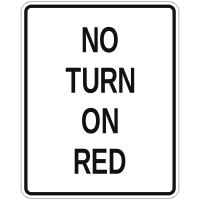
  12. White sign reading NO TURN ON RED

    What does this sign mean?

    You may not turn while the light is red This sign means you may not turn after stopping at a red light. Wait for the green.
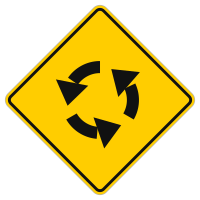
  13. Yellow diamond with three black arrows forming a counter-clockwise circle

    What does this sign warn you about?

    A circular intersection ahead This sign warns of a circular intersection ahead. Slow down, and be ready to yield to traffic already in it.
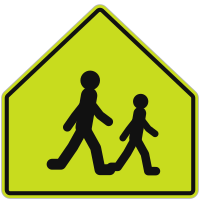
  14. Fluorescent yellow-green pentagon with two children walking

    What should you do when you see this sign?

    Look for children and crossing guards This sign marks a school zone. Look for children crossing and for crossing guards, and keep to the school zone limit.
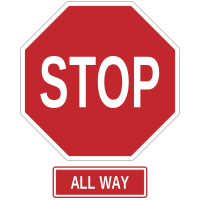
  15. STOP sign with a red ALL WAY plaque beneath it

    What does this sign tell you?

    Every driver here must come to a stop A 4-WAY or ALL WAY sign under a STOP sign means all traffic coming to the intersection must stop. The first vehicle in the intersection has the right-of-way.

  16. How does traffic move in a Massachusetts rotary?

    Counter-clockwise, yielding to traffic in the rotary Traffic in a rotary travels counter-clockwise. Yield to vehicles already in it and to pedestrians.

  17. When you pass a pedestrian, a bicyclist or a roadside worker, how much space must you leave?

    At least four feet When you pass a vulnerable road user, such as a pedestrian, a bicyclist or a roadside worker, leave at least four feet. If it’s safe, you may use part of the next lane to do it.

  18. On a two-lane road, a school bus coming toward you stops with its red lights flashing and its stop sign out. What must you do?

    Stop until the lights stop flashing Stop for a school bus with flashing red lights and its stop sign out, whichever side of the road you’re on. Stay stopped until the lights stop flashing or the stop sign folds back.

  19. Within how many feet of a fire is it illegal to drive by or park?

    800 feet It’s illegal to drive by or park within 800 feet of a fire. Don’t drive over an unprotected fire hose unless a firefighter or public safety official tells you to.

  20. What is the closest you may park to a fire hydrant?

    10 feet Don’t park within ten feet of a fire hydrant or fire lane, or within 20 feet of an intersection. Parking on a sidewalk or facing the wrong way against traffic is also banned.

Sources: Massachusetts Registry of Motor Vehicles and 6 more. Checked November 2026.

Rules and fees can change, so check the official site before your test.