Ohio · Knowledge test

The Ohio permit test (the temps test)

Forty multiple-choice questions stand between you and your temps. Ohio has no Department of Motor Vehicles (DMV): the Bureau of Motor Vehicles (BMV) gives the permit test in Ohio, along with a vision screening, and you need 75% to pass.

  • 40Multiple-choice questions
  • 75%Correct answers you need to pass
  • 15½ yearsYoungest age to take it

Key facts

At a glance

Who runs it

The Ohio Bureau of Motor Vehicles (BMV), part of the Ohio Department of Public Safety

What it covers

Motor vehicle regulations and traffic signs, from the Digest of Ohio Motor Vehicle Laws

Where you take it

Online through BMV Online Services, at a Driver Exam Station, or at select deputy registrar agencies

What it leads to

Your temps: the temporary instruction permit identification card (TIPIC), which lets you practice with a licensed adult

Book to study

The Ohio Driver Manual, also called the Digest of Ohio Motor Vehicle Laws

How it works

How the Ohio permit test works

Knowledge test · 30 to pass
30 to pass
To pass you need 30 of 40 right.
  1. The questions cover motor vehicle regulations and traffic signs, from the Digest of Ohio Motor Vehicle Laws. Sections 2 to 10 of the Digest are the ones the BMV points you to for the test.
  2. You take a vision screening as well. If you wear glasses or contacts, bring them, because the result may put a restriction on your license.
  3. You can test online through BMV Online Services, or in person at any Driver Exam Station or at select deputy registrar license agencies.
  4. You can take it in Arabic, Chinese, English, French, Haitian Creole, Japanese, Russian, Somali or Spanish, or in American Sign Language (ASL). Other languages need a booked test with your own interpreter at a Driver Exam Station.
  5. For a disability, Driver Exam Stations offer audio, paper and ASL versions of the test. Ask the Americans with Disabilities Act (ADA) unit before your test day.
  6. Pass both parts, and you buy your temps (the TIPIC) at a deputy registrar license agency. The temps page has the 60-day limit, the documents and the fee.

Topics

What the Digest covers

Sections 2 to 10 of the Digest, in eight groups, with some of the rules each one teaches. Section 1 and Sections 11 and 12 cover the license steps.

01

Your temps, the tests and your license

The vision screening and knowledge test, the temporary instruction permit (TIPIC), driver education, the driving test and the probationary license.

Key points (4)
  • Buy your TIPIC at a deputy registrar license agency within 60 days of passing the vision screening and knowledge test (Section 1).
  • Under 18, you hold the TIPIC for at least six months and log 50 hours of driving, 10 of them at night (Section 1).
  • On a TIPIC, carry the card whenever you drive, and don’t carry more people than there are seat belts (Section 1).
  • In the first 12 months of a probationary license, don’t drive from midnight to 6 a.m. unless an exception applies (Section 12).
02

Before you drive

The equipment Ohio law requires, tires and lights, setting your seat and mirrors, air bags and safety belts.

Key points (4)
  • Tires need at least 1/16 inch of tread and no major bumps, bulges or damage (Section 2).
  • The horn must be audible from 200 feet, and the taillight visible from 500 feet (Section 2).
  • Leave at least 10 inches between your chest and the steering wheel for the air bag (Section 2).
  • Drivers and front-seat passengers wear safety belts; under 18, everyone in the car does (Section 2).
03

Alertness, alcohol and penalties

Vision and fatigue, distracted driving and phones, alcohol and drugs, insurance, points and suspensions, and child passengers.

Key points (4)
  • From 18, you may not hold or support a phone while driving, but hands-free calls are allowed (Section 3).
  • The blood alcohol concentration (BAC) limits are .08% at any age, .04% for commercial drivers and .02% under 21 (Section 6).
  • Minimum liability insurance is $25,000 per person, $50,000 for two or more people and $25,000 for property damage (Section 6).
  • Six points within two years bring a warning letter, and 12 bring a suspension (Section 6).
04

Rules of the road, signals and signs

Speed limits, right-of-way, traffic signals, the groups of traffic signs, pavement markings and crosswalks.

Key points (4)
  • A flashing yellow signal means slow down and go on with caution (Section 4).
  • Treat a traffic light that isn’t working as a stop sign (Section 4).
  • On an entrance ramp, yield to drivers already on the highway (Section 4).
  • Don’t drive left of a double solid yellow line, except to turn left or to pass a slow-moving vehicle (Section 4).
05

Turns, passing, crossings and parking

Stopping and steering, turns and turning on red, roundabouts, lanes and passing, railroad crossings, school buses and parking.

Key points (4)
  • Signal at least 100 feet before you turn (Section 5).
  • Hold the steering wheel at the 4 and 8 o’clock positions (Section 5).
  • Park facing the direction of traffic, no more than 12 inches from the right curb (Section 5).
  • A left turn on red is allowed only from a one-way street onto another one-way street, unless a sign forbids it (Section 5).
06

Special situations and safe driving

Traffic stops, headlights, night, fog, winter and work zones, then visual search, speed and the space around your car.

Key points (4)
  • Headlights go on from sunset to sunrise, in rain, snow or fog, when you can’t see 1,000 feet ahead, and when the wipers are on for rain or snow (Section 7).
  • Bridges, overpasses and shaded spots ice first (Section 7).
  • Try to look 20 to 30 seconds ahead of your car (Section 8).
  • At 50 mph on dry pavement with good brakes, braking can take about 158 feet (Section 8).
07

Sharing the road

Pedestrians, motorcyclists, bicyclists, trucks and their No Zones, emergency vehicles and the Move Over law, and slow-moving vehicles.

Key points (4)
  • Give a motorcyclist a full lane width (Section 9).
  • If you can’t see a truck driver’s face in the side mirror, the driver can’t see you (Section 9).
  • A loaded truck at 55 mph needs at least 335 feet to stop (Section 9).
  • For an emergency vehicle with lights and a siren, pull to the right side of the road and stop (Section 9).
08

Emergencies and crashes

Braking and swerving, signals that are out, road edge drop-offs, brake, throttle and tire failures, breakdowns and what to do at a crash.

Key points (4)
  • If your brakes fail, use the parking brake slowly so you don’t lock the rear wheels (Section 10).
  • If your car breaks down, place flares about 200 to 300 feet behind it if you can (Section 10).
  • If you leave the pavement, ease off the accelerator and slow down before you return to it (Section 10).
  • Don’t leave a crash scene until you’ve exchanged contact and insurance information (Section 10).

Road signs

Road signs in the Digest

The Digest sorts signs by job: regulatory signs such as stop and yield, the red circle with a slash for “no”, yellow diamonds that warn, orange work zone signs and green, blue or brown guide signs. Here are 12 of them.

  • Red octagon with white border and the word STOP in whiteStop: all traffic in the lane stops
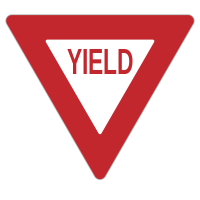
  • Downward-pointing red triangle with white center and the word YIELD in redYield: give way, and stop if traffic is coming
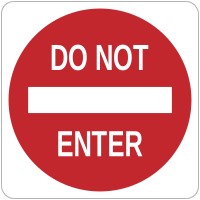
  • Red circle with a white horizontal bar on a white square, reading DO NOT ENTERDo not enter
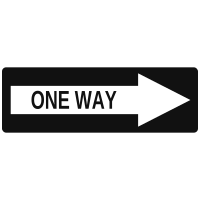
  • Black rectangle with a white arrow pointing right containing ONE WAYOne-way road
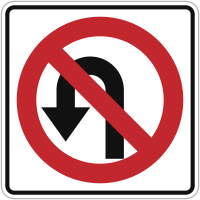
  • Black U-turn arrow inside a red circle with a red slashNo U-turn
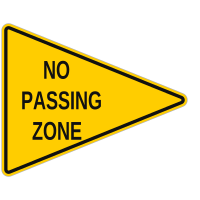
  • Yellow pennant pointing right reading NO PASSING ZONENo passing zone starts here
  • Yellow diamond reading ONE LANE BRIDGEOne-lane bridge: the vehicle nearest goes first
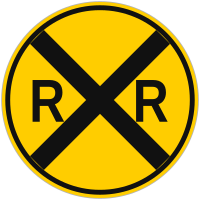
  • Round yellow sign with a black X and two letters RRailroad crossing ahead
  • White X-shaped crossbuck reading RAILROAD CROSSINGRailroad crossbuck
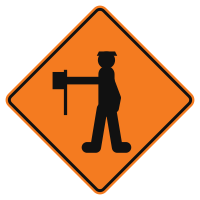
  • Orange diamond with a black flagger symbol holding a flagFlagger ahead: follow their directions
  • Fluorescent orange triangle with a red reflective borderSlow-moving vehicle: under 25 mph
  • Center lane bordered by solid yellow outer lines and broken yellow inner lines, with opposing left-turn arrowsTwo-way left turn only lane

Free practice test

Practice for the Ohio permit test

These 20 questions are ours, written from the Digest of Ohio Motor Vehicle Laws, and five of them show a sign or a road marking. The real test asks 40 and needs 75%, so 15 of 20 is the same bar here. Pick an answer to see why it’s right, and ask the tutor for another way to look at it.

Question 1 of 20

You’re 15 and a half with your temps. Who may sit in the front passenger seat while you practice?

20 practice questions we wrote from the Digest of Ohio Motor Vehicle Laws.

Test day

What to bring to the temps test

  • To test in person: documents that prove your full legal name, date of birth and Social Security number (if you have one)
  • Your glasses or contacts, if you wear them, for the vision screening
  • Your own interpreter, if you booked a proctored test in another language at a Driver Exam Station

Before you go

  1. Read Sections 2 to 10 of the Digest, the part of the manual the knowledge test draws on.
  2. Take the BMV’s Sample Driver License Knowledge Test once you’ve studied.
  3. Testing online? Read the online test page for the webcam, proctor and identity check rules first.
  4. Need an accommodation? Email the ADA unit at HRRequestADA@dps.ohio.gov before you go.
Open BMV Online ServicesOnline Knowledge Testing is one of the tiles on BMV Online Services. You don’t book the in-person test: go to a Driver Exam Station, or a deputy registrar agency that offers it.

Study options

Where to study

The Digest is the book for the knowledge test, and the BMV posts a 10-question sample test of its own. Under 21, you also take driver education, which the driver’s ed page explains.

OptionPriceFree to useLinks
Official sources
Digest of Ohio Motor Vehicle LawsOfficial · online manualThe Ohio Driver Manual. The BMV offers it as the study guide for the knowledge test, and Sections 2 to 10 hold what the test asks.
FreeAll 13 sections, each one printable
BMV Sample Driver License Knowledge TestOfficial · online quizThe BMV’s own sample, to try after you’ve studied the Digest and see how the questions are asked.
Free10 questions, scored on the page
In person
Licensed driver training schoolsIn person or online · licensed by the stateThe course drivers under 21 need: 24 hours of classroom or online instruction and 8 hours of driving time. The BMV links a list of approved schools from its teen licensing page.
Set by each schoolNo free option listed
Abbreviated Adult Driver Training CourseIn person or online · licensed schoolsFor drivers 21 or older after a first failed driving test: 4 hours of class, then 4 hours with an instructor or 24 hours with a licensed adult.
Set by each schoolNo free option listed
Motorcycle Ohio coursesIn person · Ohio Department of Public SafetyBasic Riding Skills and the two shorter courses waive the BMV motorcycle skills test; you need a motorcycle temporary instruction permit identification card (TIPIC), license or endorsement first.
$75No free course listed

Prices and ratings checked November 2026.

FAQ

Common questions

How many questions are on the Ohio permit test?

Forty, all multiple choice. You need 75% to pass, which is 30 right. The same 40-question, 75% rule applies to the motorcycle knowledge test.

Can I take the Ohio permit test online?

Yes, from 15 and a half, through BMV Online Services. You need a computer with a webcam, and if you’re under 19, a supervising adult who passes an identity check. You get two online tries in six months.

What happens if I fail the Ohio temps test?

You can take it again, but not on the same day. In person there’s no limit on how many times you try, while online you get two attempts in six months.

Does Ohio have a DMV?

No. Ohio’s licensing agency is the Bureau of Motor Vehicles (BMV), within the Department of Public Safety. Deputy registrar license agencies sell permits and licenses, and Driver Exam Stations give the tests.

Is the Ohio permit test hard?

The BMV doesn’t publish pass rates. It tells you to learn everything in the Digest, especially Sections 2 to 10, and to try its sample test first to see how the questions are asked.

All 20 practice questions with answersA printable list of the practice test above
  1. You’re 15 and a half with your temps. Who may sit in the front passenger seat while you practice?

    Your parent, guardian or a licensed driving instructor Under 16, a temporary instruction permit (TIPIC) holder drives with a parent, guardian or licensed driving instructor in the front passenger seat. That person must not be intoxicated.

  2. You passed the vision screening and the knowledge test. How long do you have to buy your TIPIC?

    60 days You buy the TIPIC at a deputy registrar license agency within 60 days of passing. If you miss that window, you start over with the vision screening and the knowledge test.

  3. You’re 16, in your first year with a probationary license, and driving alone. No work or school-event exception applies. When may you not drive?

    Midnight to 6 a.m. In the first 12 months of a probationary license, a driver under 18 may not drive from midnight to 6 a.m. The exceptions are driving with a parent or guardian, or to or from work or an official school or religious event with the right documents.

  4. Six months into your probationary license, you’re 16 and driving without a parent or guardian. How many passengers who aren’t family may ride with you?

    One In the first 12 months, a probationary driver under 18 may not drive with more than one passenger who isn’t a family member unless a parent or guardian is in the car. The driver and every passenger also wear safety belts.

  5. What is the least tread depth a tire should have, by Ohio’s equipment rules?

    1/16 inch The Digest lists a minimum of 1/16-inch tread depth, with no major bumps, bulges or damage. It also describes a check you can do with a U.S. penny.

  6. How much space should there be between your chest and the steering wheel?

    At least 10 inches Set your seat so there are at least 10 inches between your chest and the steering wheel. That leaves room for the air bag to deploy.

  7. You’re 17 and driving. Which use of your phone does Ohio law allow?

    Calling emergency services Drivers under 18 may not use any electronic device while driving, even hands-free, at a traffic light or in a traffic jam. The exceptions are navigation and calls to emergency services.

  8. You’re 19. At what blood alcohol concentration (BAC) is it against the law for you to drive?

    .02% or higher Ohio’s limits are .08% at any age, .04% for commercial drivers and .02% for drivers under 21. At 19, the .02% limit applies to you.

  9. How many points on your record within two years lead to a license suspension?

    12 or more If you build up 12 or more points within two years, the BMV suspends your license. At six points, it sends a warning letter.
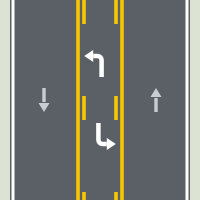
  10. Center lane bordered by solid yellow outer lines and broken yellow inner lines, with opposing left-turn arrows

    You see this marking in the center of the road. What is the lane for?

    Left turns from either direction A two-way left turn lane is marked with a solid and a broken yellow line on each side, plus white turn arrows. Drivers from either direction may use it just before turning left, but not for traveling or passing.
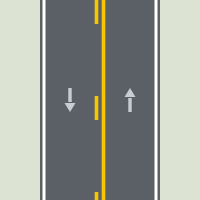
  11. Two-way road with a solid yellow line on the right-hand lane side and a broken yellow line beside it; no passing from the right-hand lane

    From your lane, the center line looks like this. May you pass the car ahead?

    No, not from your lane With a solid yellow line on your side and a broken one on the other, passing is prohibited for you. Drivers on the broken-line side may pass when it’s safe.

  12. At a roundabout with four exits, which exit takes you left?

    The third exit In a roundabout you travel counterclockwise, so the first exit turns you right, the second takes you straight and the third takes you left. The fourth makes a U-turn.
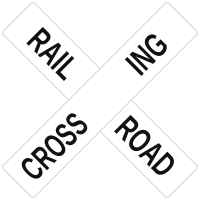
  13. White X-shaped crossbuck reading RAILROAD CROSSING

    A train is coming, and you’re stopping at this crossing. Where must you stop?

    15 to 50 feet from the crossing When a train is approaching, stop no closer than 15 feet and no farther than 50 feet from the crossing. Wait until the train has passed and any warning signals have stopped.

  14. How close to a fire hydrant may you park?

    No closer than 10 feet Ohio law bans stopping, parking or standing within 10 feet of a fire hydrant. The same list bans it within 20 feet of an intersection or crosswalk.
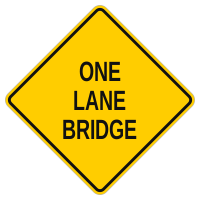
  15. Yellow diamond reading ONE LANE BRIDGE

    You see this sign ahead. Who has the right-of-way at the bridge?

    The vehicle nearest the bridge This sign warns of a one-lane bridge ahead. The Digest says the vehicle nearest the bridge has the right-of-way.
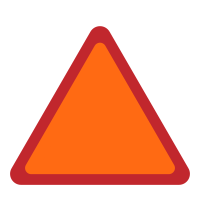
  16. Fluorescent orange triangle with a red reflective border

    A farm vehicle ahead shows this emblem. What does it tell you?

    It travels under 25 mph The orange and red triangle on animal-drawn vehicles, farm equipment and construction equipment means the vehicle travels less than 25 mph. Slow down, and pass only with caution.

  17. You’re passing a bicyclist. How much space should you keep between your vehicle and the bicycle?

    At least 3 feet Keep a safety zone of at least three feet between your vehicle and a bicycle. Slow down as you approach, and pass only when it can be done safely.

  18. A tow truck is stopped at the roadside with its warning lights on. What does Ohio’s Move Over law ask you to do?

    Change lanes away from it, or slow down Ohio law asks you to move to a lane that isn’t next to a stopped emergency, road service or maintenance vehicle with its warning lights on, if it’s safe. If a lane change isn’t safe, slow down and go by with caution.

  19. You’re driving in fog. Which headlights should you use?

    Low beams In fog, use your low beam headlights, not your high beams, and slow down. Shift your gaze instead of staring, and keep scanning for hazards.

  20. A front tire blows out while you’re driving. What should you do?

    Hold the wheel firmly and slow gradually If a front tire blows out, the vehicle pulls sharply toward the blowout. Grip the wheel firmly, keep the vehicle going straight, don’t brake, and slow down gradually before pulling off in a safe place.

Sources: Ohio Department of Public Safety · Ohio BMV and 1 more. Checked November 2026.

Rules and fees can change, so check the official site before your test.