West Virginia · Permit test

The West Virginia DMV permit test

You need 19 right answers out of 25. The West Virginia DMV permit test is a timed knowledge test on the Driver’s Licensing Handbook, and you can take it from age 15 at a Division of Motor Vehicles (DMV) regional office, or online at home through DMV’s Know to Drive service. Each attempt at a DMV office costs $7.50. Pass it and a vision screening, and DMV issues a Level 1 instruction permit, your learner’s permit, if you’re under 18, or a regular instruction permit if you’re 18 or older.

  • 15Youngest age for a Level 1 permit
  • $7.50Fee for each test attempt at a DMV office
  • 6 monthsTime on a Level 1 permit before Level 2
  • 7 daysWait before you can retest

Key facts

At a glance

Who runs it
The West Virginia Division of Motor Vehicles (DMV)
Where you take it
At a DMV regional office, or online at home with a webcam
Format
At least 25 questions on a computer, with a time limit
Reading help
An audio version you hear through headphones
Driving on the permit
With a licensed driver 21 or older in the front passenger seat

How it works

How the West Virginia DMV permit test works

Knowledge test
19 to pass
To pass you need 19 of 25 right.
  1. You take the knowledge test on a computer at a Division of Motor Vehicles (DMV) regional office, after a vision screening. You need at least 20/40 vision in one eye, with or without glasses or contacts.
  2. The questions cover traffic rules, regulations, road signs and pavement markings from the Driver’s Licensing Handbook.
  3. The test has a time limit. A question you don’t answer in time counts as wrong.
  4. If reading is hard for you, ask for the audio version, which you hear through headphones. DMV staff won’t read or reword questions for you, and headsets are limited, so you may have to wait.
  5. Phones, smart glasses, Bluetooth and other electronic devices aren’t allowed in the exam room, and only the person testing may be in it.
  6. Once you pass, DMV runs a national check that your driving privilege isn’t suspended anywhere, then issues the permit when you pay the fee.

Topics

What’s on the test

01

Permits, graduated licensing and documents

Chapter I of the Driver’s Licensing Handbook covers who must be licensed, the documents you bring, the three levels of the graduated driver’s license (GDL) and the fees.

Key points (4)
  • You can get a Level 1 instruction permit at 15 with a parent’s or guardian’s consent on form DMV-DS-23P.
  • On a Level 1 permit you drive only from 5:00 a.m. to 10:00 p.m., with a licensed driver 21 or older in the front passenger seat.
  • You need 180 days of conviction-free driving on Level 1, and 50 hours of practice (10 at night) or an approved driver’s education course, before Level 2.
  • New residents must apply for a West Virginia license within 30 days.
02

Insurance, phones and the point system

Chapter II explains what you must keep doing once you’re licensed: carry insurance, report crashes, stay off a handheld phone and keep your points down.

Key points (4)
  • Minimum liability insurance is $25,000 for one death or injury, $50,000 for two or more and $25,000 for property damage.
  • A crash with injury, death or more than $1,000 of property damage must be reported within five days.
  • Using a phone while driving is allowed only hands-free. A third offense brings a $300 fine and three points.
  • Points stay on your record for two years. At 12 points your license is subject to suspension.
03

Driving under the influence

Chapter III covers alcohol, other drugs, the implied consent law and drowsy driving.

Key points (4)
  • Under 21, any measurable alcohol in your system can cost you your license.
  • A blood alcohol concentration (BAC) of 0.08% or more means you’re presumed to be driving under the influence (DUI).
  • Refusing the breath test means your license is revoked for at least one year.
  • Only time sobers you up. Coffee, cold showers and fresh air don’t.
04

Signs, signals and pavement markings

Chapter V explains what each sign shape and color means, then traffic lights, flashers, lane signals, crosswalk signals and road markings.

Key points (4)
  • White lines separate lanes going the same way. Yellow lines separate traffic going in opposite directions.
  • A flashing red light is the same as a stop sign. On a flashing yellow you go on with caution.
  • After a full stop you may turn right on red, or left on red from a one-way street onto another one-way street, unless a sign says no.
  • Orange is the basic color for work zone signs and devices.
05

Speed, turns, parking and passing

Chapter VI starts with speed limits and signals, then turning, backing, parking, following distance and passing.

Key points (4)
  • Unless posted otherwise: 70 mph on interstates, 55 mph on open county highways, 25 mph in business and residential areas and 15 mph in a school zone while children are present.
  • Signal at least 100 feet before you turn.
  • Don’t park within 15 feet of a fire hydrant, 20 feet of a crosswalk at an intersection, 30 feet of a stop sign or signal, or 50 feet of a railroad crossing.
  • Keep at least a three to four second following distance, four seconds in the dark or rain and six seconds on ice or snow.
06

Right-of-way, pedestrians and school buses

The handbook’s right-of-way rules cover intersections, left turns, emergency vehicles, people on foot and school buses.

Key points (4)
  • If you reach an intersection at the same time as another vehicle, yield to the driver on the right.
  • When turning left, yield to oncoming traffic.
  • Traffic in both directions stops for a school bus with red lights flashing. Only on an interstate does traffic on the other side of the median keep going.
  • A blind person using a guide dog or a white cane has the right-of-way, in a crosswalk or not.
07

Sharing the road and driving on interstates

Chapters VI and VII cover motorcycles, trucks, bicycles and slow vehicles, then entering, driving on and leaving an interstate.

Key points (4)
  • Dim your headlights within 500 feet of an oncoming vehicle and within 200 feet of a vehicle you’re following.
  • A truck’s blind spots are the no-zone. Don’t linger there, and never pass a truck on the right during a turn.
  • Match the speed of traffic as you merge, and slow down in the exit lane, not on the interstate.
  • Don’t drive slower than 55 mph on an interstate unless conditions are bad or a lower speed is posted, and never make a U-turn on one.
08

Defensive driving and bad weather

Chapter VIII covers bad driving habits, light and weather conditions, your own condition and traffic situations.

Key points (4)
  • Tires start to hydroplane at about 35 mph on wet roads, and in a severe storm they can lose all contact with the road at 55 mph.
  • Never drive into a flooded road.
  • On ice or packed snow, brake gently and smoothly.
  • Headlights must be on in bad weather.
09

Emergencies and crashes

Chapter IX explains what to check before you drive and what to do when something fails or you’re in a crash.

Key points (4)
  • In a blowout, hold the wheel tightly, steer straight and ease off the gas.
  • If your brakes fail, pump the pedal quickly, then use the parking brake.
  • In a skid, take your foot off the gas and steer in the direction of the skid.
  • If the gas pedal sticks, keep steering, brake, stop somewhere safe and turn off the ignition.

Road signs

Road signs from the West Virginia Driver’s Licensing Handbook

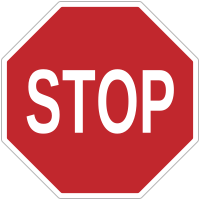
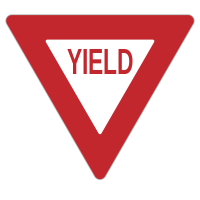
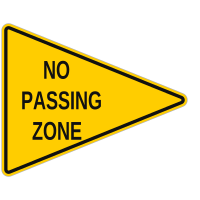
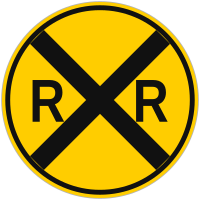
The handbook teaches signs by shape first. An octagon is only ever a stop sign, a pennant starts a no-passing zone, a five-sided sign means a school and a round yellow sign warns of a railroad crossing. Square and rectangular signs set the rules, diamonds warn, and a red circle with a slash always means no.

  • Red octagon with white border and the word STOP in whiteStop: the eight-sided shape is used only for stop signs. Stop completely behind the crosswalk, marked or not, and give the right-of-way to people on foot and cross traffic
  • Downward-pointing red triangle with white center and the word YIELD in redYield: the upside-down triangle means you give the right-of-way to cross traffic or to merging traffic
  • Yellow pennant pointing right reading NO PASSING ZONENo passing zone: the pennant shape marks the beginning of a no-passing zone
  • Round yellow sign with a black X and two letters RRailroad crossing ahead: the round yellow-and-black sign gives advance warning of a railroad crossing
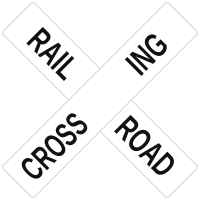
  • White X-shaped crossbuck reading RAILROAD CROSSINGCrossbuck: black letters on white bars in an X mark the crossing itself. You must yield to all trains
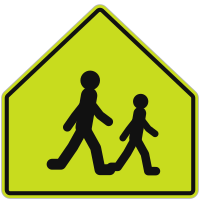
  • Fluorescent yellow-green pentagon with two children walkingSchool: the five-sided sign warns of a school zone or school crossing. The limit in a school zone is 15 mph while children are present
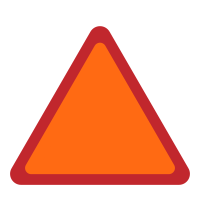
  • Fluorescent orange triangle with a red reflective borderSlow-moving vehicle: an orange triangle with a red border marks a slow vehicle, or one that has made an emergency stop
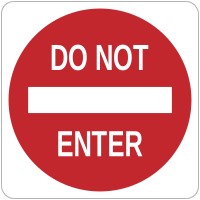
  • Red circle with a white horizontal bar on a white square, reading DO NOT ENTERDo not enter: traffic in that direction isn’t allowed, so you’d be heading into oncoming vehicles
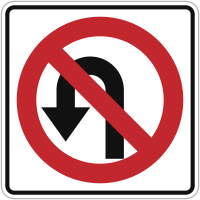
  • Black U-turn arrow inside a red circle with a red slashNo U-turn: don’t turn around in the middle of the street or at the intersection
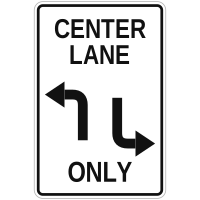
  • White sign reading CENTER LANE above two opposing left-turn arrows and the word ONLYDual turn lane: the lane is only for left turns by traffic from either direction. Never use it to pass
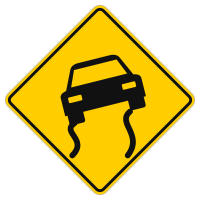
  • Yellow diamond with a car and two S-shaped skid marksSlippery when wet: this stretch is more slippery than other roads in the wet, so slow down
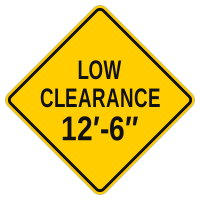
  • Yellow diamond reading LOW CLEARANCE 12 feet 6 inchesLow clearance: a bridge or underpass ahead is low, and the sign shows its height
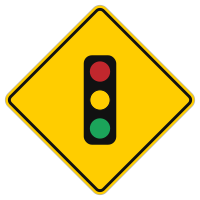
  • Yellow diamond with a black traffic signal showing red, yellow and green lightsSignal ahead: there’s a traffic signal ahead

Test day

What to bring for your West Virginia instruction permit

  • Your Social Security number. Know it, or bring proof such as your Social Security card or a W-2
  • One proof of identity, such as a certified US birth certificate or a valid US passport. Under 18, you show a certified birth certificate each time you apply and test for a Level 1 permit
  • Two proofs of your West Virginia physical address, such as a West Virginia utility bill no more than 60 days old (the handbook allows 90) or a West Virginia bank statement. PO boxes don’t count
  • Proof of any legal name change, such as a marriage certificate or court order
  • Under 18: form DMV-DS-23P signed by your parent or legal guardian, or a certified copy of your marriage certificate if you’re married
  • Your Know to Drive completion certificate, if you passed the test online

Before you go

  1. Read the Driver’s Licensing Handbook, revised July 2026.
  2. Work through DMV’s Sample Driver’s Test page. DMV says its questions aren’t the real test questions.
  3. Check your papers against DMV’s list of acceptable proof documents.
  4. Decide whether you’ll test online first. You still go to a DMV office with the certificate and your documents.
  5. Book an appointment if your office takes one. DMV says most regional offices do, for certain types of transactions.
West Virginia DMV: schedule an appointmentPlan to arrive 10 minutes early. For testing times, call DMV at 1-800-642-9066.

Study options

Where to study

The test questions come from the Driver’s Licensing Handbook. DMV also posts a Sample Driver’s Test page with study questions it says aren’t the real ones. Apps and websites from other companies add more practice.

OptionPriceFree to useLinks
Official
Driver’s Licensing HandbookOfficial · PDFThe Division of Motor Vehicles (DMV) handbook the knowledge test is based on, revised July 2026. Use this copy, not the 2022 one some DMV pages still link.
No price listedThe whole handbook to download
DMV Sample Driver’s TestOfficial · web pageDMV says the questions come from state law and the handbook but aren’t the actual test questions. The page ends with tips for the driving test.
No price listed20 study questions with an answer key
Parent’s Supervised Driving Program and RoadReadyLesson plan and app for parents · linked by DMVDMV’s GDL page points parents to this national program for teaching a teen to drive, and to its free RoadReady app for logging the 50 hours before Level 2. The program says it’s paid for by sponsors.
Free, per DMV and the programThe digital lesson plan and the RoadReady log
Apps and websites
DMV-Permit-Test.comWebsitePremium adds a West Virginia cheat sheet and a pass guarantee. Its West Virginia page describes the real test as 25 questions with 19 to pass, which matches the handbook. It also says the online test comes in Spanish, which DMV’s pages don’t say.
Practice tests on the site, optional Premium (one-time $15.99, marked down from $31.99)West Virginia car, motorcycle and commercial driver’s license (CDL) practice tests open on the site
ZutobiWeb and app · all statesSays it has 600+ West Virginia questions and narrated lessons aligned with the Driver’s Licensing Handbook. The app has 4.7 stars from about 239,000 App Store ratings.
3-day free trial, then Zutobi PLUS (App Store prices from $4.99)A free start on the West Virginia course
DMV GenieApp · all statesCar, motorcycle and CDL practice in one app; pick West Virginia when you start. Check the plan length before you pay. It has 4.8 stars from about 184,000 App Store ratings.
Free to download, Premium in the app (App Store prices from $7.99)Practice tests and quizzes, plus six guided lessons for new car learners

Prices and ratings checked October 2026.

FAQ

Common questions

How many questions are on the West Virginia DMV permit test?

The handbook says the knowledge test has at least 25 questions and you must answer 19 of the 25 correctly. The state rule for driver exams, 91 CSR 4 in the West Virginia Code of State Rules (CSR), sets the same bar as at least 76% correct.

Can I take the West Virginia permit test online?

Yes. DMV’s Know to Drive service lets you take the written test at home on a computer with a webcam and a mouse or touchpad, not a phone or touch screen. Facial recognition watches for help from anyone else. You get two warnings for leaving the test screen, and after that the test stops and counts as a fail. Under 18, an adult over 18 (ideally a parent or guardian) takes part in registration with their driver’s license number, then stays out of the camera’s view. Passing gets you a completion certificate, not a permit: you take it and your documents to a DMV office, where your photo is taken and the permit issued.

What happens if I fail the West Virginia DMV permit test?

You can’t retest for seven days. That’s in state law, the exam rule and DMV’s online test notes. Each new attempt at a DMV office costs another $7.50, and DMV’s testing partner doesn’t refund an online test you fail.

How long does a passing score last?

The state exam rule, 91 CSR 4, says you must get your permit within 30 days of passing the test. DMV’s notes on the online test say a passing score is valid for six months. Go to DMV within 30 days to be safe, or ask DMV which applies to you.

Can I take the test in Spanish, or with an interpreter?

DMV doesn’t publish a list of languages for the knowledge test. The state exam rule allows a translator at DMV’s discretion, so ask when you book. For a sign language interpreter, you and the interpreter both sign form DMV-8-SL, you book by calling 1-800-642-9066, a DMV employee stays in the room and the test is recorded. If DMV finds the interpreter helped with answers, your permit is revoked and you can’t retest for six months.

Does school attendance affect a West Virginia permit?

Yes, until you’re 17. Under W. Va. Code §18-8-11, if you drop out (more than 10 days in a row or 15 days in all of unexcused absences in a school year) or don’t keep up satisfactory academic progress, your school tells DMV. Your permit or license is then limited to driving for work, medical, school or religious reasons, unless the absences were beyond your control.

Is anything changing for West Virginia permits in 2027?

Nothing in the permit, testing or graduated driver’s license (GDL) laws takes effect on January 1, 2027. House Bill 4577, in effect since June 12, 2026, tells DMV to seek agreements to recognize driver’s licenses from Ireland and Japan, and DMV filed a matching change to its exam rule in July 2026 for the Legislature to review. House Bill 4536 of 2026, which would have let a driver’s education certificate replace DMV’s tests, didn’t pass.

Sources: West Virginia DMV · West Virginia Secretary of State · West Virginia Legislature and 11 more. Checked October 2026.

Rules and fees can change, so check the official site before your test.