You hold a Level 1 Learner’s License. Who may supervise your driving?
A licensed parent, guardian or designated adult 21 or older With a Level 1 license, you may drive only with a licensed parent or guardian, or a licensed adult 21 or older whom they designate. That person sits in the front seat next to you, and a designated adult needs a signed letter of authorization from your parent or guardian.
You have a Level 2 Intermediate License, and no exception applies. When may you not drive?
Between 10 p.m. and 5 a.m. Level 2 bans driving between 10 p.m. and 5 a.m. unless an exception applies. The exceptions are a parent, guardian or designated licensed adult 21 or older riding with you, or driving for your job, to or from work, or to or from an authorized activity.
How long is a temporary instruction permit (TIP) valid?
180 days A TIP is valid for 180 days. It lets you practice driving with a licensed adult before the driving skills test, and you practice on it for at least 30 days first.
How long do points stay on your Michigan driving record?
Two years from the date of conviction Points go on your record only after you’re convicted of a moving violation. They stay there for two years from the date of conviction.
After drinking alcohol, what will sober a person up?
Time, and nothing else Coffee, a cold shower, exercise or fresh air won’t sober anyone up. The only thing that does is time.
A driver under 21 is convicted of driving with any bodily alcohol content. How many points go on their record?
4 points Under 21, driving with any bodily alcohol content is a four-point violation. Operating while intoxicated is worth six points.
Which use of a mobile phone while driving does Michigan law allow for every driver?
Calling 911 to report a crash Michigan’s cell phone law bans every driver from holding or using a phone while driving. Calling or texting 911 to report a crash, a crime or another emergency is allowed.
Michigan’s child passenger safety law says a child rides in a car seat or booster seat until when?
Until they’re 8 or 4 feet 9 inches tall Children must be buckled into a car seat or booster seat until they’re 8 years old or 4 feet 9 inches tall, whichever comes first. The manual suggests parents go by the height, as a seat belt may not fit a smaller child.
A school bus ahead has stopped with its red overhead lights flashing. How far from it must you stop?
At least 20 feet Stop at least 20 feet from a school bus with its red overhead lights flashing. Stay stopped until the red lights go off or the bus moves on.
An emergency vehicle is stopped on the shoulder with its lights flashing. What does the law require as you pass?
Slow to 10 mph under the limit and move over if safe For a stopped emergency vehicle, the law requires you to slow down at least 10 mph below the posted limit and move over a lane if traffic and conditions allow. If you can’t move over, slow down and keep as much space as you can.
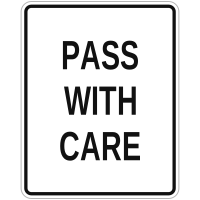
You’re passing on a two-lane highway. You must be back in your lane before you’re within what distance of an oncoming vehicle?
200 feet When passing on the left, you must return to your lane before you get within 200 feet of any oncoming vehicle. Don’t cut back in until you can see the whole vehicle you passed in your rearview mirror.
How close to a fire hydrant may you park?
No closer than 15 feet The manual’s no-parking list bans parking within 15 feet of a fire hydrant. Other distances on the list cover other things, such as 30 feet from a stop sign and 50 feet from a railroad crossing.
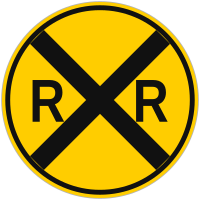
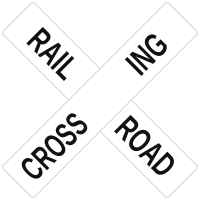
You see this sign, and a train is coming. Where must you stop?
No more than 50 feet and no less than 15 feet from the tracks This sign warns of a railroad crossing ahead. If a train is coming, stop no more than 50 feet and no less than 15 feet from the tracks. Trains overhang the tracks by at least three feet on each side.
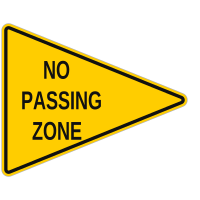
You see this sign. What does it tell you?
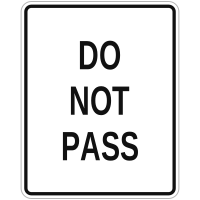
You’re in a no-passing zone, so don’t pass A pennant-shaped sign marks a no-passing zone. Don’t pass while you’re in it, the same as where a Do Not Pass sign is posted.
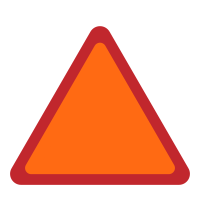
You see this on the back of a farm vehicle ahead. What does it tell you?
It can’t travel faster than 25 mph This emblem marks a slow-moving vehicle, one that can’t travel faster than 25 mph, such as farm machinery or an Amish buggy. Drive with caution around it and don’t get impatient behind it.
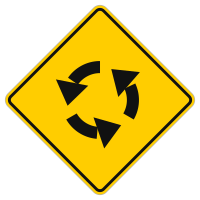
You see this sign. How do you enter the intersection it warns of?
Yield to traffic from your left, then merge in This sign warns of a roundabout ahead. Entering traffic yields to traffic coming from the left, bicyclists and pedestrians included, and vehicles already in the roundabout have the right of way.
A car at 55 mph can stop in about 130 feet. About how far does a commercial vehicle need at the same speed?
About 400 feet The manual says a commercial vehicle at 55 mph takes about 400 feet to stop, about three times what a car needs. Never cut in front of one or force it to slow down or stop suddenly.
A motorcyclist is riding in the lane ahead of you. How may you pass?
Using an adjacent lane, when legal and safe It’s illegal to drive beside a motorcyclist or pass one in the same lane. Pass by using an adjacent lane when it’s legal and safe to do so.
When rain begins to fall, when are the roads most slippery?
During the first half hour Roads are most slippery during the first half hour of rain, because oil dropped by passing vehicles hasn’t been washed away. Slow down and allow at least twice your normal following distance.
A deer runs into the road ahead, and you can’t avoid hitting it. What does the manual say to do?
Brake firmly and stay in your lane If a crash with a deer can’t be avoided, don’t veer: brake firmly, hold the wheel with both hands and come to a controlled stop. Then steer well off the road.
 Michigan · Permit test