The Delaware drivers test (Class D knowledge test)
You need 26 right answers out of 32. The Delaware drivers test, officially the Class D knowledge test, is taken in person at a Division of Motor Vehicles (DMV) office, and it covers signs, signals and the rules of the road from the Delaware Driver Manual. At 18 or older, passing it gets you a learner’s permit. Under 18, your driver education teacher gives you the written and road tests as part of the course.
Updated October 2026 · Written from the Delaware Driver Manual
Key facts
At a glance
Who runs it
The Delaware Division of Motor Vehicles (DMV), part of the Department of Transportation (DelDOT)
Where you take it
In person at a DMV office in Wilmington, Delaware City, Dover or Georgetown
Online testing
Not offered. You apply and test in person
Under 18
Your certified driver education teacher gives the written and road tests
How it works
How the Delaware drivers test works
Class D knowledge test · 26 to pass
To pass you need 26 of 32 right.
You take the test in person at a Delaware Division of Motor Vehicles (DMV) office, after a vision screening. The minimum is 20/40 vision, with or without glasses or contact lenses, and the DMV may allow daylight-only driving between 20/40 and 20/50.
The test has two parts. In the sign and signal part, you may have to name signs from their shape, color or symbol alone, and explain traffic signals and pavement markings. The rules of the road part asks about Delaware traffic laws and safe driving, such as the speed limit on two-lane roads or how close to a fire hydrant you may park.
If you have a disability and need an accommodation for the test, call the office and make an appointment before you go: Delaware City 302-326-5000, Wilmington 302-434-3200, Dover 302-744-2500 or Georgetown 302-853-1000.
At 18 or older you can skip the graduated driver license (GDL) program. You then take the eye, knowledge and road tests at the DMV, and you don’t need a sponsor.
Pass the vision and knowledge tests and pay the fee, and the DMV issues your learner’s permit.
Topics
What’s on the test
01
Licenses, permits and the GDL program
Section Two of the Delaware Driver Manual covers the documents you bring, the graduated driver license (GDL) program for drivers under 18, the learner’s permit for first-time drivers 18 and older, and moving to Delaware with a license.
Key points (4)
Under 18, you need a Delaware driver education certificate and a sponsor’s signature to get a Level One Learner’s Permit, from age 16.
For the first six months on a Level One permit, you drive only with a supervisor: a licensed parent or guardian, or a licensed driver at least 25 who has held a Class D license for at least five years.
A GDL permit holder may not use a cell phone or other electronic device while driving, even hands-free.
New residents must apply for a Delaware license within 60 days of moving in.
02
The driver examination
The examination checks your vision, your knowledge of signs and signals, the rules of the road and, last, your driving on a road test.
Key points (4)
The minimum vision for a Delaware license is 20/40, with or without glasses or contact lenses.
You may be asked to name signs by their shape, color or symbol alone, without their words.
The road test lasts about 30 minutes and includes parallel parking, a three-point turn and backing 50 feet.
Road tests are given every weekday except Wednesday.
03
Points, suspensions and impaired driving
This part explains the Driver Improvement Problem Driver Program and its point system, then alcohol, drugs, distracted and drowsy driving, and Delaware’s driving under the influence (DUI) laws.
Key points (4)
A blood alcohol concentration (BAC) of .08 or more is conclusive evidence of driving under the influence, but you can be charged below .08.
Under 21, Delaware’s zero tolerance law means a license revocation at a .02 BAC.
At 8 calculated points in two years the DMV sends an advisory letter, and at 12 you must take a behavior modification course.
Speeding 1 to 9 mph over the limit is 2 points, and 10 to 14 mph over is 4 points.
04
Vehicle equipment, seat belts and insurance
Section Three lists the equipment your vehicle needs and what’s not allowed, then headlights, seat belts, child seats and the steps to title and register a vehicle.
Key points (3)
Low beams must show people at least 100 feet ahead.
Delaware requires seat belts, child restraints and helmets for motorcycle riders.
Driving an uninsured vehicle brings a fine of $1,500 to $2,000 and a six-month license suspension for a first offense.
05
Signals, signs and work zones
Section Four starts with traffic signals, arrows and pedestrian signals, then regulatory, warning, guide and information signs, and how to drive through a work zone.
Key points (4)
Warning signs are usually yellow with black letters or symbols, and most are diamond shaped.
Guide signs are green with white letters, motorist service signs are blue and recreation signs are brown.
Work zone warning signs are usually orange.
Fines for speeding in a work zone are doubled.
06
Delaware traffic laws, parking and speed
The manual’s “Some Important Delaware Laws” covers phones, signaling, passing and the move over law, followed by right-of-way, school buses, roundabouts, parking and speed limits.
Key points (4)
Delaware bans hand-held phones and texting while driving; you may talk only with a hands-free device.
Unless posted, the limit is 25 mph in business and residential districts, 50 mph on two-lane roads and 55 mph on divided or four-lane roads.
Don’t park within 15 feet of a fire hydrant, 20 feet of a crosswalk at an intersection, 30 feet of a stop sign or signal, or 50 feet of a railroad crossing.
Stop for a school bus loading or unloading children from either direction, unless you’re on the opposite side of a road with four or more lanes.
07
Sharing the road
Other Highway Users covers people on foot, bicycles, motorcycles, mopeds, farm equipment and trucks.
Key points (3)
On a two-lane road, slow below the posted limit when you pass a stopped emergency vehicle; on a multi-lane road, move over a lane.
Watch for less visible road users, such as bicycles, mopeds and motorcycles, before you pull out from a stop sign.
Farm machinery and horse-drawn vehicle signs warn you to be alert and ready to slow down.
08
Driving skills and safe space
Section Five covers what to check before you drive, basic driving, seeing and being seen, adjusting your speed, night driving and the space you leave around your vehicle, plus what to expect at a traffic stop.
Key points (3)
Follow at least three seconds behind the vehicle ahead, and leave four seconds on slippery roads and in other risky conditions.
Try to signal at least three seconds before you move, and by law signal for at least 300 feet before you turn.
Delaware law puts at least two questions about traffic stops by law enforcement on the knowledge test.
09
Emergencies and crashes
The last part covers vehicle emergencies, how to avoid a collision, how to protect yourself in one and what the law asks of you after a crash.
Key points (3)
If your car stalls on railroad tracks and a train is coming, get out and move away, toward the direction the train is coming from.
After a crash with injury or death, stop at once and give aid to anyone hurt.
Report a crash to the police right away when someone is hurt or killed, or when a crash on a public road causes apparent property damage of $500 or more.
Road signs
Road signs in the Delaware Driver Manual
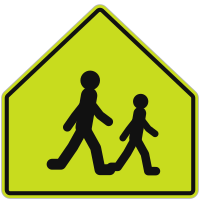
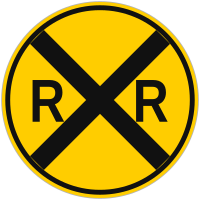
The manual teaches signs by shape and color, and the sign part of the test may show you a shape with no words on it. The stop sign is the only eight-sided sign, school signs have five sides and the round black-on-yellow sign warns of a railroad crossing. Warning signs are usually yellow diamonds, and work zone signs are usually orange.
Stop: the only eight-sided sign. Stop at the stop line, or at the crosswalk if there’s no line, or before the intersection if there’s neither
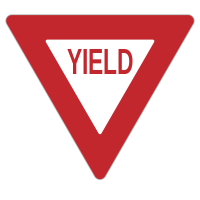
Yield: slow down, look left and right, and give the right-of-way to vehicles and people on foot, stopping if you need to
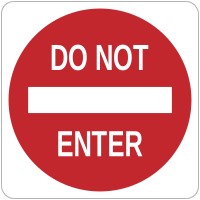
Do not enter: you must not enter this street. It may be one-way the other way, or closed to all vehicles
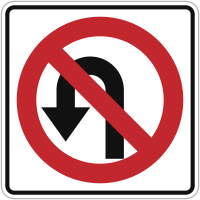
No U-turn: one of the international symbol signs Delaware uses, along with no left turn and no right turn
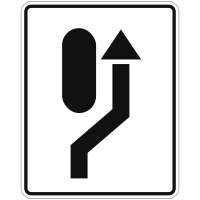
Keep right: keep to the right of the traffic island or divider ahead
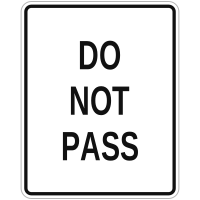
Do not pass: obey it, and look for double solid lines on the road as well
School: the five-sided sign warns of a school or school crossing. Slow down and watch for children. It may also be fluorescent yellow-green
Railroad crossing ahead: the round black-on-yellow sign. Slow down and watch for the tracks, with extra care at night
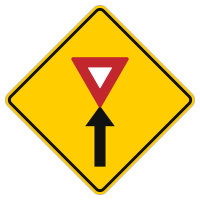
Yield ahead: slow down and be ready to stop at the yield sign, or adjust your speed to the traffic
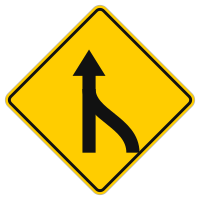
Merging traffic: traffic is merging from the right just ahead
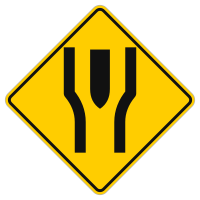
Divided highway: you’re coming to a divided highway, so keep right
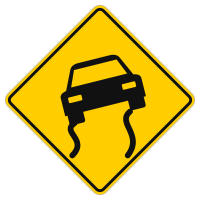
Slippery when wet: the manual says the first half hour of rain is the most dangerous
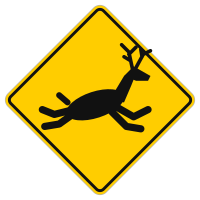
Deer crossing: be alert for deer on both sides of the road
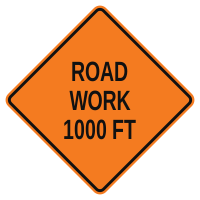
Road work ahead: work zone warning signs are usually orange, and speeding fines in a work zone are doubled
Test day
What to bring to the DMV
One proof of identity and legal presence, such as a US passport or an original or certified US birth certificate with a raised seal. Hospital records and wallet cards aren’t accepted
One proof of your Social Security number, such as your Social Security card, a W-2 or a pay stub showing the full number
Two proofs of your Delaware address from separate sources, showing your street address, not a P.O. box. Mail must have come by the US Postal Service within the last 60 days, and printouts aren’t accepted
Every name change document, such as a marriage license or court order, if your name differs from your birth record
Payment: the DMV takes cash, checks, money orders, Visa, MasterCard, American Express and Discover
Before you go
Read the Delaware Driver Manual dated July 2026, especially Section Four, the rules of the road.
Try the DMV’s online Sample Driving Exam and the 10-question sample written test on its website.
Use the DMV’s Document Selector Guide to check your papers before you go.
Check the office hours: Monday, Tuesday, Thursday and Friday from 8 a.m. to 4 p.m., and Wednesday from 11 a.m. to 6:30 p.m.
The test questions come from the Delaware Driver Manual. The DMV also posts a Sample Driving Exam online, with general knowledge tests in English, Spanish and Haitian Creole and a traffic sign test, plus a 10-question sample written test with its answers. Apps and websites from other companies add practice questions of their own.
Option
Price
Free to use
Links
Official
Delaware Driver ManualOfficial · PDF, five languagesThe Delaware Division of Motor Vehicles (DMV) manual the knowledge test is based on, dated July 2026. The Spanish edition is dated July 2025, so check details against the English one.
No cost at DMV offices
The whole manual to download, plus editions in Spanish, Chinese, Korean and Haitian Creole
DMV Sample Driving ExamOfficial · web pageThe DMV says the samples show the test format and a few questions, not every question on the real test. Its driver’s license pages also have a 10-question sample written test with an answer key, and the manual says the samples are on the DelDOT mobile app.
No price listed
General knowledge tests in English, Spanish and Haitian Creole, and a traffic sign test, marked as you go
The Parent’s Supervised Driving ProgramOfficial · PDF guide for parentsPublished with the Delaware DMV by Safe Roads Alliance for parents of teen drivers on a Level One Learner’s Permit. It points to the free RoadReady app for logging practice drives.
No price listed
Lessons by driving skill, a supervised driving log and the parent sign-off form
DMV-Permit-Test.comWebsiteIts Delaware page describes the real test as 32 questions with 26 to pass, the same as the DMV’s sample test page. The site also offers Premium and a Delaware cheat sheet with a pass guarantee, and links a Spanish version.
Practice tests on the site, optional paid Premium
20 Delaware car practice tests open on the site, plus motorcycle tests and CDL tests by topic
ZutobiWeb and app · all statesSays it has 600+ Delaware questions and narrated video lessons by certified instructors. The app has 4.7 stars from about 239,000 App Store ratings.
3-day free trial, then Zutobi Plus (App Store prices from $4.99)
DDMV GenieApp · all statesCar, motorcycle and CDL practice in one app; pick Delaware when you start. Check the plan length before you pay. It has 4.8 stars from about 184,000 App Store ratings.
Free to download, Premium in the app (weekly plan $7.99 in the App Store)
Free and premium study tools, per its App Store listing
How many questions are on the Delaware drivers test?
32, and you need 26 right to pass. That’s what the instructions on the DMV’s sample written test page say about the real Class D knowledge test. The DMV’s general FAQ page gives 30 questions with 24 to pass, so if the exact count matters to you, ask at the office. Either way, the bar is about 80%.
Can I take the Delaware permit test online?
No. You apply in person at a DMV office in Wilmington, Delaware City, Dover or Georgetown, and you take the test there. The DMV’s online Sample Driving Exam is practice only: the DMV says it’s meant to show the test format and a few of the questions.
Do I take the permit test at the DMV if I’m under 18?
Not if you take driver education, which you need under 18 anyway. Delaware law (21 Del. C. §2713) has certified driver education teachers give the written and road tests to their students, and the DMV accepts the course certificate in place of its own tests. The DMV itself tests students with a disability who need specialized evaluation, and anyone under 18 who transfers a license from another state.
What happens if I fail the knowledge test?
The DMV doesn’t publish a waiting period or a limit on tries for the knowledge test, so ask at the office about retesting. Your fee is paid when you apply. The waiting period you’ll see on DMV pages, 10 or 30 days, is for the road test.
What languages is the Delaware DMV test in?
The DMV doesn’t publish a list of test languages. The Driver Manual says audio tests with headphones are available on request. The manual itself comes in English, Spanish, Chinese, Korean and Haitian Creole, and the online sample tests in English, Spanish and Haitian Creole.
Are there questions about traffic stops on the test?
Yes. Delaware law (21 Del. C. §2713) requires at least 2 questions on traffic stops by law enforcement. The Driver Manual has a section on them: your rights, what to do and expect when you’re stopped, proof of identity, and how to file a compliment or a complaint about an officer.
Sources: Delaware Division of Motor Vehicles · Delaware General Assembly and 8 more. Checked October 2026.
 Delaware · Permit test