Maryland · Permit test

The Maryland permit test (Class C knowledge test)

You need 22 right answers out of 25, a score of 88%. The Maryland permit test is a multiple-choice knowledge test on traffic laws, road signs and safe driving, and you take it at a Motor Vehicle Administration (MVA) branch. Pass it and the vision screening at the same appointment, and you get a learner’s instructional permit, the first stage of its Rookie Driver program.

  • 17Languages, American Sign Language included
  • 6 monthsHow long a passing score counts
  • 20 minutesTime limit for the whole test

Key facts

At a glance

Who runs it
The Maryland Department of Transportation Motor Vehicle Administration (MVA)
Where you take it
At a full-service MVA branch, by appointment
Study book
The Maryland Driver’s Manual, October 2026 edition
What a pass leads to
A Type 1 learner’s instructional permit, if you’ve never had a license

How it works

How the Maryland permit test works

Class C knowledge test · 22 to pass
22 to pass
To pass you need 22 of 25 right.
  1. A vision screening comes first. MVA staff can do it when you apply, or an eye doctor who’s an authorized MVA vision provider can send your results in.
  2. For a license with no vision restrictions, you need vision in both eyes, at least 20/40 in each eye and a continuous field of vision of at least 140 degrees. If you need glasses or contacts to get there, your license will say you must wear them. Between 20/40 and 20/70, the MVA may give a restricted license instead.
  3. The questions are multiple choice, usually on a computer, and they come from the Maryland Driver’s Manual. The MVA’s knowledge test page lists what to know: sign shapes and meanings, right-of-way, following distance, turns and lanes, weather, intersections, and the effects of alcohol and drugs.
  4. A 2026 Maryland law, Chapter 539, requires at least one motorcycle safety question on the licensing exam from October 1, 2026. The questions come from a pool of at least five, on seeing motorcycles, lane position and following distance around them, and avoiding crashes with them.
  5. If a disability makes testing hard, contact the MVA before your appointment. Its accessibility page lists extended time, an oral reader, screen reader support and headphones for the knowledge test, and the MVA may ask for documents from a qualified professional. Deaf and hard of hearing customers can get a sign language interpreter at no cost.
  6. After you pass, the MVA mails your permit to the address it has on file, so check that address in myMVA. A pass doesn’t last forever: if no permit is issued within those 6 months, you apply and test again.

Topics

What’s on the test

01

Driving tests and licensing requirements

Sections 1 and 2 of the Driver’s Manual: the vision screening, knowledge test and driving skills test, then the Rookie Driver graduated licensing stages.

Key points (4)
  • You bring original documents or copies certified by the agency that issued them. The MVA won’t take photocopies, notarized copies or documents with changed or erased information.
  • State law requires you to tell the MVA about a medical condition that could affect your driving.
  • The graduated licensing process applies to people of any age who have never had a driver’s license.
  • A Developmental Disability Disclosure Card is voluntary, and you can get one at the information desk of any MVA location.
02

Basic driving

Section 3: defensive driving, right-of-way, speed, following and stopping distance, lanes, turns, passing and parking.

Key points (4)
  • If two drivers reach an intersection at the same time, yield to the driver on your right.
  • When you turn left, yield to drivers in the opposing lane.
  • The MVA recommends a following distance of at least 3 to 4 seconds in ideal conditions, and 4 to 5 seconds behind vehicles that stop often, such as buses.
  • The posted speed limit is the most you may drive in ideal conditions. Driving faster is illegal, and bad conditions call for less.
03

Signs, signals and pavement markings

Section 4: traffic and crosswalk signals, sign colors and shapes, regulatory and warning signs, and line markings.

Key points (4)
  • A flashing red light means stop, then go on with caution.
  • Orange signs warn of construction and maintenance work areas.
  • Fluorescent yellow-green signs are for schools, pedestrians and bicycles, and fluorescent pink ones mark emergency traffic incidents.
  • Brown signs point to recreation and cultural interest areas.
04

Driving situations and conditions

Section 5: night and low visibility, fog and bad weather, skids and hydroplaning, railroad crossings, work zones, roundabouts and interstates.

Key points (4)
  • Turn on your headlights whenever you can’t clearly see at least 1,000 feet ahead, and whenever you use your wipers in bad weather.
  • To avoid hydroplaning, keep your tires in good condition and slow down on wet roads. If you start to lose control, take your foot off the gas.
  • Buses, school buses and trucks carrying hazardous materials must stop before every railroad crossing.
  • At a roundabout, yield to traffic already in the circle and keep to the right of the island.
05

Dangerous driving behaviors

Section 6: alcohol and drugs, aggressive driving and road rage, distracted driving and drowsy driving.

Key points (3)
  • Maryland treats a blood alcohol concentration of .08 or higher as driving under the influence, and the manual warns that any amount of alcohol can affect your driving.
  • Holding a cell phone while you drive is illegal, texting included. Fully licensed drivers may make hands-free calls, but the manual says to keep them to a minimum. On a learner’s permit, no phone at all, except to call 911.
  • Under 21, Maryland has zero tolerance for alcohol, says the Rookie Driver Manual.
06

Sharing the road

Section 7: pedestrians, emergency vehicles, large trucks and buses, school buses, motorcycles, bicycles, mopeds and vehicle technology.

Key points (4)
  • When a stopped school bus has its red lights flashing, stop at least 20 feet from it, in front or behind. On a road divided by a physical barrier, you don’t stop for a bus on the other side.
  • For an emergency vehicle using its signals, move as close as you can to the edge of the road, stay out of intersections and stay stopped until it has passed.
  • Leave at least 3 feet when you pass a bicycle, whether it’s in a bike lane, on the shoulder or in your lane.
  • Keep at least a 3 to 4 second following distance behind a motorcycle.
07

Crashes and traffic stops

Section 8: what to do after a crash, roadside emergencies, traffic stops and the Move Over Law.

Key points (3)
  • If anyone is hurt in a crash, stay at the scene, call 911 and don’t move the vehicles.
  • Move over for any vehicle stopped, standing or parked on the road with its lights flashing. If you can’t, slow down to a safe speed.
  • Breaking the Move Over Law is a misdemeanor: the lowest penalty the manual lists is a $110 fine and one point.
08

Restrictions, violations and penalties

Section 9: license restrictions, implied consent drug and alcohol testing, false documents, administrative actions and penalties.

Key points (3)
  • Driving in violation of a restriction on your license is a serious offense, and you could lose your driving privileges.
  • By accepting a permit or license you agree to a drug or alcohol test when a police officer asks. That’s implied consent, says the Rookie Driver Manual, and refusing can get your license suspended.
  • When a license is suspended, the MVA may in some cases give a restricted license, for example only for getting to work and school.
09

Other important information

Section 10: medical conditions to report, the supervising driver, insurance, seat belts, child safety seats, air bags, anti-lock brakes and parking.

Key points (3)
  • The driver and every passenger must wear a safety belt or be buckled into a child safety seat.
  • Children under 8 ride in a child safety seat unless they’re 4 feet 9 inches or taller, and children under 2 ride rear-facing.
  • A supervising driver sits beside you, unless the vehicle is a motorcycle.

Road signs

Road signs from the Maryland Driver’s Manual

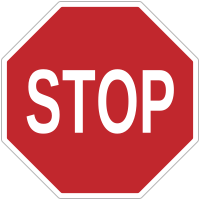
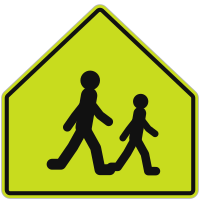
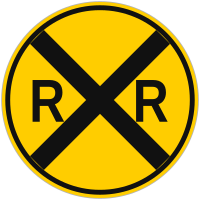
The Driver’s Manual teaches signs by color and shape first. An eight-sided sign always means stop, a pennant marks the start of a no-passing zone, a five-sided sign warns of a school zone or crossing, and a round sign warns of a railroad crossing ahead.

  • Red octagon with white border and the word STOP in whiteStop: the eight-sided shape always means stop. Stop at the stop line, or before the crosswalk or intersection if there’s no line
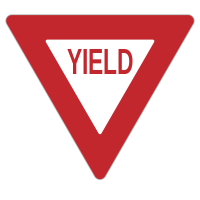
  • Downward-pointing red triangle with white center and the word YIELD in redYield: slow down, look left and right and give the right-of-way to pedestrians, bicycles and vehicles
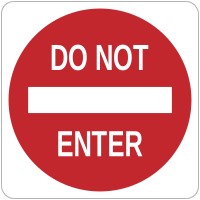
  • Red circle with a white horizontal bar on a white square, reading DO NOT ENTERDo not enter: a red sign, one of the colors the manual gives for stop, yield, do not enter and wrong way
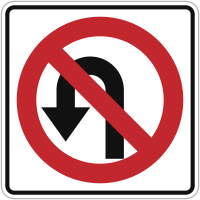
  • Black U-turn arrow inside a red circle with a red slashNo U-turn: one of the black-on-white rectangular signs that regulate traffic
  • Black rectangle with a white arrow pointing right containing ONE WAYOne way: traffic can only go in the direction of the arrow
  • Yellow pennant pointing right reading NO PASSING ZONENo passing zone: the pennant marks the start of a no-passing zone
  • Fluorescent yellow-green pentagon with two children walkingSchool crossing: the five-sided shape warns of school zones and marks school crossings
  • Round yellow sign with a black X and two letters RRailroad crossing ahead: the round sign warns of a railroad crossing
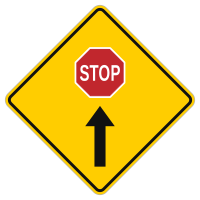
  • Yellow diamond with a red octagon and a black arrow pointing up toward itStop ahead: a yellow diamond warns of what’s ahead, so be ready to slow down
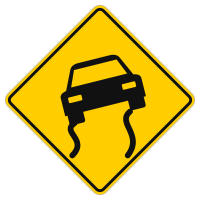
  • Yellow diamond with a car and two S-shaped skid marksSlippery when wet: slow down when the road is wet
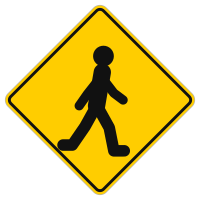
  • Yellow diamond with a black walking personPedestrian crossing: watch for people crossing
  • Orange diamond reading ROAD WORK 1000 FTRoad work ahead: orange signs warn of construction and maintenance work areas

Free practice test

20 practice questions from the Maryland Driver’s Manual

These 20 questions are written from the Maryland Driver’s Manual. The real knowledge test has 25 questions and you need 22 right, which is 88%. Here we use our own bar, 18 of 20, which is close to that. Four show a sign or signal, and one is on motorcycles, as Maryland law requires on the real test. After each answer, the tutor can explain it another way or tell you why the other choices are wrong.

Question 1 of 20

For a license with no vision restrictions, what visual acuity do you need in each eye?

20 practice questions in the style of the permit test.

Test day

What to bring to your MVA permit appointment

  • Proof of identity: a birth certificate, US passport, Permanent Resident Card, Consular Report of Birth Abroad, or Certificate of Naturalization or Citizenship
  • Proof of your Social Security number: your Social Security card, a pay stub showing it, or a W-2 or 1099
  • Two documents with your name and Maryland address, which the Driver’s Manual asks for
  • If your identity document doesn’t name your parent or guardian, proof of the relationship, such as a tax return or health insurance card
  • Under 16: form DL-300, completed by your school or county home school coordinator and handed over in the school’s sealed envelope, or form DL-300A, co-signed by a parent or guardian
  • Under 18: a parent or legal guardian to co-sign your application

Before you go

  1. Read the whole Maryland Driver’s Manual, signs section included.
  2. Practice with the MVA’s Online Driver Test Tutorial, untimed first, then timed.
  3. Do the pre-application in your myMVA account and book an appointment at a full-service MVA branch.
  4. Check your documents with the MVA’s Online Document Guide. Bring originals or certified copies, not photocopies.
  5. Arrive early, so you have time to check in.
Read the MVA’s permit stepsThe learner’s permit page walks through the four steps and links the MVA’s appointment scheduler and Online Document Guide.

Study options

Where to study

The MVA publishes three free study aids: the Driver’s Manual, its Online Driver Test Tutorial, and the Rookie Driver Manual for the driving practice after the permit. Driver education is a separate course, priced by each school.

OptionPriceFree to useLinks
Official sources
MVA Online Driver Test TutorialOfficial · website and phone appThe Maryland Motor Vehicle Administration’s own practice tests, open to anyone. The tutorial page also links the MVA’s app for iPhone and Android.
FreeUntimed and timed practice tests, in English and Spanish
Maryland Driver’s ManualOfficial · PDFThe book the knowledge test is written from. It covers the tests, licensing, driving rules, signs, sharing the road and penalties in 10 sections.
FreeThe whole manual, October 2026 edition
Maryland Rookie Driver ManualOfficial · PDFA practice guide for new drivers and their coaches, for the time between the permit and the driving test. It isn’t a knowledge test book.
FreePractice lessons, the practice log and the certification page
Required courses
MVA-approved driver education schoolsDriving schools · in personEvery new driver takes an approved course before the driving test. The MVA keeps a searchable list of approved schools as a public service and doesn’t endorse any of them.
Set by each schoolNo

Prices and ratings checked November 2026.

FAQ

Common questions

How many questions are on the Maryland permit test?

It depends on the permit. The car (Class C) test, the motorcycle (Class M) test and the moped permit test each have 25 questions. Class A and Class B have 20. All of them share the same time limit and pass mark.

Can I take the Maryland permit test online?

No. The Driver’s Manual says you take it at an MVA location. Online, you can practice with the MVA’s free Online Driver Test Tutorial and fill in the pre-application before you go.

What happens if I fail the knowledge test?

After a first fail, you can retest the next business day if there’s an appointment free. After two or more fails, you wait at least seven calendar days. Book the retest like any other appointment, at a branch or on the MVA website.

What languages is the Maryland MVA test in?

The car (Class C) test comes in English, Spanish, American Sign Language, Amharic, Arabic, Chinese (Traditional), Farsi, French, Hindi, Korean, Nepali, Portuguese, Russian, Tagalog, Urdu, Vietnamese and Yoruba. You may bring a spoken language interpreter from the MVA’s approved list, and you pay them. If the test is offered in your language, you must try it on your own first: the MVA’s accessibility page says at least three attempts, while the October 2026 Driver’s Manual says at least five, so ask the MVA which applies to you.

Does the permit test cost anything?

There’s no MVA fee for the knowledge test itself. You pay for the permit it leads to, and the learner’s permit page sets out that fee.

Is the Maryland learner’s permit test hard?

The MVA’s tutorial page says about half of first-time test takers fail, so it pays to study first. The where-to-learn page sets out the MVA’s free practice tests and a study plan.

All 20 practice questions with answersA printable list of the practice test above
  1. For a license with no vision restrictions, what visual acuity do you need in each eye?

    20/40 or better To get a license with no vision restrictions, you need vision in both eyes, at least 20/40 in each eye without glasses or contacts, and a continuous field of vision of at least 140 degrees. If you need glasses or contacts to meet the rules, your license carries a restriction.

  2. Who does Maryland’s graduated licensing process apply to?

    First-time drivers of any age The graduated licensing process applies to people of any age who have never had a driver’s license. It starts with the learner’s instructional permit.

  3. You and another driver reach an intersection at the same time. Who should you yield to?

    The driver on your right Yield to the driver who arrives before you. If you both arrive at the same time, yield to the driver on your right.

  4. How much following distance does the MVA recommend behind a bus or another vehicle that stops often?

    4 to 5 seconds The MVA recommends at least 3 to 4 seconds in ideal conditions, and 4 to 5 seconds behind vehicles that stop often, such as buses. Count the seconds from a fixed point, like a sign or a bridge.

  5. When you turn left at an intersection, who must you yield to?

    Drivers in the opposing lane When you turn left, yield to drivers in the opposing lane. Also yield to pedestrians, bicyclists and other drivers in the intersection.
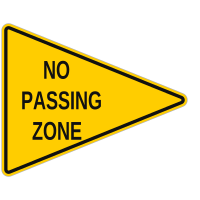
  6. Yellow pennant pointing right reading NO PASSING ZONE

    What does this sign mark?

    The start of a no-passing zone This pennant marks the start of a no-passing zone. Don’t pass other vehicles.
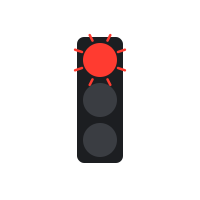
  7. Traffic signal with the red light lit and flash marks around it

    You come to an intersection where this signal is flashing. What must you do?

    Stop, yield, then go when it’s clear At a flashing red signal, come to a complete stop at the stop line, or before the crosswalk and intersection. Yield to all other traffic and pedestrians, then go when the way is clear.
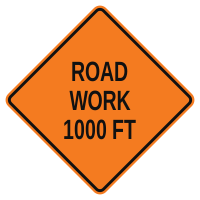
  8. Orange diamond reading ROAD WORK 1000 FT

    What does the color of this sign tell you?

    It warns of a work area Orange signs warn of construction and maintenance work areas. Slow down, obey the work zone signs and watch for workers.
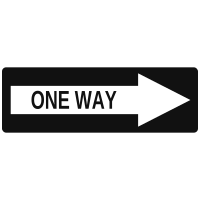
  9. Black rectangle with a white arrow pointing right containing ONE WAY

    What does this sign tell you?

    Traffic goes only the arrow’s way This sign means one way: traffic can only go in the direction of the arrow. Turn onto the street only in that direction.

  10. You must turn on your headlights whenever there isn’t enough light to clearly see at least how far ahead?

    1,000 feet Turn on your headlights whenever there isn’t enough light to clearly see at least 1,000 feet in front of your vehicle. Also turn them on whenever you use your wipers in bad weather.

  11. Which vehicles must stop before every railroad crossing?

    Buses and trucks carrying hazardous materials Buses, school buses and trucks carrying hazardous materials must stop before every railroad crossing. Be aware that the vehicle ahead of you may be one of them.

  12. As you come to a traffic circle, what must you do?

    Yield to traffic already in the circle At a traffic circle, always yield to traffic already in it. Reduce your speed, keep to the right of the island and yield to pedestrians in the crosswalk.

  13. On a learner’s permit, when may you use a cell phone while driving?

    Only to make a 911 emergency call With a provisional license or a learner’s permit, you may not use any wireless device while driving, even a hands-free phone. The only exception is a 911 emergency call.

  14. At what blood alcohol concentration does Maryland treat a driver as driving under the influence?

    .08 or higher Maryland treats a blood alcohol concentration of .08 or higher as driving under the influence. The manual warns that any amount of alcohol can affect your driving.

  15. A school bus has stopped with its red lights flashing. How far from it must you stop?

    At least 20 feet Stop at least 20 feet from the back of the bus if you’re behind it, or from the front if you’re in front of it. Don’t move again until it starts moving or turns off its red lights.

  16. How much space must you leave when you pass a bicycle?

    At least 3 feet Leave at least 3 feet between your vehicle and the bicycle when you pass, whether it’s in a bike lane, on the shoulder or in your lane. Make sure you see the bicycle in your rear-view mirror before you move back.

  17. How much following distance should you leave behind a motorcycle?

    At least 3 to 4 seconds Leave at least a 3 to 4 second following distance behind a motorcycle. Motorcyclists often slow down in ways that don’t turn on their brake lights.

  18. Someone is hurt in a crash you’re in. What must you do?

    Stay, call 911 and don’t move the vehicles If anyone is hurt in a crash, including a pedestrian or bicyclist, stay at the scene, call 911 and don’t move the vehicles. Report the number of people involved, the injuries and the location.

  19. When you drive on a Maryland road, what have you agreed to by law?

    A drug or alcohol test if police ask If you drive or try to drive on a road or private property used by the public, you agree to a drug or alcohol test when a police officer asks. That’s implied consent, and if you refuse, the MVA will suspend your license.

  20. Unless they’re 4’9” or taller, children under what age must ride in a child safety seat?

    Under 8 All children under 8 must ride in a child safety seat, unless they’re 4’9” or taller. Children younger than 2 ride rear-facing.

Sources: Maryland Motor Vehicle Administration · Maryland General Assembly and 6 more. Checked November 2026.

Rules and fees can change, so check the official site before your test.