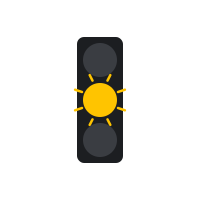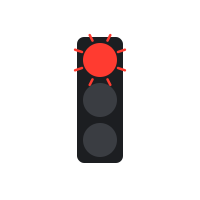
You come to an intersection where this signal is flashing. What does it mean?
It means the same as a stop sign The Hawaii Driver's Manual says a flashing red signal has the same meaning as a stop sign, and a stop sign is also posted where one is used. Come to a complete stop, yield to traffic that has the right-of-way, then go when it's safe.
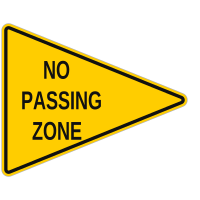
Where is this sign posted, and what does it mark?
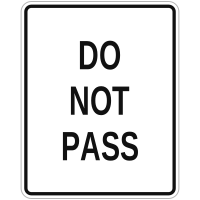
On the left side of the road, pointing to where a no-passing zone begins This pennant-shaped no passing zone sign goes on the left side of the road and points to the beginning of the no-passing zone. The manual says it adds to the rectangular Do Not Pass sign, so you see the warning from the side where you'd be passing.
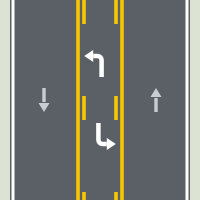
What may you use a center lane marked like this for?
Left turns only, by traffic from either direction These are two-way left turn markings: solid and dashed yellow lines on each side of a center lane. The manual says the lane is for left turns only, by vehicles going either way, and must never be used for passing.
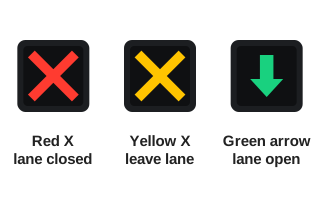
These lane control signals hang over the lanes. What does a steady yellow X above your lane mean?
Move out of the lane, because it will soon carry traffic going the other way Lane control signals change which way a lane runs at different times. The manual says a yellow X means you must move out of that lane because it's going to be used by traffic moving in the opposite direction. A red X means don't use the lane, and a green arrow means you may.
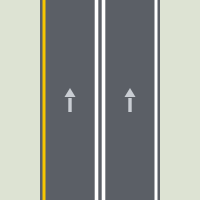
What does this marking between two lanes going your way mean?
You must not cross it Double solid white lines mean moving from lane to lane is prohibited. The manual puts it in capitals: you must not cross a double solid white line. A single solid white line is different: you may cross it only in unusual circumstances, with great care.
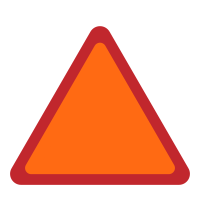
You see this emblem on the back of a vehicle ahead. What does it tell you?
The vehicle is built to go 25 mph or less, so slow down and approach with care This reflective triangle is the slow moving vehicle emblem. The manual says it must be shown on the rear of vehicles designed to run at 25 mph or less, and that when you see it you should reduce speed and approach cautiously.
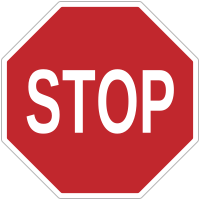
You stop at this sign, but there's no stop line painted on the road. Where do you stop?
Before the crosswalk, whether it's marked or not The manual says to stop at the stop line, and if there isn't one, before crossing any marked or unmarked crosswalk. If you still can't see traffic from there, move ahead slowly and stop again where you can.
What's the youngest age at which you can get an instruction permit in Hawaii?
15 and a half The Hawaii Driver's Manual says you must be at least 15 and a half to get an instruction permit. If you're under 18, each living parent or your legal guardian must also give consent.
You're 16 and driving on your instruction permit at midnight. Who must be with you?
Your parent or guardian On a permit you always drive with a licensed driver who is at least 21. Between 11 p.m. and 5 a.m., the manual says that person must be your parent or guardian.
You have a provisional license and no parent or guardian is in the car. How many passengers under 18 who don't live with you may you carry?
One The manual says a provisional license lets you carry only one person under 18 who isn't a member of your household. Family members who live with you don't count toward that limit.
How far before a turn or lane change does Hawaii's manual say you must start signaling?
At least 100 feet, about five car lengths Signals must be given for at least 100 feet before you change lanes, turn or stop. The manual says that's about five car lengths, and that signaling for longer is a good idea at higher speeds.
The gate is down at a railroad crossing ahead. How close to the nearest rail may you stop?
No closer than 15 feet You must stop not less than 15 feet from the nearest rail when a gate is lowered, a signal is warning of a train, a flagman signals one, or a train is close enough to be a hazard.
You park next to a curb on a hill. Which way should your front wheels point?
To the right, toward the curb, whether you face uphill or downhill The Hawaii Driver's Manual says to turn the front wheels toward the curb and, uphill or downhill, to turn them to the right, so the car rolls away from traffic if it gets loose. Set the hand brake and shift into park, or reverse or low gear.
When does the Hawaii Driver's Manual allow a left turn on a red light?
After stopping, from a one-way street into a one-way street where traffic moves to the left, unless a sign forbids it After a full stop on red you may turn right unless a sign prohibits it. You may also turn left, but only from a one-way street into another one-way street where traffic moves to the left, again unless a sign forbids it. Either way you yield to pedestrians and other vehicles.
The car ahead passes a pole and you start counting "one thousand one, one thousand two." Your car reaches the pole before you say "two." What does that tell you?
You're following too closely, so drop back The manual's count gives you at least a two-second gap if you get to the word two before your car reaches the marker. Reaching the marker sooner means the gap is under two seconds, and the manual says you should never have less.
When is a road usually most slippery in the rain?
In the first few drops, before oil from cars has washed away The manual calls the first few drops of rain a danger signal: roads are most slippery then because the oil dropped by passing cars hasn't been washed away. It says to slow down, take extra care and leave at least twice the normal following distance.
A tire blows out while you're driving at speed. What should you do first?
Hold the wheel firmly, stay in your lane and slow down gradually without braking The manual says not to apply the brakes after a blowout, because the car may become uncontrollable. Grip the wheel firmly, steer to stay in your lane and let your speed drop gradually. Once you're moving very slowly, brake lightly and pull off the road into a safe area.
Under Hawaii's zero tolerance rule, a driver under 21 may not drive with a blood alcohol content at or above what level?
.02 The manual says drivers under 21 are prohibited from driving with a blood alcohol content of .02 or more. For drivers of any age, .08 or more counts as under the influence and leads to administrative license revocation.
Which crash must be reported to the police right away?
Any crash with an injury, a death, or property damage of $3,000 or more Chapter VII of the manual says crashes that cause personal injury to any extent, death, or property damage of $3,000 or more must be reported to the police immediately, by the quickest means of communication.
You're on a divided highway. On the other roadway, going the opposite way, a school bus has stopped with its red lights flashing. What must you do?
You don't have to stop, but stay alert for children Hawaii law makes drivers in the bus's lane and the lanes next to it stop until the bus moves again or its red lights go off. The manual says vehicles going the opposite direction on a divided highway are not required to stop. A divided highway is two roadways separated by space not meant for driving.
 Hawaii · Permit test