Kansas · Permit test

The Kansas instructional permit test

It's a 25-question written test on Kansas traffic laws and road signs, and you need 80% to pass. The Division of Vehicles, part of the Kansas Department of Revenue (KDOR), gives it at driver's license offices, and it also lets people who qualify take the same exam online at home. Pass the Kansas instructional permit test and a vision screening, and you can get a Class C instruction permit from age 14. The questions come from the free Kansas Driving Handbook, and so do the 20 practice questions on this page.

  • 25Multiple-choice questions on laws and signs
  • 80%Needed to pass, so 20 right answers
  • 14Youngest age for a Class C or M instruction permit
  • 4Tries before a six-month wait

Key facts

At a glance

Who gives it
KDOR's Division of Vehicles. Kansas has no agency called the DMV
Where
A driver's license office that gives knowledge tests, or online through KDOR's KnowToDrive portal if you qualify
Pass mark
80%, so 20 of 25 right. The test isn't timed
Permit fee
$10 on KDOR's fee chart (updated May 2023): $2 plus an $8 photo fee. The chart's notes also charge $3 for a first exam, but not if you bring a driver's ed form

How it works

How the Kansas instructional permit test works: 25 questions, in an office or online

  1. The Kansas Department of Revenue's Division of Vehicles gives the test. Its Driver's License Examination section tests everyone who applies for a Kansas license.
  2. The test has 25 multiple-choice questions on Kansas traffic laws, road signs and pavement markings, and some questions ask you to identify a sign by its shape, color or symbol.
  3. You need 80% to pass. The test isn't timed, but the handbook says it usually takes 15 to 20 minutes.
  4. You can take it at a driver's license office that gives knowledge tests, or online through KDOR's KnowToDrive portal if you qualify, then bring your passing result to an office.
  5. Your vision is screened too. You need at least 20/40 in one eye, with or without glasses or contacts.
  6. If you fail, you can try again the next working day after paying a $1.50 re-exam fee. After a fourth failure you wait at least six months.
  7. A completion form (DE-99) from an approved driver's education course can take the place of the written test.

Topics

What’s on the test

01

Signs, signals and pavement markings

Section 6 of the Kansas Driving Handbook covers lights, signs and the lines on the road. The test asks you to identify some signs by shape, color or symbol.

Key points (4)
  • Warning signs are usually yellow diamonds. Work zone signs are orange, and incident signs are fluorescent pink.
  • Regulatory signs are white with black, red or green letters or symbols.
  • A flashing red light means stop, then go as at a stop sign. A flashing yellow light means slow down and go with caution.
  • Don't pass when the solid yellow line is on your side of the center line.
02

Instruction permits and teen license rules

Section 1 of the handbook covers the instruction permit, the farm permit and the restricted license. Kansas uses a graduated system, so privileges grow with age and experience.

Key points (4)
  • You can get a Class C or M instruction permit at 14.
  • A permit holder drives only with a licensed adult, 21 or older, in the front seat.
  • The Class C permit is valid one year and is renewed by passing the written exam again.
  • A restricted license at 15 needs a state-issued permit held for a year, driver's education and 25 hours of supervised driving.
03

Right-of-way, roundabouts and parking

The handbook says the law tells you who must yield, but never gives anyone the right-of-way. Sections 2 and 6 cover intersections, turns, roundabouts and parking.

Key points (4)
  • At an intersection with no signs or signals, yield to the vehicle on your right.
  • When turning left, yield to oncoming vehicles going straight or turning right.
  • Entering traffic yields to traffic already in a roundabout.
  • Don't park within 15 feet of a fire hydrant or within 50 feet of a railroad crossing.
04

Speed limits and signaling

Kansas sets default speed limits by type of road, and its basic speed law says never drive faster than is reasonable for the conditions.

Key points (3)
  • Unless posted: 30 mph in urban districts, 55 on county and township roads, 65 on state and federal highways.
  • Separated multilane highways can be posted at 75 mph.
  • Signal at least 100 feet before you turn or change lanes.
05

School buses, emergency vehicles and cyclists

Section 9 of the handbook covers sharing the road, and Sections 2 and 6 set the school bus and move-over rules.

Key points (3)
  • Stop for a school bus with red lights flashing or its stop arm out, from either direction, unless a median or other barrier separates you.
  • On a road with two or more lanes each way, move out of the lane next to a stopped emergency vehicle with flashing lights, or slow down.
  • Don't pass a bicyclist right before you turn right.
06

Alcohol and phones

Section 3 of the handbook covers alcohol, drugs, fatigue and distractions, and Section 2 gives the Kansas texting law.

Key points (3)
  • A BAC of .08 or higher breaks the law. Under 21, you can be arrested for impairment at .02.
  • Refusing a breath, blood or urine test can cost you your license for a year.
  • Kansas bans writing, sending or reading texts and other written messages while driving.

Road signs

Road signs from Section 6 of the Kansas Driving Handbook

Section 6 of the Kansas Driving Handbook sorts signs by color: yellow for warnings, orange for work zones, white for rules you must obey, and fluorescent pink for temporary incident signs after crashes or spills. The handbook says the test asks you to identify some signs by their shape, color or symbol, so learn the shapes first.

  • Red octagon with white border and the word STOP in whiteStop: eight sides, red with white letters. Stop behind the line, then yield
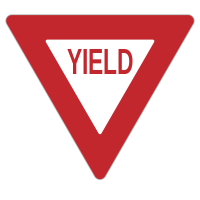
  • Downward-pointing red triangle with white center and the word YIELD in redYield: slow down and let traffic with the right-of-way go first
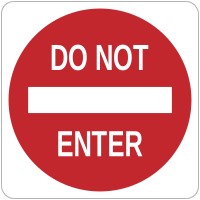
  • Red circle with a white horizontal bar on a white square, reading DO NOT ENTERDo not enter: you may not drive into this road or ramp
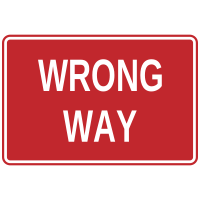
  • Red rectangle with white border reading WRONG WAYWrong way: you are driving against traffic, so turn around safely
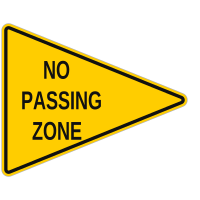
  • Yellow pennant pointing right reading NO PASSING ZONENo passing zone: the only pennant-shaped sign, on the left side of the road
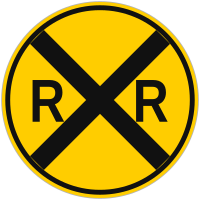
  • Round yellow sign with a black X and two letters RRailroad ahead: slow down, look and listen, and be ready to stop
  • White X-shaped crossbuck reading RAILROAD CROSSINGCrossbuck: at the tracks, wait behind the line for any train
  • White sign: SCHOOL on fluorescent yellow-green, SPEED LIMIT 20, WHEN FLASHINGSchool speed limit: the lower limit applies only while flashing
  • White sign reading NO TURN ON REDNo turn on red: wait for green before turning either way
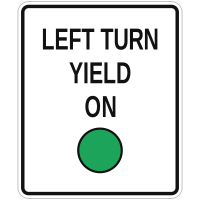
  • White sign reading LEFT TURN YIELD ON above a green circleLeft turn yield on green: you may turn, but oncoming traffic goes first
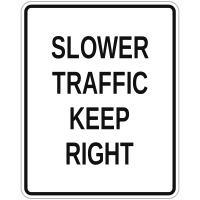
  • White sign reading SLOWER TRAFFIC KEEP RIGHTSlower traffic keep right: on a multilane highway, slower drivers use the right lane
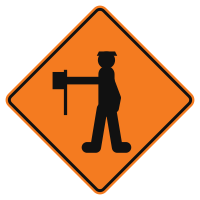
  • Orange diamond with a black flagger symbol holding a flagFlagger ahead: orange work zone sign. Follow the flagger's directions

Free practice test

20 practice questions from the Kansas Driving Handbook

The real test has 25 questions. Here are 20 in the same multiple-choice style, with three choices each like the handbook's own sample questions, and the same 80% bar: get 16 right and you'd pass. Every answer is explained, and if you miss one, the tutor explains it another way and says what's wrong with each other choice.

Question 1 of 20
Yellow pennant pointing right reading NO PASSING ZONE

You see this sign on the left side of a two-lane road. What does it tell you?

20 practice questions in the style of the knowledge test.

Test day

What to bring to the driver's license office

  • One proof of identity and lawful presence, such as a state-issued birth certificate or a U.S. passport. Hospital birth certificates aren't accepted
  • Proof of your Social Security number, such as your Social Security card
  • Two proofs of your Kansas home address, such as a utility bill or a school transcript
  • Under 16: a parent or guardian with photo ID, who signs the application
  • Your driver's education completion form, if you have one, and your glasses or contacts

Before you go

  1. Read the Kansas Driving Handbook. It's a free PDF from KDOR.
  2. Answer the Test Your Knowledge questions at the end of each handbook section, then the sample questions in Section 11.
  3. Try the 20 practice questions on this page.
  4. Check your documents against KDOR's acceptable documents list. Bring originals, not copies.
  5. Book an appointment, since KDOR says appointments get priority.
  6. If you're testing at home, check KDOR's KnowToDrive portal to see if you qualify.
Kansas Department of Revenue: driver's license appointmentsKDOR lists which offices use which scheduler. Appointments aren't required, but KDOR says customers with appointments get priority.

Study options

Where to study

KDOR's Kansas Driving Handbook is a free PDF, and a printed copy costs $2 at a driver's license office. KDOR also has a voice practice test for Alexa, and it publishes lists of the private driver's education schools it approves.

OptionPriceFree to useLinks
Official and free
Kansas Driving HandbookOfficial · PDFKDOR's own book for the knowledge test and the driving test, revised February 2022, with Test Your Knowledge questions after each section and 13 sample questions in Section 11. The Spanish edition is older, revised February 2019. KDOR's FAQ says a printed copy costs $2 at a driver's license office.
Free as a PDF, $2 printedThe whole handbook, in English and Spanish
Kansas Driver's Practice Test for AlexaOfficial · Voice skillA KDOR practice test for Amazon's Alexa. You say "Alexa, enable Kansas driving test", then Alexa asks multiple-choice questions and you answer with the letter. KDOR's page doesn't say how many questions it has.
No price listed by KDOREnable it on an Alexa device
Motorcycle and CDL handbooksOfficial · PDFFor a motorcycle license, the Kansas Motorcycle Handbook (revised 2020) is built on the Motorcycle Safety Foundation's manual, with Kansas statutes and sample questions added. For a commercial license, KDOR's CDL manual (March 2025 version) covers every knowledge test and the three-part skills test.
FreeBoth books
Apps and websites
Road Ready AppApp · linked by KDORKDOR's teen driving page links the Road Ready App in its list of teen driving resources, next to the supervised driving handbook. KDOR's page doesn't describe the app or say who makes it.
Not listed on KDOR's pageNot stated on KDOR's page
Parent's supervised driving program handbookWebsite · linked by KDORKDOR's teen driving page links this handbook for parents, hosted on edrivermanuals.com. KDOR's page gives the title only and doesn't say who publishes it.
Not listed on KDOR's pageNot stated on KDOR's page
In person
KDOR-approved private driving schoolsIn person · CourseKDOR's list of private driver training schools, dated July 2026, gives contacts for schools in towns including Wichita, Lawrence, Lenexa, Leawood, Salina, Overland Park and Kansas City, Kansas. The handbook says approved private schools give 8 hours of classroom and 6 hours of behind-the-wheel instruction, and that online courses don't count for a Kansas license.
Set by each school; KDOR's list doesn't give pricesNothing free listed
School district driver's educationIn person · CourseThe handbook counts programs from accredited local school districts approved by the Kansas Department of Education. Finishing one gets you a DE-99 form, which KDOR accepts in place of the written test for an instruction permit.
Set by each districtNothing free listed
Motorcycle schools and community college programsIn person · Rider courseKDOR's July 2026 list includes private motorcycle schools in towns such as Wichita, Hays and Olathe, and community college programs in El Dorado, Junction City and Arkansas City. Kansas law lets the riding test be given as part of a course recognized by the Motorcycle Safety Foundation.
Set by each school; KDOR's list doesn't give pricesNothing free listed

Prices and ratings checked October 2026.

FAQ

Common questions

Is the Kansas instructional permit test the same as the learner's permit test?

Yes. The handbook calls the permit an instructional permit, KDOR's fee chart calls it a learner's permit, so you'll see both names. It's one test: the non-commercial knowledge exam, which is also the written test for a full license if you're 17 or older.

How many questions are on the Kansas permit test?

25 multiple-choice questions, according to Section 11 of the Kansas Driving Handbook. You need 80% to pass, which is 20 right answers. There's no time limit, and the handbook says it generally takes 15 to 20 minutes.

Can I take the Kansas permit test online?

Yes, if you qualify. KDOR lets people complete the non-commercial knowledge exam online through its KnowToDrive portal and bring the passing result to an office instead of testing there. KDOR's FAQ says to use a laptop or desktop computer, not Internet Explorer. The handbook says vision is screened at the driver's license station, unless you bring KDOR's vision form filled in by an eye doctor in the last 90 days.

How old do you have to be to get a learner's permit in Kansas?

14. Under 16, a parent or guardian has to apply with you in writing and sign an affidavit at the office, and KDOR says they must be there with photo ID.

What happens if I fail the Kansas permit test?

You can take it again the next working day after paying a $1.50 re-exam fee, or wait and study more. The handbook gives you four tries. After a fourth failure, you wait at least six months from that exam before testing again.

Can driver's education replace the written test?

Yes. KDOR's teen driving FAQ says an office will accept a DE-99 completion certificate from an approved course, with proof of your name and date of birth, and issue an instruction permit without written testing. Online driver's ed courses don't count in Kansas.

Sources: KDOR and 7 more. Checked October 2026.

Rules and fees can change, so check the official site before your test.

All 20 practice questions with answersA printable list of the practice test above
  1. Yellow pennant pointing right reading NO PASSING ZONE

    You see this sign on the left side of a two-lane road. What does it tell you?

    A no-passing zone starts here The handbook says this is the only pennant-shaped warning sign. It marks the start of a no-passing zone and stands on the left side of the road, facing you.
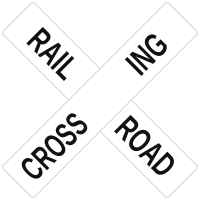
  2. White X-shaped crossbuck reading RAILROAD CROSSING

    You reach this sign at a railroad crossing and a train is coming. What must you do?

    Stay behind the stop line until the crossing is clear This is the crossbuck, which stands at the crossing itself. The handbook says you must wait for an approaching train and keep your vehicle behind the stop line, or before the crossing, until it's clear.
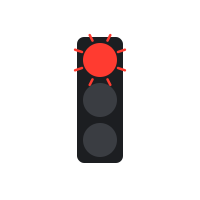
  3. Traffic signal with the red light lit and flash marks around it

    What must you do when you face this signal at an intersection?

    Stop completely, then go when it's safe, as at a stop sign A flashing red light works like a stop sign. The handbook says to stop behind the stop line, crosswalk or intersection, look both ways and yield before you go.
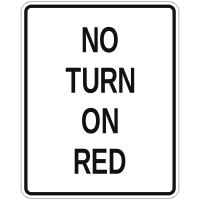
  4. White sign reading NO TURN ON RED

    You're stopped at a red light where this sign is posted. When may you turn right?

    Only after the light turns green The handbook says this sign means you may not turn right or left during the red light. You wait for the signal to turn green before turning.
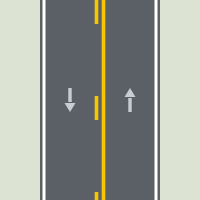
  5. Two-way road with a solid yellow line on the right-hand lane side and a broken yellow line beside it; no passing from the right-hand lane

    These are the center lines on a two-lane road, seen from your lane. May you pass the car ahead?

    No, you may not pass from your side When there's a solid yellow line and a broken one, the line on your side decides. The handbook says not to pass if the solid yellow line is on your side.
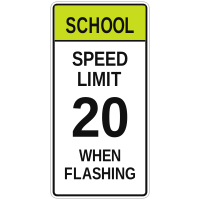
  6. White sign: SCHOOL on fluorescent yellow-green, SPEED LIMIT 20, WHEN FLASHING

    When does the lower limit on this sign apply?

    Only while the lights are flashing The handbook says this sign is posted before a school, and the lower limit is required only when it's flashing. The rest of the time you obey the road's normal speed limit.

  7. You're 14 and have a Kansas instruction permit. Who has to be with you when you drive?

    A licensed adult, 21 or older, in the front seat The handbook says a permit holder may drive only with a licensed adult in the front seat. That adult must be at least 21 and have at least one year of driving experience, and no one else may sit in the front.

  8. How long is a Kansas Class C instruction permit valid?

    One year A Class C instructional permit is valid for one year from the day it's issued. The handbook says you renew it by retaking and passing the written exam.

  9. You want a restricted license at 15. Which time counts toward the year you must hold a permit?

    Time on a state-issued instruction permit The handbook says you must have held a state-issued permit for a year, and that driver's education permit slip time doesn't count. KDOR's teen driving FAQ adds that the law requires the instruction permit to be issued in Kansas.

  10. Two cars reach an intersection with no signs or signals at about the same time. Which one goes first?

    The car on the right When two vehicles enter from different roads at about the same time, the handbook says the driver on the left yields to the vehicle on the right.

  11. You're turning left at a green light, and a car is coming straight toward you. What should you do?

    Yield until the oncoming car has passed The handbook says a driver turning left must yield to oncoming vehicles going straight ahead or turning right. A steady green lets you turn only when the intersection is clear.

  12. How close to a fire hydrant may you park in Kansas?

    No closer than 15 feet Both parking lists in the handbook say you may not park within 15 feet of a fire hydrant.

  13. You're about to enter a roundabout and a car is already going around it. Who has the right-of-way?

    The car already in the roundabout The handbook says entering traffic yields to traffic already circulating. Vehicles go counterclockwise around the center island.

  14. Unless a sign says otherwise, what's the top speed on a Kansas county or township road?

    55 mph The handbook's list of maximum speeds, unless otherwise posted, gives 55 mph on any county or township road.

  15. How far before a turn must you start signaling in Kansas?

    At least 100 feet The handbook says all signals must be given at least 100 feet before the turn or move, and held until you're ready to make it.

  16. You're on a road with two lanes each way and see a police car stopped ahead with its lights flashing. What should you do?

    Move to a lane not next to it, or slow down if you can't change lanes The handbook says that when you come up behind a stationary emergency vehicle with flashing lights on a road with two or more lanes each way, you move to a lane not next to it. If you can't, you slow down and go with caution.

  17. A school bus is stopped with red lights flashing on the other side of a highway divided by a median. What do you do?

    Keep going with care, since you don't have to stop The handbook says you aren't required to stop if the bus is coming toward you on a road separated by a median or other physical barrier. Traffic on the bus's side still stops.

  18. You'll turn right just ahead, and a cyclist is riding in front of you near the curb. What's the safe move?

    Slow down and let the cyclist go through before you turn The handbook says you must not pass a bicyclist immediately before making a right turn. Slow down and let the cyclist go through the intersection first.

  19. At what blood alcohol level can a driver under 21 be arrested for alcohol impairment in Kansas?

    .02 The handbook says that in Kansas, a driver under 21 can be arrested for alcohol impairment at .02. For drivers 21 and over, .08 or higher breaks the law.

  20. Which of these does Kansas law ban while you're driving?

    Reading a text message The handbook says Kansas law bans using any electronic device to write, send or read a written communication while driving. It names GPS devices and weather reports as not included.