Connecticut · Permit test

CT permit test

You need 20 right out of 25 on the CT permit test, taken on a computer at a DMV office by appointment. Since January 1, 2026, you also need the free Work Zone Safety Course certificate.

  • 25Multiple-choice questions
  • 20Correct answers needed to pass
  • $40 + $19Testing fee plus permit fee (as of October 2026)
  • 7 daysWait before a retake

Key facts

At a glance

To pass
20 correct, so you can miss 5
Minimum age
16. From 18 you apply for the adult learner's permit
Where
Ten DMV locations, by appointment only, after a vision test
Languages
11 on the computer, and 24 more as a paper test on request

How it works

How the CT permit test works: 25 questions, 20 to pass

Knowledge test
20 to pass
To pass you need 20 of 25 right.
  1. The knowledge test has 25 questions from the Connecticut Driver's Manual, and you need 20 right to pass.
  2. You take it on a computer at a DMV office, by appointment only, after a vision test at the same visit.
  3. If you fail the vision test, you can't take the knowledge test that day.
  4. On the computer, the test comes in Albanian, Arabic, Mandarin Chinese, English, French, Italian, Polish, Portuguese, Russian, Spanish and Vietnamese. A paper test is available in 24 more languages on request.
  5. You book and prepay online. The $40 testing fee covers the vision, knowledge and road tests, and the permit itself is $19.
  6. If you fail the knowledge test, you wait seven days and pay $40 again to retake it.
  7. You leave with a paper permit, and the permanent one comes by mail.

Topics

What’s on the test

01

Permits, driver training and teen rules

Chapter 1 of the manual: who can get a learner's permit, the training 16- and 17-year-olds need, and the passenger and curfew limits on teen drivers.

Key points (4)
  • You must be at least 16, and the permit is valid until you get a license or for 2 years, whichever comes first.
  • A qualified trainer is at least 20 and has held a license for four or more years with no suspension in that time.
  • Teens trained by a driving school or high school wait 120 days after the permit to take the road test. Home-trained teens wait 180 days, and adults 18 and older wait 90.
  • For the first six months of a teen license, passengers are limited to a driving instructor, parents or guardians, or one qualified adult. Curfew is 11 p.m. to 5 a.m. until 18.
02

Your vehicle, seat belts, phones and insurance

Chapter 2 of the manual: checking your car before you drive, Connecticut's seat belt and child seat laws, the cell phone law and the insurance rule.

Key points (4)
  • Everyone in the car must wear a seat belt, and each person who doesn't can be fined $75.
  • Children under 2, or under 30 pounds, ride in a rear-facing seat with a 5-point harness.
  • No driver may use a hand-held phone, even when stopped at a light. Drivers who are 16 or 17 can't use any phone, not even hands-free.
  • Any registered vehicle must be insured all the time. If the policy is canceled, the DMV can suspend the registration.
03

Work zones and sharing the road

Chapter 3 of the manual on work zones, emergency vehicles, Connecticut's Move Over and Vulnerable User laws, cyclists, motorcycles and trucks.

Key points (4)
  • Temporary work zone signs have an orange background. Speeding or endangering a highway worker in a work zone can mean fines of up to $1,000.
  • For an emergency vehicle with a siren or red or blue lights, pull to the right edge and stop until it passes.
  • When any vehicle is pulled over on the road, slow down below the limit and move over one lane when it's safe.
  • Give a bicyclist or other vulnerable user at least three feet when you pass.
04

Following distance, passing and visibility

How much room to leave around your car, when passing is safe, and how to drive when you can't see far.

Key points (4)
  • Stay at least three seconds behind the vehicle ahead. Use four seconds on slippery roads or behind a motorcycle.
  • You need a four-second gap to merge or change lanes.
  • At 55 mph, passing takes about 10 seconds, so you need over 1,600 feet of clear road.
  • High beams let you see about 400 feet ahead. Dim them within about one block of an oncoming vehicle.
05

Alcohol, drugs and license suspensions

How alcohol and drugs affect driving, Connecticut's zero tolerance rule for drivers under 21, and the suspensions that hit teen drivers.

Key points (4)
  • Under 21, a blood alcohol content of .02% or more breaks the zero tolerance law.
  • Failing or refusing a chemical test means a suspension of at least 45 days and an ignition interlock device afterward.
  • A 16- or 17-year-old's first GDL or phone violation brings a 30-day suspension and a $175 restoration fee.
  • Speeding 20 mph or more over the limit brings a 60-day suspension for a teen's first offense.
06

Right-of-way, roundabouts and parking

Chapter 4's rules of the road: who goes first, how roundabouts work, school buses, U-turns and where you can't park.

Key points (4)
  • At a four-way stop, the first to arrive goes first. If two arrive together, the vehicle on the right goes first.
  • Stop for a school bus with flashing red lights on either side of the road, unless a median or barrier divides the road.
  • In a roundabout, yield to traffic already circulating and signal right just before your exit.
  • Don't park within 10 feet of a fire hydrant, within 25 feet of a stop sign, or more than one foot from the curb.
07

Equipment failures and crashes

What to do when brakes, tires or lights fail, and what the law asks of you after a crash.

Key points (4)
  • In a blowout, hold the wheel tightly, keep straight, ease off the gas and brake lightly.
  • If your headlights go out, slow down, pull off and turn on your emergency flashers.
  • If you're in a crash you must stop, and if anyone is hurt or killed, police must be told.
  • Leaving a crash with an injury or death before police have your information is a crime.
08

Pavement markings, signals and signs

Chapter 5 of the manual: what lines on the road allow, what each light and arrow means, and how sign shapes and colors tell you what kind of message you're reading.

Key points (4)
  • A broken yellow line lets you pass when it's safe. A solid yellow line on your side means no passing.
  • A flashing red light means stop, like a stop sign. You may turn right on red after a full stop unless a sign says no.
  • A pentagon marks a school zone, a circle a railroad crossing, and a pennant a no-passing zone.
  • Red signs are rules, yellow warns, orange marks construction, green guides, blue shows services and brown points to parks.

Road signs

Signs from Chapter 5 of the Connecticut Driver's Manual

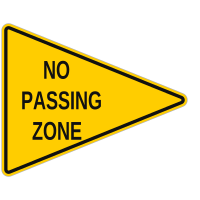
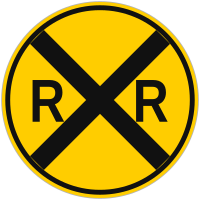
Chapter 5 of the Connecticut Driver's Manual teaches signs by shape first, then by color, and the DMV's own study questions ask what a shape means. Two shapes differ from what you might expect: in Connecticut's manual a round sign warns of a railroad crossing, and a pennant on the left side of the road marks the start of a no-passing zone.

  • Red octagon with white border and the word STOP in whiteStop: eight sides, and you come to a full stop at the line, the crosswalk or the curb
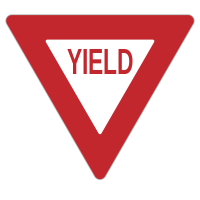
  • Downward-pointing red triangle with white center and the word YIELD in redYield: a downward triangle, so slow down and stop if you need to
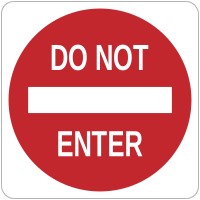
  • Red circle with a white horizontal bar on a white square, reading DO NOT ENTERDo not enter: you'll see it at exit ramps and on one-way streets
  • Yellow pennant pointing right reading NO PASSING ZONENo passing zone: a pennant on the left side of a two-lane road
  • Round yellow sign with a black X and two letters RRailroad crossing ahead: in Connecticut's manual, a circle means a railroad crossing
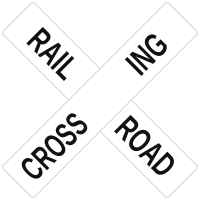
  • White X-shaped crossbuck reading RAILROAD CROSSINGCrossbuck: it means the same as a yield sign, so yield to trains
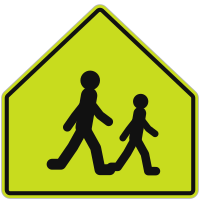
  • Fluorescent yellow-green pentagon with two children walkingSchool zone: five sides mean a school zone or school crossing
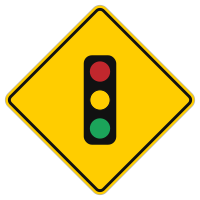
  • Yellow diamond with a black traffic signal showing red, yellow and green lightsSignal ahead: slow down, the light may be red
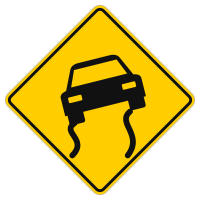
  • Yellow diamond with a car and two S-shaped skid marksSlippery when wet: slow down and leave more room ahead
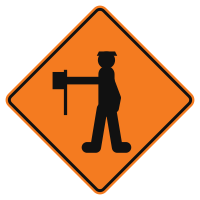
  • Orange diamond with a black flagger symbol holding a flagFlagger ahead: orange work area signs, and the flagger's directions come first
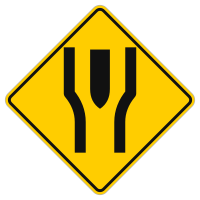
  • Yellow diamond showing a road splitting around a black median aheadDivided highway begins: the road splits ahead, so keep right
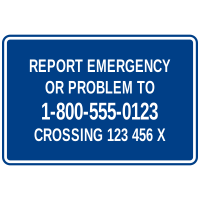
  • Blue rectangle: REPORT EMERGENCY OR PROBLEM TO 1-800 number, CROSSING numberEmergency notification sign: a blue sign at rail crossings with a number to call

Test day

What to bring to your knowledge test appointment

  • Your original identity documents from the DMV's checklist. Photocopies and faxes aren't accepted
  • Form R-229, completed and signed
  • Your Connecticut Work Zone Safety Course certificate, printed
  • Under 18: a parent or guardian, or a notarized Form 2-D if they can't come
  • Your Connecticut non-driver ID, if you have one. You hand it in when the permit is issued
  • Your glasses or contacts, if you need them for the vision test

Before you go

  1. Take the free Connecticut Work Zone Safety Course. It's required for permit applicants from January 1, 2026, and takes under an hour.
  2. Read the Connecticut Driver's Manual. The DMV says it's the source of all test questions.
  3. Work through the DMV's three practice tests, which come in English and Spanish with answers at the end.
  4. Check your documents against the DMV's identification checklist.
  5. Book your knowledge test online and pay when you book.
  6. Under 18, make sure a parent or guardian can come, or get Form 2-D notarized.
CT DMV: Knowledge test schedulingPermit testing is by appointment only at ten DMV locations. You pay the testing and permit fees online when you book.

Study options

Where to study

The Connecticut Driver's Manual is free from the DMV in English and Spanish, and the DMV calls it the only source for all test questions. The DMV also posts three practice tests with answers, in both languages, and its CT DMV Mobile app has sample questions. If you want more practice than that, the apps, websites and driving schools on this page are compared on price and what you get free.

OptionPriceFree to useLinks
Official and free
Connecticut Driver's ManualOfficial · PDF and web pageRevised March 2023. The DMV calls it the only source for all test questions. Chapters 2 to 5 end with study questions, with the answers on the last pages. The DMV notes the audio version doesn't reflect recent updates, so read the PDF.
FreeThe whole manual, in English and Spanish
DMV Practice Tests One, Two and ThreeOfficial · PDFThe DMV's own practice tests, linked from its learner's permit page. Practice Test One has 42 three-choice questions on teen rules, alcohol, signs, parking, turns, lane lines and following distance, with the answers at the end.
FreeAll three tests and their answers, in English and Spanish
CT DMV MobileOfficial · AppThe DMV's app, which it says has practice knowledge test questions and answers from the real learner's permit test, a parent quiz on teen drivers and office locations. Rated 3.1 on the App Store from 455 ratings. Its last App Store update was in August 2019, so check answers against the 2023 manual.
FreeEverything
Connecticut Work Zone Safety CourseRequired · Online courseRequired for learner's permit applicants from January 1, 2026. It takes under an hour, and you print the completion certificate and bring it to the knowledge test. It's the first step on the DMV's learner's permit page.
FreeThe course and certificate
Motorcycle and CDL manualsOfficial · PDFThe Motorcycle Operator's Manual (revised October 2025) for the 16-question motorcycle permit test, and the CDL manual for the commercial permit tests. The DMV uses an updated CDL manual for tests from July 1, 2025.
FreeEvery manual in full
Apps and websites
Driving-Tests.org and DMV GenieWeb and app · all statesDriving-Tests.org also makes the DMV Genie app. Its Connecticut section groups 140 essentials questions, 330 harder ones and 93 on fines, distracted driving and drinking, plus a 25-question exam simulator. DMV Genie is rated 4.8 on the App Store from about 184,000 ratings for all states.
Connecticut tests on the website marked free. DMV Genie app purchases from $9.99Five CT permit practice tests, road sign tests and topic tests
ZutobiApp and web · all statesShort lessons and quizzes that play like a game. The Connecticut page claims more than 600 Connecticut questions based on the Driver's Manual and gives the same 25 questions and 20 to pass that the DMV publishes. It also says it doesn't replace the driver education teens need.
Free to try, then paid plans. Its page lists no pricesA free start; the rest needs a paid plan
Connecticut CT DMV Permit Test (Nilu Rathod)App · iPhoneA Connecticut-named app with car, motorcycle and CDL sections. Rated 4.7 from about 820 ratings. The developer is Nilu Rathod, not the DMV.
Free download. Premium $3.99 a week, $8.99 a month or $14.99 for lifeThe free download. The listing doesn't say how much is free
In person
DMV-licensed driving schoolsLocalWhere teens take the 30-hour course and adults take the 8-hour Safe Driving Practices course, and where a parent takes the 2-hour class. Finishing at a school lets a teen take the road test after 120 days instead of 180. The DMV's directory searches by town or ZIP code and can filter for schools teaching in other languages.
Set by each schoolNothing; you pay the school

Prices and ratings checked October 2026.

FAQ

Common questions

How many questions are on the CT permit test, and how many can you miss?

There are 25 questions, and you need at least 20 right, so you can miss 5. Every question is multiple choice and comes from the Connecticut Driver's Manual.

Can I take the Connecticut permit test online?

No. The vision and knowledge tests are both taken in person at a DMV office, in one appointment. What you do online is book the test, pay for it, take the Work Zone Safety Course and study. The online services page lists what else the DMV lets you do from home.

What happens if I fail the CT DMV knowledge test?

You wait seven days, then book again and pay the $40 testing fee again. If you fail the vision test instead, you can rebook right away. Use the week to reread the manual chapters behind the questions you missed.

How old do you have to be to get a learner's permit in Connecticut?

16. If you're 16 or 17, a parent or guardian comes to the test with you or signs a notarized Form 2-D, and you'll need driver education before your license. From 18 you apply for the adult learner's permit, which you hold for at least 90 days before the road test.

Do I need an appointment for the CT DMV permit test?

Yes. Learner's permit testing is by appointment only, and you prepay online when you book. Tests are held in Bridgeport, Cheshire, Danbury, Enfield, Hamden, Norwalk, Old Saybrook, Waterbury, Wethersfield and Willimantic.

Is the CT DMV written test the same as the driving test?

No. The written test is the knowledge test you pass for your permit. The driving test, which the DMV calls the road test, comes later, after you've held the permit for 90 to 180 days depending on your age and training.

What is the Work Zone Safety Course, and do I need it?

It's a free online course of under an hour, and it's required for learner's permit applicants from January 1, 2026. Print the completion certificate and bring it to your knowledge test appointment. The DMV lists it as the first step to a permit.

Sources: CT DMV · Connecticut Driver's Manual and 4 more. Checked October 2026.

Rules and fees can change, so check the official site before your test.