New Brunswick · Learner’s test

NB permit test for a Class 7 Level 1 licence

Your first licence in New Brunswick is a Class 7 Level 1 learner’s licence. To get it, you pass two written exams, one on road sign recognition and one on the rules of the road, and a vision test at a Service New Brunswick (SNB) centre. The province’s testing page calls the licence the Class 7.1 learner’s permit, the one the NB permit test leads to.

  • 16Minimum age, with consent if under 18
  • $25Written test fee, first attempt
  • $15Fee to rewrite after a failed test

Key facts

At a glance

Vision test
20/40 in your best eye
Results
Valid for 6 months; your licence must be issued within 6 months of starting
Your card
A 30-day temporary document, then the card by mail in about 14 days
Licensing run by
The Motor Vehicle Branch, Department of Justice and Public Safety

How it works

How the NB permit test works

  1. Pick one way to take the written exams: online, or in person at a Service New Brunswick (SNB) centre. You don’t need both.
  2. Pass both exams. Then you visit an SNB centre to finish: the vision test, your documents and the licence itself.
  3. With a Class 7 Level 1 licence you can start driving, but only with an accompanying driver. The driver’s licence page sets out the Level 1 rules.

Topics

What the rules say

These points come from the Motor Vehicle Act, not from the handbook PDFs.

01

Emergency vehicles

Motor Vehicle Act rules for when an emergency vehicle comes up behind you or is stopped ahead.

Key points (2)
  • When an emergency vehicle comes up with a flashing red light and siren, pull over as close as you can to the right-hand edge, clear of any intersection, and stop until it has passed (Motor Vehicle Act).
  • Passing a stopped emergency vehicle with a flashing red light, or a service vehicle with a flashing amber light, on your side of the highway, slow to half the posted limit and go with caution (Motor Vehicle Act).
02

Right-of-way and speed

Rules from the Motor Vehicle Act for intersections and speed.

Key points (3)
  • When two vehicles reach an intersection from different roads at about the same time, the driver on the left yields to the driver on the right (Motor Vehicle Act).
  • Turning left, yield to oncoming vehicles in the intersection or close enough to be a hazard (Motor Vehicle Act).
  • Where no limit is posted, the limit is 80 km/h in a rural district (Motor Vehicle Act).
03

Driving to the conditions

What the Motor Vehicle Act says about speed and hazards.

Key points (2)
  • Whatever the posted limit, don’t drive faster than is reasonable and prudent for the conditions and the hazards around you (Motor Vehicle Act).
  • You can’t have a radar warning device in your vehicle (Motor Vehicle Act).
04

Pedestrians and cyclists

Motor Vehicle Act rules for sharing the road with people on foot and on bikes.

Key points (3)
  • Where traffic signals aren’t working or aren’t there, yield to a pedestrian crossing in a crosswalk (Motor Vehicle Act).
  • Don’t pass a vehicle that has stopped at a crosswalk to let a pedestrian cross (Motor Vehicle Act).
  • A cyclist on the road has the same rights and duties as a driver (Motor Vehicle Act).
05

Crossings and following distance

Motor Vehicle Act rules for railway crossings, school crossing guards and following distance.

Key points (3)
  • At a railway crossing with a stop sign, stop between 5 and 15 metres from the nearest rail, and go only when it’s safe (Motor Vehicle Act).
  • When a school crossing guard holds up a stop sign, stop no closer than 5 metres from the crosswalk (Motor Vehicle Act).
  • Don’t follow another vehicle more closely than is reasonable and prudent for the speed, the traffic and the road (Motor Vehicle Act).

Road signs

Road signs and the rules behind them

Road sign recognition is one of the two exams. The province sorts traffic signs into regulatory signs for laws you must obey, warning signs for hazards ahead and guide signs for routes and places.

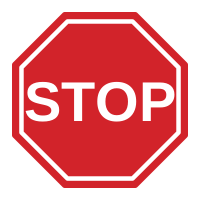
  • Red octagon with a white border and the word STOP in white.Stop: come to a full stop at the stop line, or before the crosswalk, or where you can see traffic on the road you’re entering, then go only when it’s safe and yield
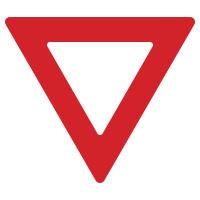
  • Downward-pointing triangle with a wide red border and white centre, no text.Yield right-of-way: slow down before and while you enter the intersection, and give the right-of-way
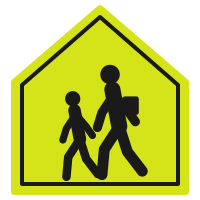
  • Five-sided fluorescent yellow-green sign with a black border and two black schoolchildren walking.School zone: 30 km/h in a municipality from 7:30 a.m. to 4 p.m. on school days, unless another limit is set for the zone
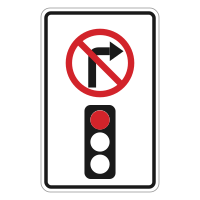
  • Vertical white sign: a right-turn arrow in a red circle and slash above a traffic-signal symbol with the red light lit.No right turn on a red light where this sign is posted
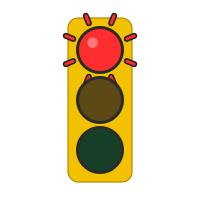
  • Traffic-signal head with the red light lit and short rays showing it is flashing.Flashing red signal: treat it as a stop sign
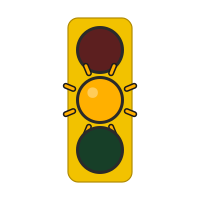
  • Traffic-signal head with the yellow light lit and rays showing it is flashing.Flashing yellow signal: go through only with caution
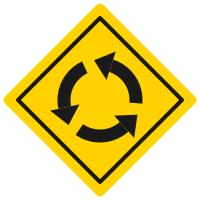
  • Yellow diamond with three black arrows chasing each other counter-clockwise in a circle.Roundabout ahead: yield to traffic already in the circle, then drive counterclockwise
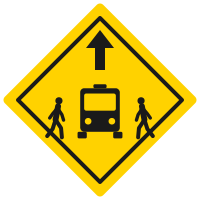
  • Yellow diamond: an arrow pointing up above the front of a school bus with a child on each side.School bus stop ahead: when a stopped school bus shows flashing red lights, stop at least 5 metres away

Test day

What to bring to Service New Brunswick

  • One identification document from the province’s list, such as a Canadian birth certificate, a valid Canadian passport or a valid Permanent Resident Card
  • Two proofs of New Brunswick residency showing the address for your licence, such as a utility bill and a residential lease, from two different agencies
  • The Parental Consent Form if you’re under 18, signed by a parent or legal guardian with custody and witnessed by someone who isn’t a relative
  • Proof of a name change, such as a marriage certificate, if your name differs between documents

Before you go

  1. Check the Motor Vehicle Branch’s Driver’s Licence Testing Requirements sheet to make sure you can apply.
  2. Bring originals. Only original documents, or copies certified by the agency that issued them, are accepted.
  3. Licensed in another province or a US state? You can exchange your licence class for class, Class 7 included, with no test, if you meet the conditions on the new residents page.
Service New Brunswick: Book or take a driver examThe same booking service handles in-person written tests, the online written tests and road tests.

Study options

Where to study

The province’s own study material is the New Brunswick Driver’s Handbook, published as nine PDF parts. The study page shows how to use it, where driver training courses fit, and which practice apps other companies make.

OptionPriceFree to useLinks
Official sources
Government of New Brunswick: New Brunswick Driver’s HandbookOfficial · PDF, nine partsThe study material the province names for the written exams, in English and French, with the Parental Consent Form on the same page.
No charge shown for the PDFsAll nine parts
Government of New Brunswick: driver licence testing pageOfficial · webWhat you need before and after the written exams, and the link to take them online. It’s the real test, not a practice test.
Written test $25, rewrite $15The page itself
In person
Licensed driver training coursesLessons and driver education coursesEach course needs a driver training course licence from the Motor Vehicle Branch for its location. Passing a course shortens the Level 1 wait before the road test.
Not listed on gnb.caNot stated
Apps and websites
New Brunswick Driving Tests (Quizzard Exam Preparation)iPhone, iPad and Android appMore than 1,000 questions in 14+ quizzes covering each section of the handbook, with a review list and mock exams. Rated 4.7 from 27 ratings on the Canadian App Store. Its Google Play listing says it isn’t affiliated with any government agency.
Free download; Premium listed at $9.99 on the App StoreNot stated
New Brunswick Driving Test (Movil Softwares)iPhone and iPad appMore than 500 New Brunswick questions, mock tests and a road sign guide. Its listing says it’s for practice only and not a substitute for official resources. Rated 4.7 from 15 ratings on the Canadian App Store.
Free download; in-app purchases from $0.99, subscriptions from $1.99 a week, or $12.99 for lifetime accessNot stated

Prices and ratings checked November 2026.

FAQ

Common questions

How many questions are on the NB permit test?

The province doesn’t publish the number of questions or the pass mark for either written exam. Its testing page names the exams, but not how long they are or how they’re scored.

What happens if you fail the NB permit test?

You pay the rewrite fee and try again after a wait. After a first failed attempt you wait one day, and after a second you wait one week before a third try. If you don’t pass in three attempts, you book an appointment to take the test in person at a Service New Brunswick Driver Examiner office.

Is a Class 7 Level 1 licence the same as a learner’s permit or beginner’s licence?

Yes. The province says a Level 1 licence is what people used to know as a learner’s permit, and its testing page calls it the Class 7.1 learner’s permit. The province’s pages don’t use the word beginner’s: Class 7 Level 1 is the first stage for every new driver.

Can you take the NB permit test in French?

The province’s pages don’t say whether the written exams are offered in French. The testing page, the online test link and the Driver’s Handbook all come in French, and the road test can be taken in English or French.

Do you need to book the NB permit test?

Only if you take it in person. Book an appointment at your local Service New Brunswick centre through the online booking service, or call SNB TeleServices at 1-888-762-8600. The online test needs no appointment.

Sources: Government of New Brunswick · Department of Justice and Public Safety · Gouvernement du Nouveau-Brunswick and 8 more. Checked November 2026.

Rules and fees can change, so check the official site before your test.