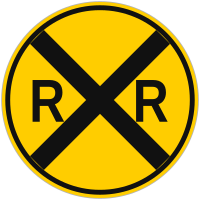
You see this round yellow sign ahead. What is it telling you?
A railroad crossing is ahead, so slow down, look and listen, and be ready to stop The study guide calls this the Round Yellow Advance Warning sign. It sits ahead of a highway-rail crossing and tells you to slow down, look and listen for a train, and be ready to stop at the tracks.
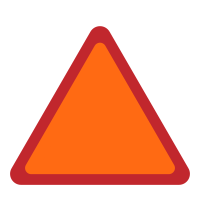
You see this sign on the back of a farm tractor. What does it mean?
The vehicle is moving slower than normal traffic The study guide says this reflective orange triangle with a red border warns other road users that the vehicle is traveling slower than the normal speed of traffic. Farm tractors, animal-drawn vehicles and road maintenance vehicles usually go 25 mph or less.
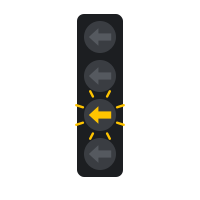
You're in a left-turn lane and this signal is showing. What may you do?
Turn left, but first yield to oncoming traffic and pedestrians A flashing yellow arrow means left turns are allowed, but they aren't protected. The study guide says you may turn left after yielding to oncoming traffic and pedestrians, then go with caution.
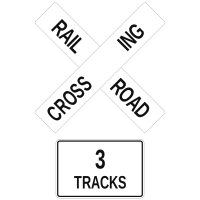
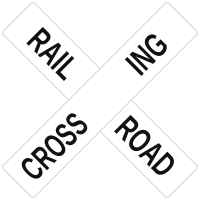
You reach a railroad crossing marked with this sign. What should you expect?
There is more than one track, and trains may come from either direction The study guide says a sign under the crossbuck with a number shows how many tracks there are. With more than one track there may be more than one train, so watch for others coming from either direction.
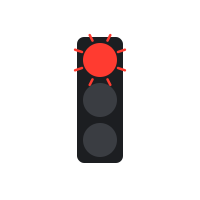
What must you do when you reach this signal?
Come to a complete stop, then go only when it's safe The study guide says a flashing red light is the same as a stop sign. You come to a complete stop, and then you go only when it's safe.
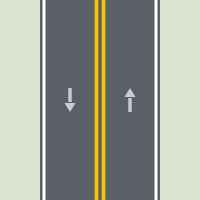
You're driving on a two-lane road with these center lines. Which is true?
No one may pass in either direction, but you may cross to turn into a driveway if no traffic is coming The study guide says a solid double yellow line means passing is prohibited for traffic in both directions. It also says you may cross a solid yellow line to turn into a driveway when no opposing traffic is approaching.
What is the youngest age at which you can apply for an Arkansas instruction permit?
14 The study guide says you must be at least 14 to apply for an instruction permit. You pass the knowledge exam and a vision test, and the permit is issued for two years from the date you passed.
You have an Arkansas instruction permit. Who must be with you when you drive?
A licensed driver who is 21 or older, in the seat beside you The study guide says a permit holder may drive with a licensed driver who is 21 or older and sits in the seat beside the driver. Everyone in the car must also wear a seat belt.
You reach an intersection with no stop sign or traffic signal, and another car is approaching from your right. What should you do?
Yield to the car on your right The study guide says that at an intersection with no stop sign or traffic signal, drivers must yield to vehicles approaching from the right.
How close to a fire hydrant may you park?
No closer than 15 feet The study guide's list of places not to park includes within 15 feet of a fire hydrant. Firefighters need room to reach it.
You're turning left at a green light, and an oncoming car is going straight through the intersection. What should you do?
Yield and let the oncoming car go first The study guide says drivers turning left must yield to oncoming cars traveling straight ahead. A green ball light lets you turn, but it doesn't put you ahead of oncoming traffic.
In normal conditions, how far back should you follow the vehicle ahead, according to the study guide?
At least two seconds The study guide uses the two-second rule. When the car ahead passes a fixed point, count the seconds until you reach it, and drop back if you get there before you finish counting to two. It adds that some situations need four seconds.
When does the study guide say you must have your headlights on in Arkansas?
From 30 minutes after sunset to 30 minutes before sunrise, and whenever you need your windshield wipers The guide says to turn on your headlights from half an hour after sunset to half an hour before sunrise, or any time you can't clearly see a person or object 500 feet away. It also says Arkansas law requires headlights whenever your wipers are needed.
How far before a turn should you start signaling?
At least 100 feet The study guide says to signal at least 100 feet before a turn, and to use your signal 100 feet before a lane change, when merging into traffic and when parking.
Your brakes suddenly stop working. What should you try first?
Pump the brake pedal several times The study guide says to pump the brake pedal several times first, since that often builds up enough pressure to stop. If that fails, apply the parking brake slowly so you don't lock the rear wheels, then shift to lower gears and look for a safe place to stop.
On a two-lane road, a school bus stopped in the oncoming lane has its red lights flashing. What must you do?
Stop, and stay stopped until the red lights go off The study guide says you must make a complete stop for a stopped school bus with red lights flashing, whether it's in your lane, the opposing lane or at an intersection. The only exception is a bus on the other side of a median 20 feet or more wide.
How far behind a tractor-trailer can your car disappear from the truck driver's view?
Up to 200 feet The study guide says a car can disappear up to 20 feet in front of the cab, on either side of the truck, and up to 200 feet behind it. Its rule of thumb: if you can't see the truck driver in the side mirror, the driver can't see you.
On a multilane highway, you're coming up on a police car stopped on the shoulder with its lights on. What does Arkansas law require?
Move to the lane farthest from it if you can, and slow down if you can't The study guide says Arkansas law requires you to move over, when possible, to the lane farthest from a stopped law enforcement vehicle with its lights on. If changing lanes isn't safe or possible, you must reduce your speed as you pass.
A driver under 21 can be arrested for underage driving under the influence at what alcohol concentration?
0.02% The study guide says you can be arrested for underage DUI with an alcohol concentration of 0.02% in breath or blood. If found guilty, you could have your license revoked until you turn 21 and be fined $2,000.
You're 17 and driving with an intermediate license. Which phone use does Arkansas law allow?
None, except in an emergency The study guide says drivers under 18 may not use a cell phone while driving, and hands-free devices aren't allowed either. Use is limited to emergencies. Texting while driving isn't allowed at any age.
 Arkansas · Permit test