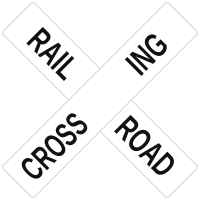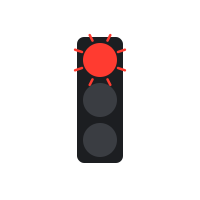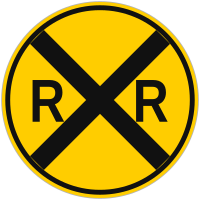
You see this sign ahead on a country road. What does it tell you to do?
Slow down and be ready to stop This round sign means you’re coming to a railroad grade crossing. The manual says to slow down and be ready to stop, because it’s up to you to stop if a train is coming.
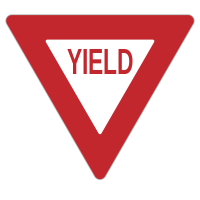
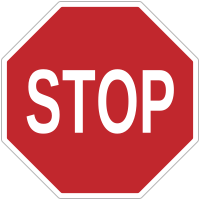
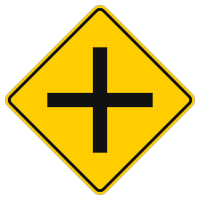
You reach this sign as cars approach on the cross road. What must you do?
Stop and wait until they pass This sign means you must stop and wait when other vehicles are approaching from the right or left on the other road. If you’re sure no one is coming, you may slow down and go on with care instead of stopping.
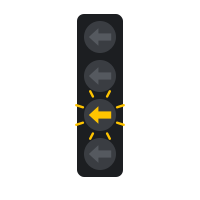
You want to turn left and see this signal. What does it let you do?
Turn after yielding to oncoming traffic A flashing yellow arrow lets you turn left after yielding to all oncoming traffic and to any bicyclists and pedestrians in the crosswalk. You must wait for a safe gap before you turn.

You’re stopped at this signal and no sign forbids turning. When may you turn right?
After a full stop, if the way is clear At a steady red light, you stop behind the crosswalk or stop line. Unless a sign says otherwise, you may then turn right once no pedestrians or cross traffic are present.
A traffic light at an intersection isn’t working at all. How does Tennessee law say to treat it?
As an all-way stop Tennessee law says an intersection with a signal that isn’t working is treated as an all-way stop. Stop as you would if there were stop signs in every direction, and don’t go until it’s safe.
A train is coming as you reach a railroad crossing. Where do you stop?
Between 15 and 50 feet from the tracks When a train is approaching, you must stop between 15 and 50 feet from the tracks. Never stop on the tracks, and wait until the train has passed and it’s safe to cross.
On a four-lane road with a center turn lane, a school bus coming toward you stops with its red lights flashing. What must you do?
Stop until the bus moves on The manual says a turn lane in the middle of a four-lane highway is not a barrier but a fifth lane, so drivers in both directions must stop for a stopped school bus. You stay stopped until the stop arm is pulled back and the bus moves.
When does Tennessee law require your headlights at night?
30 minutes after sunset to 30 before sunrise Your headlights must be on from 30 minutes after sunset until 30 minutes before sunrise. They must also be on whenever daylight isn’t good enough to see 200 feet ahead, and when rain or snow keeps your wipers going.
You and another car stop at an all-way stop at the same time. The other car is on your right. Who goes first?
The other car, on your right At an all-way stop, the first car to reach the intersection goes first. If more than one arrives at the same time, you yield the right-of-way to the vehicle on your right.
Your car has anti-lock brakes and you must stop fast. What should you do with the brake pedal?
Press it firmly and keep it down With anti-lock brakes, apply firm, steady pressure and keep your foot on the pedal until the car stops, steering around hazards as you go. Pumping the pedal or lifting your foot disengages the anti-lock system.
On a four-lane interstate, a highway patrol car is stopped on the right shoulder with its lights on. What does the Move Over law ask you to do when it’s safe?
Change to a lane not next to it Tennessee law says you yield the lane closest to an emergency, maintenance or recovery vehicle stopped on the shoulder. When it’s safe, change to a lane that isn’t next to it, so with a vehicle on the right shoulder, you merge left.
A 6-year-old who is 4 feet tall rides in your car. What does Tennessee law require?
A booster seat with a belt Children 4 through 8 years old who are shorter than 4 feet 9 inches must ride in a belt-positioning booster seat and wear a seat belt. Booster seats go in the back seat if the vehicle has one.
Under Tennessee’s hands-free law, when may you hold your phone to change your GPS route?
Once you’ve pulled over and stopped The hands-free law makes it illegal to hold a phone with any part of your body while driving, and you may not touch it to use GPS. To change the route, find a safe place such as a parking lot, come to a full stop and then use the phone.
Your car starts to hydroplane on a wet road. What should you do?
Ease off the gas and slow gently When your tires ride up on water, you lose the grip you need to steer and brake. The manual says to slow down gradually by letting up on the gas, and not to slam on the brakes.
You’re driving behind a large truck. If you can’t see the driver in the truck’s side mirror, what does that tell you?
The driver can’t see you either Large trucks have blind spots, called No-Zones, at the front, back and sides. The manual says that if you can’t see the truck driver in the truck’s mirror, the truck driver can’t see you.
After a few drinks, what does the manual say will lower your blood alcohol?
Time passing, and nothing else The liver can only oxidize about one drink per hour, and the manual says coffee, exercise, a cold shower or anything else can’t increase that rate. Only time can sober a person who has been drinking.
You’re 18 and you’re stopped while driving with a blood alcohol concentration of .02. What can you be convicted of?
Underage driving while impaired A driver who is at least 16 but not yet 21 and is found driving with a blood alcohol concentration of .02 is convicted of underage driving while impaired. The penalty is a year without a license and a $250 fine, sometimes with public service work.
You’re arrested for driving under the influence (DUI) and refuse the test the officer asks for. What does the manual say is the likely result?
A 12-month license suspension By driving in Tennessee, you have consented to be tested for alcohol or drugs if an officer has reasonable grounds. If you’re arrested and refuse, the manual says it will likely mean the court suspends your driving privileges for 12 months.
You’re 15 and caught with alcohol, and you’ve never had a license. What can happen to your driving privilege?
Suspended a year or to age 17, if longer If you’re 13 to 17 and found to have possessed, consumed or sold alcohol or drugs, your driving privilege is suspended for one year or until age 17, whichever is longer. That applies even if you’ve never been licensed.
What does the manual say happens when you mix alcohol with a tranquilizer or sedative?
The effects multiply, not add up When alcohol is combined with another depressant, like tranquilizers or sedatives, the manual says the results are not just added together, they are multiplied. Even some over-the-counter medicines can affect your driving.
 Tennessee · Permit test